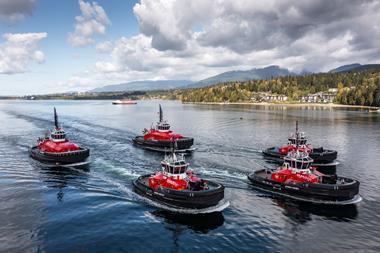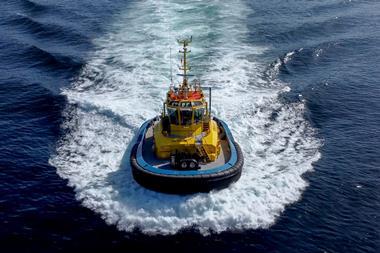


In September 2009 the new tugs Riverwijs Maryon and Riverwijs Karoline were delivered to Riverwijs, a joint venture company formed by Riverside Marine and Svitzer A/S. The tugs are the first of four new RAmparts 3000 Class Mk II tugs to be stationed at the Port of Dampier, Australia to handle LNG ships calling at Woodside Energy' s Withnell Bay Terminal.
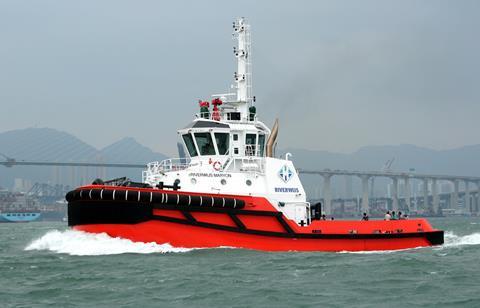
These tugs incorporate the very latest refinements to the widely accepted RAmparts 3000 Class design from Robert Allan Ltd. Various modifications have been made in the light of lessons learned from previous vessels built in Asia and South America and those changes have been embodied in this Mk II version.
Among the changes made to the design is a higher raised forecastle deck, enabling the crew to reach more easily the recessed bollards that are common on many of today's high freeboard LNG ships. The raised forecastle also provides ample freeboard for operation in exposed sea conditions, and allows a desirable increase in headroom in the forward accommodation.
Robert Allan Ltd worked closely with the owners to establish the final specification and vessel layout for the demanding service these tugs will undertake. The hull form still reflects the well proven double chine design with a sweeping ‘chined’ stern that characterises all Robert Allan Ltd. designs. A ‘ship docking’ skeg is fitted to enhance the manoeuvring capability within the confines of the constricted harbour and entrance channel.
All four tugs will be classed Lloyd's Register of Shipping: +100A1 Tug, +LMC, UMS, IWS, Unrestricted Service, and registered under the Australian flag, complying with all the stringent requirements associated with that flag state.
The new RAmparts 3000 Class Mk.II tugs are 30.80m long, with a 11.00m moulded beam and a 5.18m maximum overall draft. Fendering at the bow, designed for shiphandling operations, comprises a 900mm by 450mm cylindrical fender above a row of 450mm ‘W’ block mouldings. A hollow ‘D’ section moulding provides protection at the main and forecastle deck sheer lines, and ‘W’ block type fendering is used again at the stern.
A single drum Kraaijeveld ‘Safewinch’ carrying 150m of high performance UHMWPE towline is installed on the foredeck of all four tugs for shiphandling. The first two tugs are also fitted with a Kraaijeveld towing winch aft, containing 1,000m of steel wire towline. The second pair will be fitted with an H-bitt and tow hook only.
Each tug is fitted with a pair of Niigata 6L28HX main engines, each rated 1,838 kW at 750 rpm (total approximately 4,995bhp), coupled to Niigata Z-Peller ZP 41 fully azimuthing propulsion units with fixed pitch propellers.
On trials the vessels performed exceptionally well, as predicted, achieving a sustained mean bollard pull of 68 tons ahead, and 63.5 tons astern at full power, and a free running speed of 12.5 knots.
A significant fire fighting capability is provided, using FFS pumps and monitors. The single pump, rated 1,200 cu/m/hr, is driven from the front of the starboard main engine through a step-up gearbox. Foam is injected into the system via an educator.
Tank capacities in this RAmparts 3000 MkII design are; fuel oil 100cu/m, potable water 25cu/m, lubricating oils 4cu/m, fire fighting foam 12cu/m, oily water 3cu/m and waste oil 3cu/m.
Although the normal operating crew is three, the vessels have been fitted out to the highest standards for a crew of up to seven people. A ship's office, a spacious crew mess/lounge and fully equipped modern galley are located on the main deck. Accommodation in the main deckhouse includes cabins for the Master, Chief Engineer and single crew cabins with a shared lavatory. There is space for four extra crew members when required, in one cabin below deck.
The wheelhouse is designed for maximum all-round visibility with a single control station providing excellent visibility over both fore and aft working areas. Noise levels throughout the accommodation and control spaces are in the range of 60 to 63 dBA, achieved by isolating main propulsion machinery and utilising high grade insulation and floating floor techniques.