





FLIR Systems introduces advanced maritime thermal camera
FLIR Systems has announced the addition of a new cooled thermal camera to its range of M-series platforms.
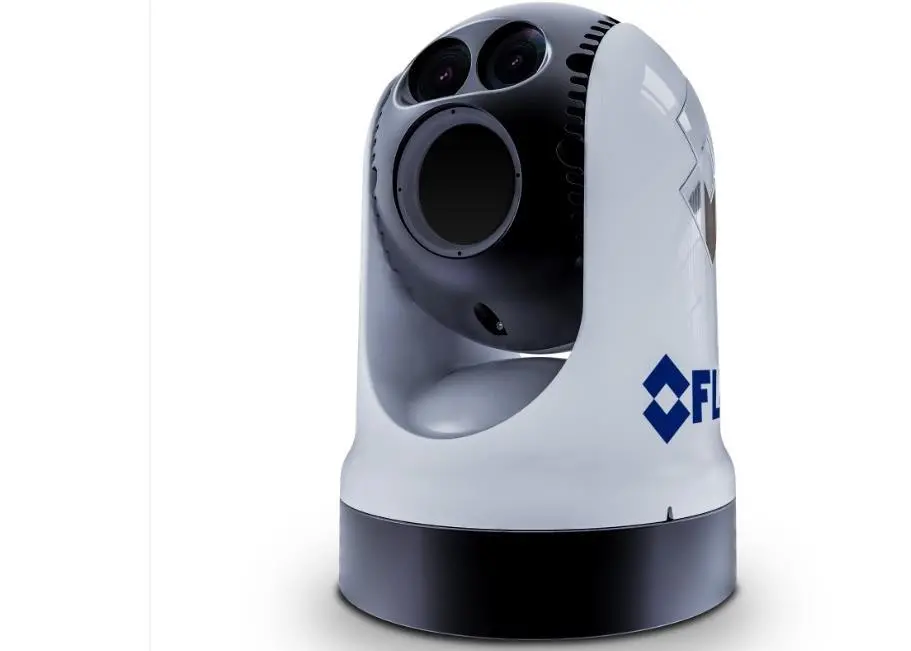
The new M500 multi-sensor maritime camera is designed as a new navigation tool for emergency vessels and workboats to detect long range targets with exceptional clarity and to provide professional captains with enhanced situational awareness. The new camera has the ability to detect targets more than 7 miles away and is also a significant aid when navigating inland waterways and rivers and, the company claims, a significant tool for avoiding collisions both day and night.
The M500’s cooled midwave, 640×512 thermal camera’s ability to detect very small temperature variations in distant targets can be translated into greater detail and enhanced image clarity. This allows captains to positively identify targets and avoid hazards with much greater confidence while underway. FLIR’s cooled thermal technology and the M500’s 14X optical zoom lens also provides superior early detection of vessels, key landmarks, and navigation aids. Being a thermal infra-red camera it can detect targets in poor visibility because it relies on heat sources rather than light sources for detection
An integrated high-definition visible camera supplements the intra-red detection and so also improves navigational awareness and helps to easily identify both vessels and landmarks in daytime and lowlight conditions. Equipped with active gyro-stabilisation for steady imagery in rough seas, the FLIR M500 also includes video tracking to monitor a selected moving or stationary target.
“The FLIR M500 multi-sensor camera is FLIR’s most technologically advanced M-Series camera to date,” said Grégoire Outters, Vice President and General Manager of FLIR Maritime. “Its cooled thermal camera and superior image quality enables professional captains to discern obstacles and navigation aids with much greater detail, providing them with improved situational awareness and safer navigation around the clock. First responders will appreciate the long-range target detection, stabilisation, and video tracking for exceptional precision on the water.”
A unique feature of this new camera is its ability to integrate with the radar on board. The camera can be programmed so that if a target is detected on the radar, the camera can be directed to point in the direction of the detected target thus enabling it to be identified ‘visually’. This represents a significant development in the integration of detection sensors that can help to ensure that even small targets that might make a poor radar target can still be detected.
This type of sensor integration could eventually lead to a fully integrated system whereby radar, thermal camera and videos camera are all coupled in a rotating antenna for the detection of targets thus ensuring that at least one of these sensors will detect an approaching target.
By Dag Pike
Related Articles
 OTHER NEWS
 ACCESSORIES & EQUIPMENT
 ACCESSORIES & EQUIPMENT