


Hi Flo ROV development
Tidal energy installations are located in areas of very strong tides and this makes their installation and maintenance a challenging task. British company Mojo Maritime together with German ship owner Hammonia Reederi have joined forces to develop the design of the Hi Flo 4 (HF4).
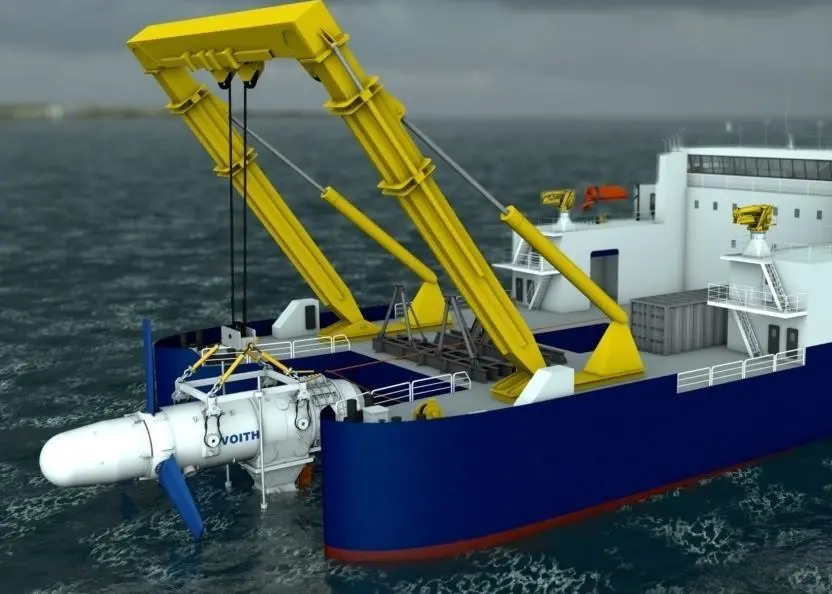
This is a vessel specifically designed to carry out installation work in these challenging conditions and now Mojo has teamed up with Norwegian ROV builder IKM Subsea to develop an ROV which will also be capable of operating in these strong tidal flow conditions.
The two partners have jointly secured an EU Horizon 2020 grant to support a €1,200,000 R&D project aimed at developing an ROV for use in high energy tidal sites and capable of being operated from Mojo’s ground breaking tidal energy vessel, the HF4.
A significant proportion of overall tidal energy costs are incurred during the array installation phase of the operation and, between 2012 and 2014, Mojo Maritime designed and developed the HF4, an offshore construction vessel (OCV) capable of lifting the heaviest envisaged tidal turbines and being capable of dynamically positioning itself tidal flows up to10 knots. Mojo’s analysis showed that in medium energy tidal sites HF4 can install tidal arrays in half the time and at a third of the cost of conventional methods.
However this installation capability depends on having a ROV that can operate in these strong tidal flows to assist with turbine and foundation installation and to also be used for cable touch-down monitoring. Divers cannot operate in these conditions except during short periods at high and low water and conventional ROVs are generally designed to operate in subsurface currents of up to 1.5 ms which would also limit their operation to the short slack water periods.
For this reason, Mojo and IKM joined forces in mid-2014 to bid for EU funding, from the Maritime Technologies (MARTEC II) call, to develop a HF ROV capable of being operated from the HF4 in high energy tidal sites. Mojo’s extensive tidal technology installation background complements IKM’s ROV manufacture and operations experience including the design, build and operation of modern ROVs. The two companies target is to develop a basic design for an HF ROV that is capable of then being manufactured according to a schedule that will align with the envisaged build schedule for the HF4 ship.
The two companies were awarded the funding at the end of 2014, granted as part of the EU’s Marine Technology II Horizon 2020 program, and administered by InnovateUK in the United Kingdom. Work on the ROV development began in earnest on the project in early January and will continue through to the end of 2015.
By Dag Pike
Related Articles
 MARINE CONSTRUCTION
 ENVIRONMENT
 ENVIRONMENT