![MaritimeJournal[Seawork]](https://www.maritimejournal.com/wp-content/uploads/2026/09/MaritimeJournalSeawork.svg)






Hyperdrives bets on a smaller electric propulsion future
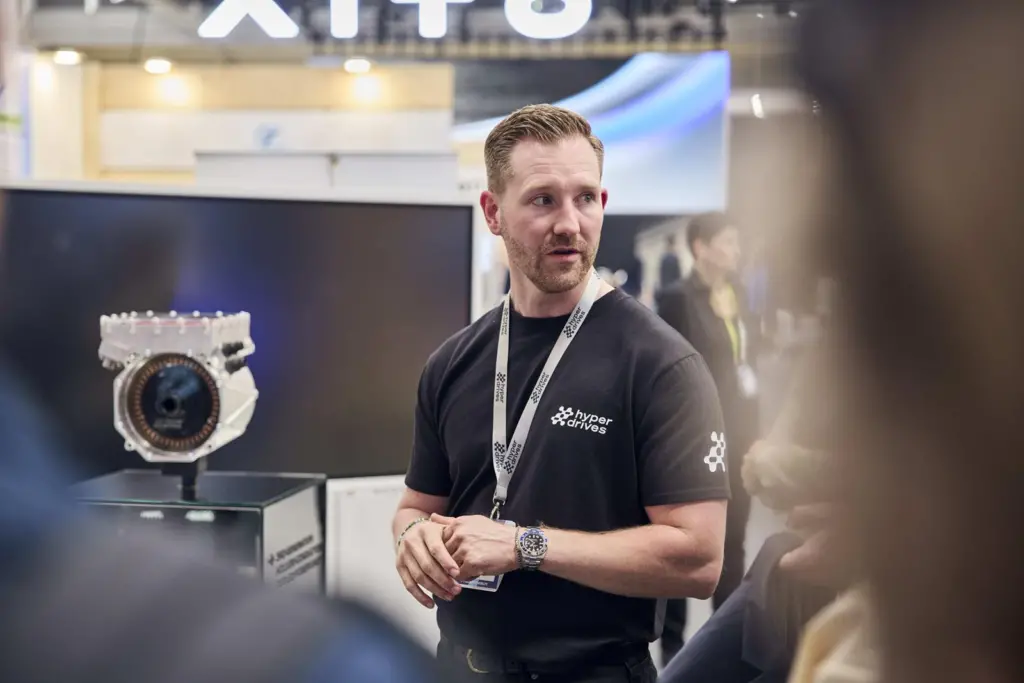
Could one of the biggest opportunities for vessel propulsion lie not in the kind of fuel, but in shrinking the electric motor by up to 70%? That’s what Robin Renz, CEO of start-up Hyperdrives, believes, and he told MJ editor Debbie Mason how.
The maritime industry’s transition towards electrification has largely focused on batteries, charging infrastructure and alternative fuels.
But one German start-up believes one of the biggest opportunities lies elsewhere: making the electric motor so much smaller that it changes how vessels themselves are designed.
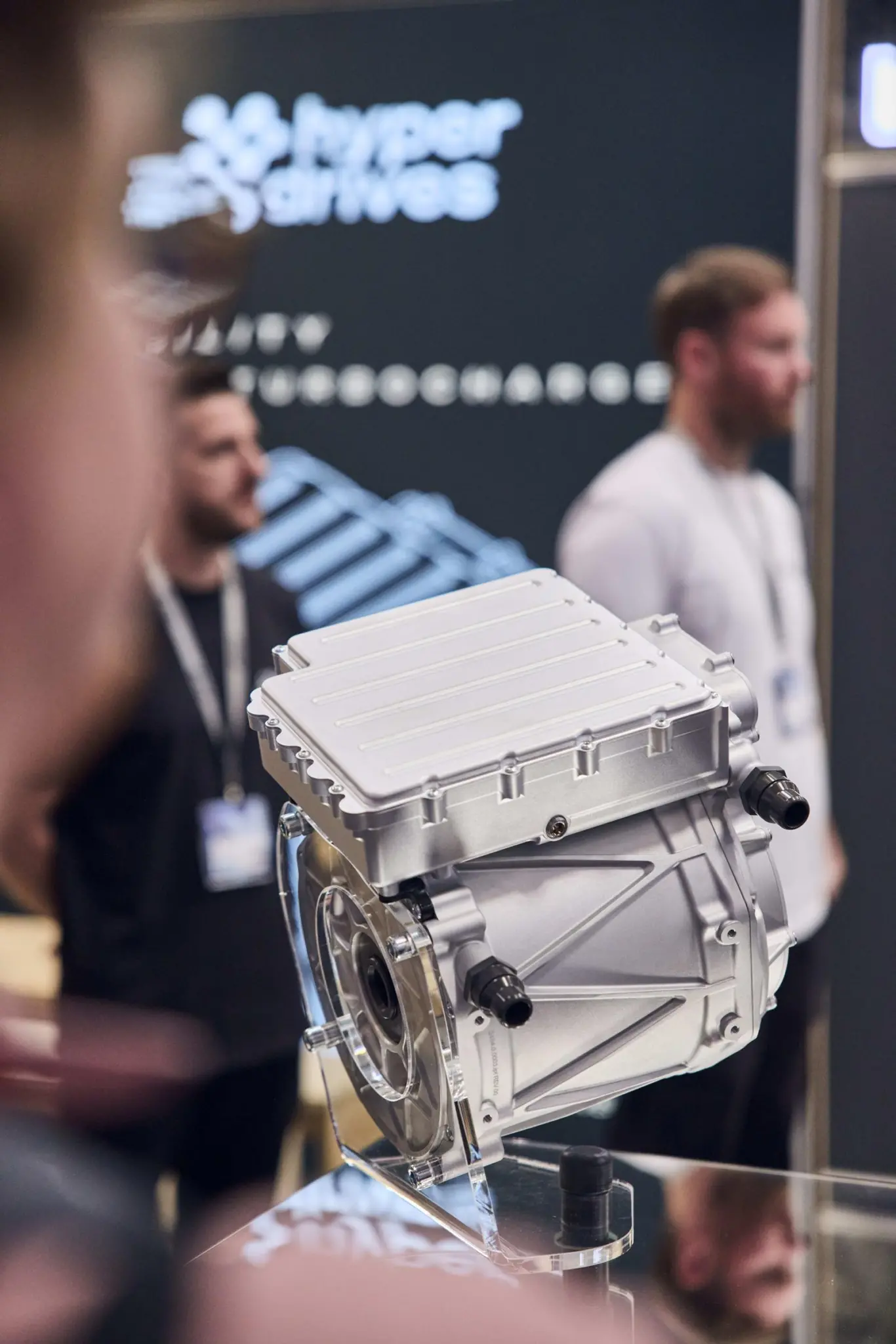
Munich-based Hyperdrives has developed an electric motor that it says can reduce the size and weight of propulsion motors by up to 70%, freeing valuable space inside a vessel for batteries, payload, fuel, equipment or even extra crew.
Rather than focusing solely on efficiency, chief executive Robin Renz believes compact propulsion could fundamentally change how workboats, harbour craft and small ferries are designed.
Solving the heat problem
The company’s innovation lies not in reinventing the electric motor, but in changing how it is cooled.
Traditional electric motors remove heat through a cooling jacket built into the outside of the motor housing. Hyperdrives instead circulates coolant through the copper conductors inside the motor itself, removing heat where it is generated.
“Thermal management in an electric motor is kind of the performance ceiling in a motor,” Renz says. “Once you solve heat you can solve everything else.”
Cooling the motor internally, he says, allows Hyperdrives to extract ‘literally 10 times the heat out of that motor than you could usually do otherwise’. The result is that more electrical current can pass through the motor without overheating, increasing its continuous power density.
That extra performance does not necessarily have to be used to produce a more powerful propulsion system: instead, vessel designers can choose to install a much smaller motor delivering the same output.
“We see downsizing potential of 60, close to 70%, so the motor shrinks by an order of magnitude,” he says. “You can shrink it to a third of the size and a third of the weight and use all that space that you can free up.
“Even if you have a big hull the space in the hull is limited. If you look at the architect and the operators who order that vessel, they love flexibility and options and having more design freedom in designing that electric vessel.”
Making electrification pay
While much of the industry’s decarbonisation debate centres on emissions, Renz repeatedly returns to commercial benefits.
“I think it’s not about just electrifying for the sake of electrification, right? I think it has to make sense commercially,” he says.
One example comes from a customer building hydrofoiling workboats for harbour operations. Because hydrofoils create much less wake than conventional craft, they can travel faster through ports while remaining within operational limits, reducing journey times for pilot transfers and other harbour duties.
“It seems like a small benefit, but it compounds over time because you can do faster runs. You can get your pilots to your tankers or whatever much faster. You can save time. You’re upping efficiency and effectiveness at the end of the day and make more money.”
Hyperdrives is targeting vessels where those operational gains can be most valuable, such as tugs, pilot boats, harbour craft and small ferries.
The company also sees significant potential in hybrid propulsion rather than fully battery-electric vessels. While batteries continue to improve, Renz acknowledges they cannot yet match the energy density of conventional fuels for every application. In the meantime, he sees compact electric motors working alongside highly efficient diesel generators or battery-hybrid vessels.
“You have to look at the total cost of ownership and we see that with serial hybrids. where you have a very efficient generator powering an electric motor, you can run the diesel much more efficiently than before.
“Also an electric motor has two main advantages in that application. First of all, especially ours, It’s very small. So you have more freedom of not just in space but also how you integrate that electric motor in terms of the entire drivetrain.
“The other thing is that an electric motor has a better dynamic range. So for example with a tug you need instant thrust to very precisely steer that tugboat and yes, the diesel motors can do that with the help of torque converters, but an electric motor is much better on that. It’s the best for having this highly variable burst of power from zero RPM and this is something that helps you in a tug boat too.
“I think this is something where hybridization makes a lot of sense but there needs to be a business case. The fuel costs and overall efficiency need to make up for the upfront investment.”
Integration
Hyperdrives has also integrated the motor and inverter into a single package.
“Traditionally the motor and the inverter are two different pieces,” Renz says. “You have the motor and the inverter that manages the DC current out of the battery, or your energy source into AC current that you use in the motor. Those are two different pieces.
“Also the inverter is very large and you have cables running around the vessel and in the hull to connect both connection points. Things can fail. You also have electromagnetic interference by running very high currents through those cables. Those electric electromagnetic fields interfere with systems you have on the boat. And the more cables you have the worse it gets.
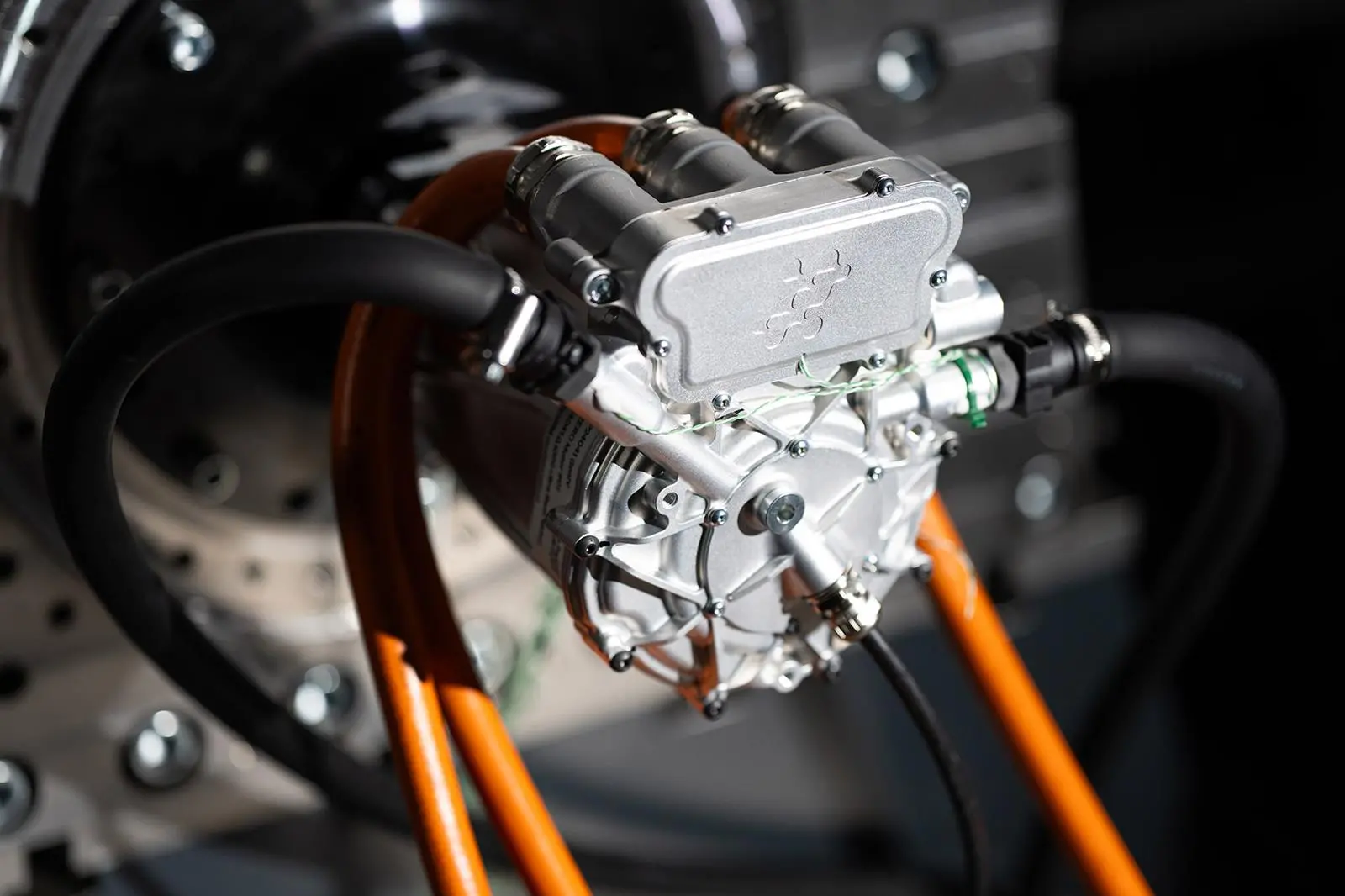
“We integrate those two units into one system, a motor and the inverter integrated in one system. You have one integrated system that again uses much less space and gives you more flexibility in terms of how you integrate that electric drive.”
Renz also says electric propulsion is often perceived as less durable than traditional diesel machinery, and less sturdy.
“Just because it’s smaller and it looks a little bit less sturdy, it’s not more fragile,” he says. “An electric motor has one moving part instead of hundreds of moving parts. You have the moving part which is a rotor, which creates the torque. And then you basically have two bearings that you have to care about. And that’s it.”
Because Hyperdrives’ cooling system keeps operating temperatures significantly lower than conventional electric motors, he believes it can also improve long-term reliability by reducing thermal stress: with all the different metals expanding and contracting at different temperatures within the motor, eventually faults will occur – but not if they don’t experience so much heat in the first place.
From start-up to scale
Founded in Munich, Hyperdrives spent more than three years ‘bootstrapping’ its business before taking on venture capital. According to Renz, the company exceeded €1 million in revenue during 2024 before raising external funding and is now working with manufacturing partners, he says, on scaling producing in-house.

“From personal experience, there are two main challenges I’m facing as CEO,” he says. “First, I feel this market is very fragmented. So the go-to market for a small company like mine is hard to do: you have a lot of different players in a lot of different geographical areas so it’s really hard to address them without having a huge sales force and business development crew, but we’re on it. One step at a time.
“The other thing is durability: we are an early-stage company that does things differently and you have to prove yourself because nobody wants to take a risk.”
Whether the maritime industry ultimately adopts batteries, hybrid propulsion, hydrogen, fuel cells or all of the above, they will all need motors and Hyperdrives is betting that compact electric motors will become a common denominator.
Its argument is a simple one: if propulsion machinery occupies only a fraction of the space it does today, shipowners gain something that every vessel values – more room to do its job, with no compromise on power.