![MaritimeJournal[Seawork]](https://www.maritimejournal.com/wp-content/uploads/2026/09/MaritimeJournalSeawork.svg)

Baltimore’s bridge releases Dali
As salvors made final preparations to refloat Dali from the wrecked Francis Scott Key Bridge in Baltimore, the US National Transportation Safety Board (NTSB) published a preliminary report into the accident that claimed six lives.
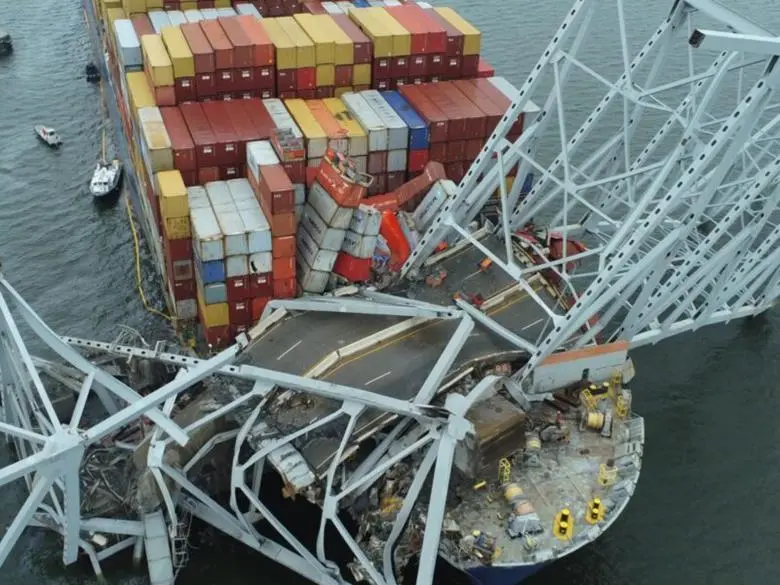
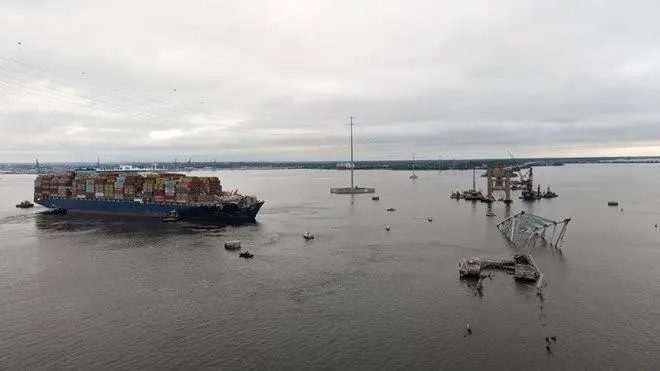
On March 26, after losing electrical power and propulsion the container ship struck the southern pier of the bridge, part of which collapsed, including where portions of the deck and truss spans fell onto the vessel’s forward deck.
A warning from the ship allowed the bridge to be closed to traffic but six construction workers on the bridge at the time were lost in the accident.
Subsequent clearance operations included removing debris from the seabed to allow phased access to the port and trapped commercial traffic to be released.
Freeing Dali, which was pinned to the seabed, was a complex operation. Fifty-six of the 4,680 containers on board contained dangerous goods, 14 of which were forward of the superstructure and recorded as containing hazardous material. These were possibly damaged during the bridge’s collapse.
Responders included Resolve Marine as salvor and Marine Spill Response Corporation acting as oil spill responders, while USCG deployed its Atlantic Strike Team and Salvage Engineering Response Team. The US Army Corp of Engineers and US Navy Supervisor of Salvage and Diving were among many other agencies involved.
Salvage
While much of the wreckage was removed by floating cranes, a different approach was required for debris on Dali’s foredeck and explosives were used in a “controlled demolition” of the wreckage.
With confirmation that the demolition had gone as planned, the next stage prepared the vessel for removal from the site.
Refloating started roughly 18 hours in advance, the check-list including the release of some of the anchors and mooring lines attached to the Dali with tugs standing by; de-ballasting of part or all of the 1.25 million gallons of water pumped onto the vessel to compensate for weight removed during an earlier cutting operation; and a detailed inspection by dive teams confirming all obstructions had been removed from the vessel’s port side.
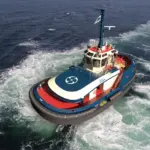
Once Dali was refloated on the rising tide and with assistance from the tugs Lynne Moran, Bridget McAllister, Eric McAllister, Vicki McAllister and Mark Moran and a plethora of smaller support craft in attendance, the vessel was moored alongside a local marine terminal, 2.5 miles away.
Preliminary report
A week earlier, NTSB published a preliminary report into the accident.
As well as a timeline of the incident, the report includes details of Dali’s machinery arrangements, in particular in relation to the vessel losing electrical and propulsion power prior to contacting the bridge.
The vessel was propelled by a single, slow-speed diesel engine directly connected to a single, right-turning propeller.
One of the four diesel generators was required to be operating and supplying electrical power to run the main engine, the emergency generator alone unable to be used to restart or run the engines.
The main engine required compressed air to start and change direction (for going from ahead to astern power), and loss of electrical power to the lubricating oil or cooling water pumps, along with the alarm and other systems, would lead to automatic shutdown of the main engine.
The report describes in detail the high and low voltage electrical power distribution system and the sequence whereby two electrical breakers that fed most of Dali’s equipment, including the steering pumps, unexpectedly tripped, causing the first blackout.
The crew were able to restore power, but with the ship 0.2 miles from the bridge a second blackout occurred, and while power was restored again it was too late to prevent the allision with the bridge.
The report examines an electrical power loss the previous day and NTSB is still investigating the electrical configuration during this blackout and potential impacts on the events during the accident voyage.
Voyage Data Recorder and bridge audio recordings form part of the investigation, which included alcohol and drug testing of the crew and pilots (all negative), and testing of the vessel’s fuels, which found no quality concerns.
Construction of the bridge is also examined and NTSB will continue evaluating Dali’s power distribution system with the vessel alongside, and with other parties look in detail at arrangements for other similar bridges and whether their protection needs to be improved.