![MaritimeJournal[Seawork]](https://www.maritimejournal.com/wp-content/uploads/2026/09/MaritimeJournalSeawork.svg)






First viable electric RIB has commercial potential
Jake Frith has a first steer of the RS Pulse 63, one of the first series production electric RIBs capable of planing performance.
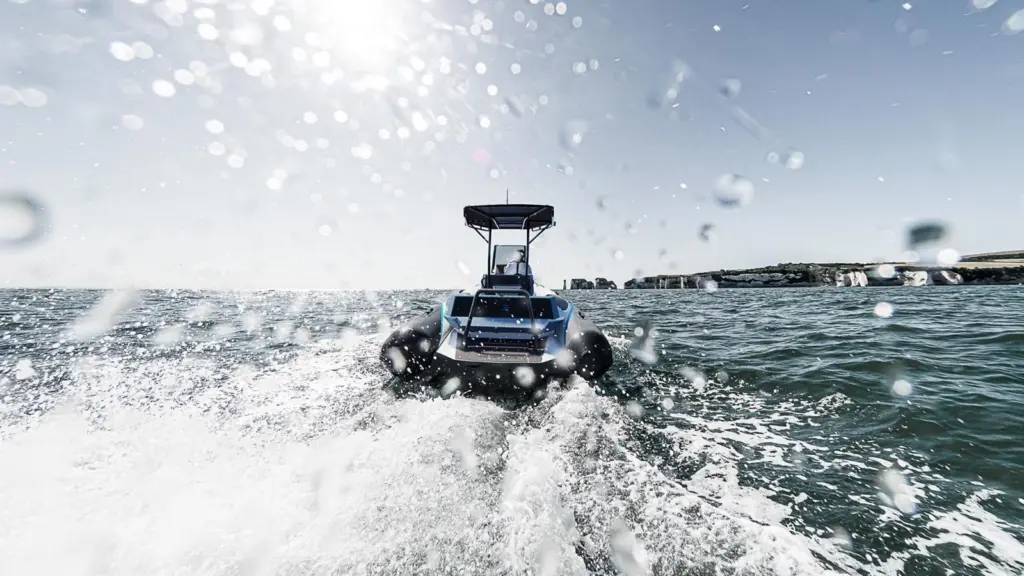
The RS Pulse 63 from Seawork exhibitors RS Electric Boats could solve a lot of problems for commercial operators.
For a start, it’s a small electric boat, capable of more than jogging speed in open water, that you can actually buy today in decent numbers. There are simply not many boats that match these criteria, and for good reason: the design, lightweighting, mechanical, innovation and manufacturing skills required to make this sort of boat work without any serious gaps in its capabilities are rare.
Boatbuilders have built electric RIBs that go quickly but for a uselessly short range, even at slow speeds. Others have built electric boats that can go all day, but very slowly. What there are not many of, or perhaps even none of until now, are electric boats that have a quick recharge time using non specialist electrical infrastructure, some moderate offshore ability, a good, usable range for slow speed harbour work, the ability to achieve useful speeds for short emergency periods and good efficiency at all speed ranges in between.
It’s no surprise that there are RIB manufacturers, both commercial and leisure, that are dodging the electrification race completely. Battery technologies are improving all the time, and it’s tempting for some to sit it out and say that the compromises are still too great for today’s technology to allow a RIB to be viably electrified. And that’s perfectly true if your definition of a RIB is something that will do 40 knots in a metre of offshore chop for 200 miles at a time.
But think for a minute about how RIBs really get used, particularly in the commercial setting. Imagine a harbourmaster, for example. Maybe they will spend an hour in the morning up an inlet checking moorings – the RS Pulse has a 100nm range at 5 knots. Then back to the office for a couple of hours of meetings and admin while the RIB recharges, then perhaps a trip is required beyond the speed limited areas – it can do 45nm at 15 knots. All in the knowledge that if there was an emergency and they had to get somewhere fast, the RIB is capable of 23 knots for short bursts.
Monitoring system
For that reason, it was fitting that I took the Pulse 63 out for a spin in the somewhat industrial setting of Southampton’s river Itchen.
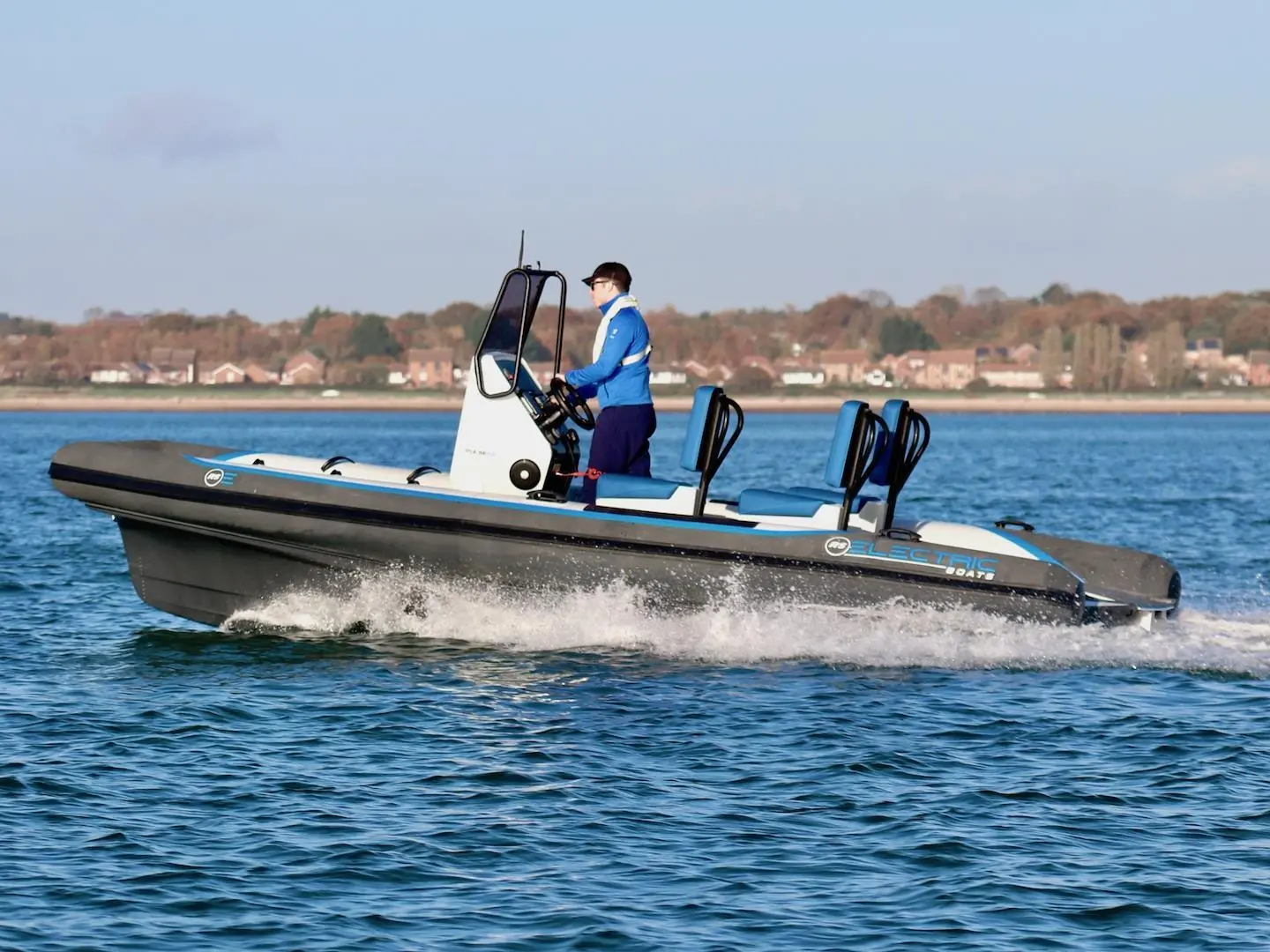
The six knot speed limit was a perfect place for the Pulse to show off one of its party tricks. It utilises clever monitoring and control software, which as well as constantly playing with parameters such as motor voltage to maximise range, includes a widget that RS calls the RADTag.
This is a dual purpose magnetic key fob device that fits in a cup on the dash. Not only does it act as the killcord – pull it out of the cup and the motor stops – it also assigns a configureable set of parameters to each fob. The idea is that, particularly in a commercial setting, each operator will be assigned a personal fob and their driving behaviour, such as range achieved, speeds, throttle settings etc, can be monitored in real time from a shore office and/or recorded.
It’s a GPS device, so the boat’s performance can be regulated in certain geofenced areas too, as it was when we were testing the boat, although not regulated down to six knots, I’m happy to report.
Low grumble
At river speeds the boat is very quiet. It’s not silent, though, and at slow speeds emits a rather pleasing low grumble that builds to a light whine as the boat gets onto the plane. It’s ‘no contest’ quiet in comparison to even the most refined internal combustion engine boats though.
There’s a veritable showcase of technology going on under the deck of course, and this makes the sole a little higher than that on most RIBs. Throwing in a few turns at higher speed did not give me any impression that the boat was standing on its tiptoes, or any impression that in open water it might feel more exposed than others.
Rolling on
The sensation of rolling the throttle on and attaining planing speed was unlike any I’ve felt in a RIB before. RS is the biggest builder of sailing dinghies in the world and its most successful products in that area have mainly been planing skiffs of one flavour or another. Unlike a traditional deep-V hull RIB and actually much more like a planing skiff, the boat rises up with increasing speed very evenly fore and aft.
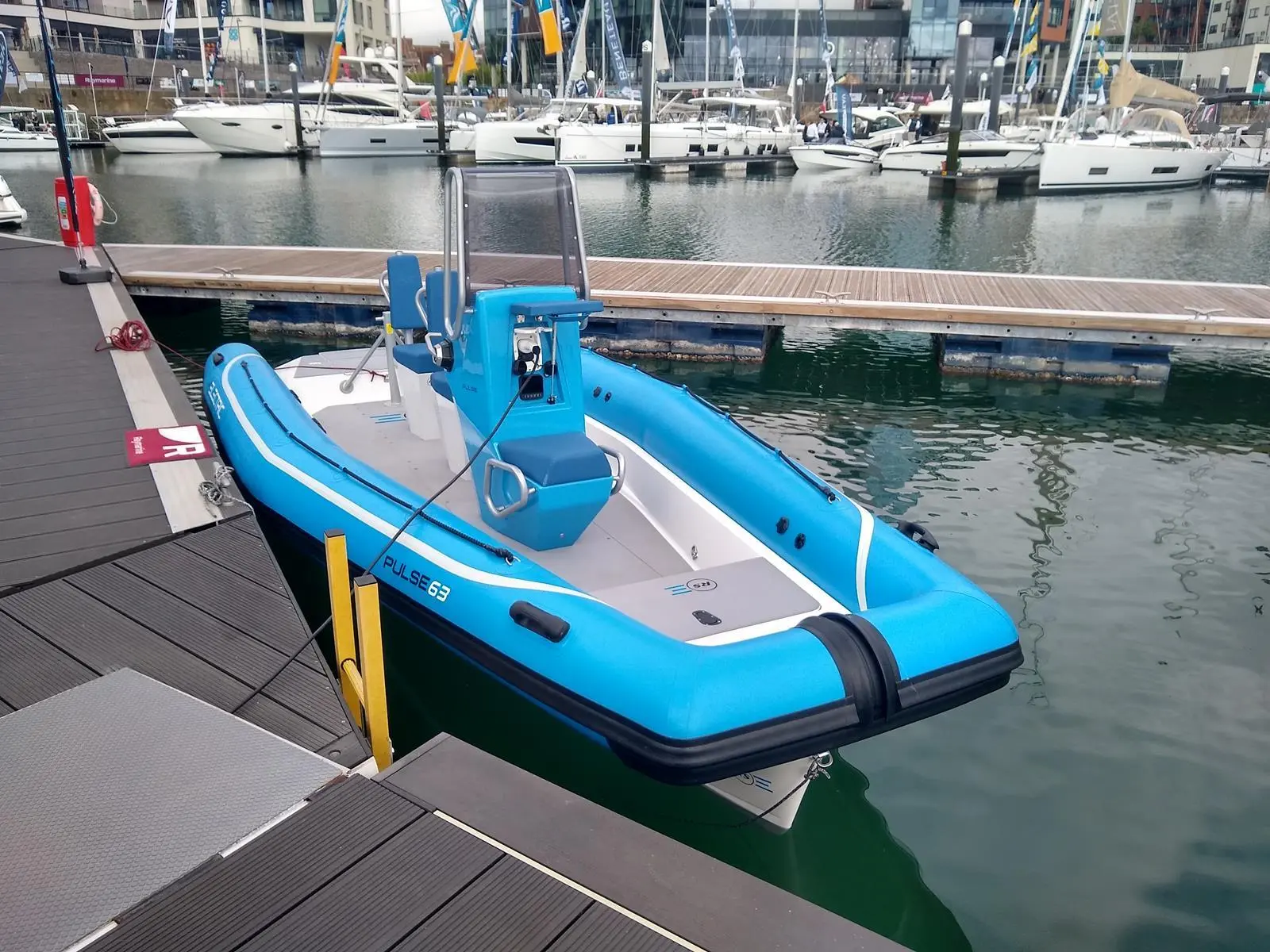
It’s very difficult to tell even if it is planing, unlike a deep-V RIB that has to ascend a very steep bow wave once it gets much above jogging speed. The problem with this for the traditional deep-V RIB is that at 8 knots or so up the river or through a harbour,this is a hugely uneconomical way to use the hull.
Not so the Pulse 63. It’s got a deep forefoot and a reasonably flat rocker line. This keeps the waterline long to maximise efficiency at sub-planing speeds. That’s not a luxury that fast RIBs have to play with as a plumb stem would be a hooking accident waiting to happen at 40 knots in open water – but it’s a viable design solution when you can only sprint up to 23 knots. It’s also got a triple hull form, that I’d call a ‘modified cathedral hull’. Its central hull is almost flat in terms of deadrise – that’s necessary for low powered planing to be achieved – but a full width hull that flat would cause slamming in open water. So the air channels work as shock absorbers, trapping air to reduce slamming.
Hull alchemy
The hull is its USP as far as I’m concerned. It doesn’t seem to have any ‘bad’ or uneconomical speed, (other than the very high speeds which would be best avoided for the sake of range), and that’s quite an achievement. You get ‘planing hulls’ that are hopelessly uneconomical at low speeds and you get ‘displacement hulls’ that are economical at low speeds but cannot achieve high speeds.
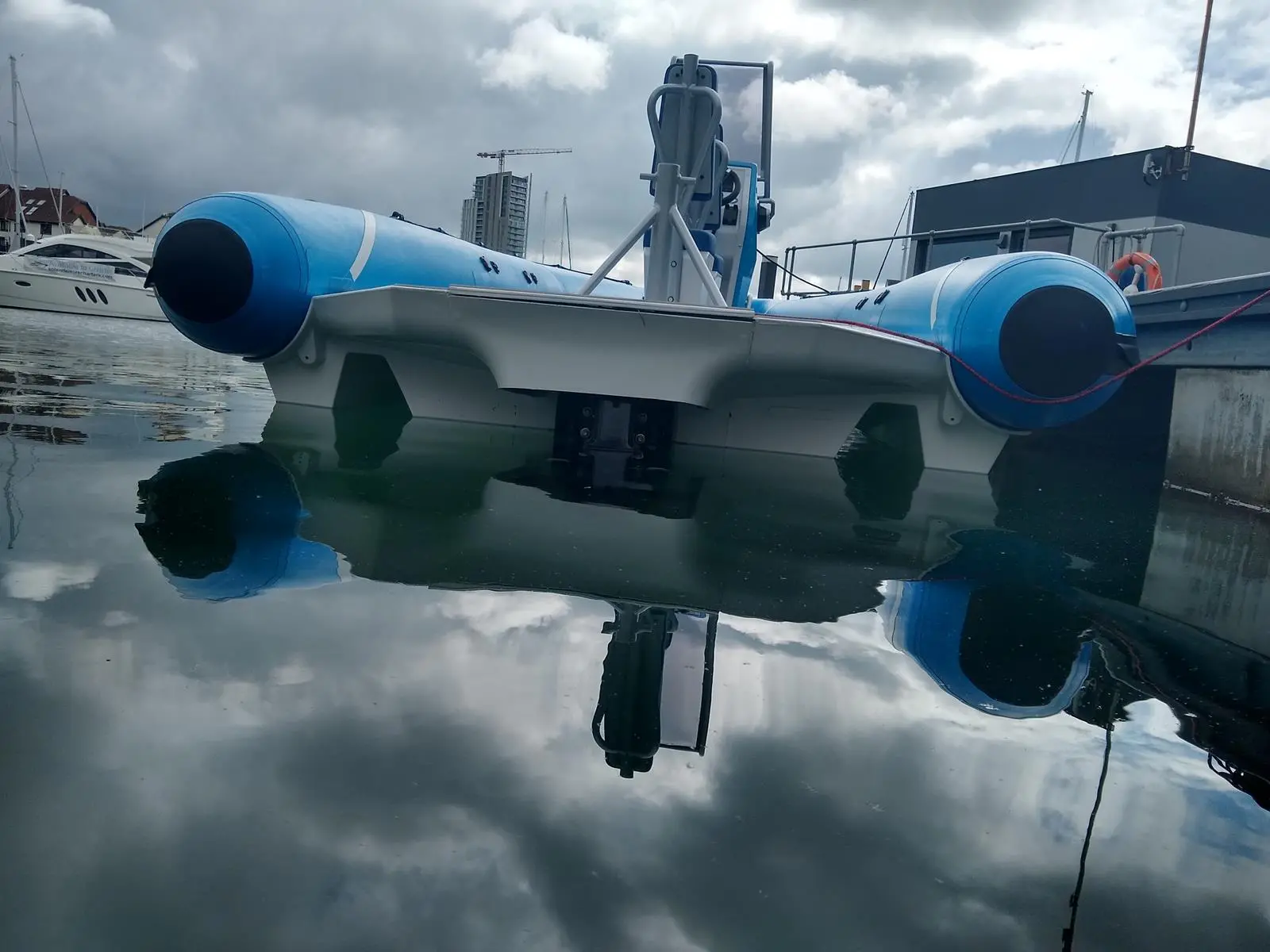
This hull that RS has delivered feels like naval architectural alchemy; it doesn’t know or care if it is planing or not, and its range against speed graph looks like an even slope. It’s very beneficial for commercial use that there aren’t large swathes of the speed curve that operators have to avoid.
It has some other advantages for commercial work too. The absence of a dirty great petrol outboard on a transom means it has a low and smooth rear deck. This would of course be exceptionally useful for diver recovery, search & rescue, light towing and the like.
The variant we drove was configured as a sail racing support boat and therein lies the RS Pulse’s origin story. The world governing body of sailing has set an ambitious decarbonisation target – all coaching and support boats at the Paris Olympics in 2024 must be zero carbon.
I’d guess this is how a sailing dinghy manufacturer first got the heads-up, but the market for sail racing support is small compared with what this boat can achieve.
A vast array of commercial configurations are available, as are various more robust finishes and tube colours. Of course it’s also not just sports governing bodies that have decarbonisation targets.
It uses 46kWhs worth of Nissan Leaf automotive batteries, which with the standard 25kW charger will recharge from flat in two hours using dockside CCS technology. It will also recharge in eight hours using standard marina shore power.
For commercial users though there’s a 75kW charge option that will fully charge in just 30 minutes. RS hopes to sell 100 units in this first year in production, and has the production line in place to meet this demand.
One possible area that needs development is the choice of sterndrive. It uses a presumably very durable and proven off the shelf Mercury unit, but this is not electric-specific, has a big gearbox, a draggy and unnecessary hub centre exhaust, general purpose propeller and generally looks suboptimal for a boat like this that has to eke out every Watt as far as it will go.
I note that the first iteration of this RIB, the now dropped Pulse 58, had a wacky RAD propulsion rim drive unit, and perhaps with this earlier model RS realised that customers don’t want to take chances with low volume-built drive units.
The Mercury unit will be a safer bet I suspect for commercial users with its over-engineered size and worldwide spares availability. With Mercury themselves bringing out a full range of electric outboards in 2022, perhaps they already have a suitably smaller drive unit waiting in the wings to more efficiently handle this boat’s 63hp?
The overall package is impressive. With us so far behind the curve in the race to cut carbon, there must be marine operators all over the world who could use a boat like this.