



Innovative load testing solution for harbour wall
Dover’s development plan for the Wellington Dock marina in the UK included the design of a mobile boat hoist with a maximum future lift capacity of 75 tonnes.
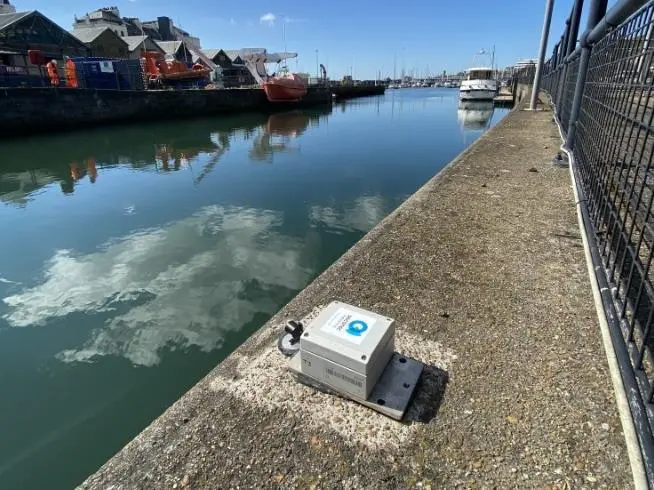
The hoist will operate from an area that is retained by a Grade II listed harbour wall, and the task was to confirm that the structure would remain stable during the operation of the proposed hoist.
A detailed structural analysis was undertaken by Atkins to assess if, as expected, the wall would support the new loads. A ground investigation was also carried out by others to provide Atkins with the necessary ground and laboratory data. This initial investigation and assessment identified highly variable ground conditions which made an analysis of the whole length of quay difficult.
Standard load testing requires defined loads to be applied and a measurement of the settlement to be undertaken. However, the Northampton Quay Wall site had a number of constraints that prevented conventional testing from being deployed. Firstly, access was restricted, and SOCOTEC Monitoring was not permitted to impose any load within two metres of the harbour wall. Secondly, SOCOTEC Monitoring could not apply a pressure greater than 20kPa within six metres of that exclusion zone. The limited and variable depth of the harbour water, as well as existing marine traffic, further restricted access and test options.
Normally in such situations, static loads are directly placed or hydraulically loaded via a 20tonne excavator or similar. However, on this occasion, those conventional options were not possible.
CHALLENGE
The main challenge was that several plate load tests (the 750mm diameter plate test) had to be undertaken as close to the harbour wall as possible (i.e. within two metres). However, conventional kentledge solutions very quickly exceeded the safety criteria. Furthermore, and due to the listed status of the wall, extremely accurate and near real-time ground settlement and wall deflection monitoring was also required prior to, during and after the testing.
After much discussion and collaboration between SOCOTEC Monitoring, Atkins, Port of Dover and specialist contractors, Thanet Crane Hire and Unique Group, an ingenious solution was found. The end solution incorporated marine and civil engineering disciplines and leveraged the strengths of SOCOTEC’s combined group capabilities.
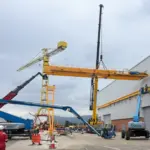
Specialist open-top floor test bags that are frequently used in the marine sector were provided by Unique Group to allow uniformly distributed load (UDL) tests to be undertaken. The test bags were filled with 36,000 litres of seawater (36 tonnes) and placed in the six-metre exclusion zone to check that those loads were acceptable. A one hundred tonne crane was then brought to site and carefully loaded and positioned so as not to contravene any of the restrictions. Thanet Crane Hire had designed a bespoke configuration that ensured that three of the four crane’s outriggers would not exceed 20kPa. This enabled the remaining outrigger to safely apply incremental loads for the 750mm diameter point load test, up to a maximum pressure of 565kPa.
A LAYERED APPROACH TO MONITORING
SOCOTEC’s Materials Testing team undertook each plate load test in accordance with a UKAS-accredited test method. However, to ensure that their technician was not beneath the lift area, all measurements of the applied loads and ground settlement were remotely captured using WiFi-enabled equipment. SOCOTEC Monitoring’s survey team also observed survey targets and prisms on the harbour wall while the load tests were undertaken, and wireless biaxial tilt sensors were used to accurately measure rotational movement. Finally, monitoring of the applied loads and movement was provided by Thanet Crane’s on-board computers. Movement trigger limits were defined by Atkins so that in the event of any excessive movement, the testing could be immediately and safely halted.
In addition to the monitoring during the load testing, SOCOTEC’s survey targets and tilt sensors enabled baseline data to be gathered prior to the loads being applied and continued to monitor movement of the existing dock wall after the testing had been completed. The wireless sensors will also assist during the construction phase and with the ongoing monitoring of the listed structure.