![MaritimeJournal[Seawork]](https://www.maritimejournal.com/wp-content/uploads/2026/09/MaritimeJournalSeawork.svg)




Inside the UK’s first commercial hydrogen retrofit: Interview
Lloyd’s Register’s approval of a hydrogen fuel cell retrofit for the research vessel Prince Madog is finally a demonstration of the growing maturity of hydrogen-powered solutions. Maritime Journal editor Debbie Mason spoke to the man behind the solution.

The project is also a note of confidence to the sector about alternative energy, says Nik Lekkas, chief technical officer with Ecomar Propulsion, a marine propulsion systems integrator and designer.
For all the discussion surrounding alternative fuels, few projects attempt to retrofit hydrogen propulsion into existing commercial vessels. It is easier to begin with a blank sheet of paper and design a newbuild around fuel storage, machinery spaces and safety systems than it is to adapt a vessel conceived decades before hydrogen entered the maritime conversation.
That is why the conversion of the research vessel Prince Madog is attracting attention after it was awarded the ShipRight Risk Based Certification (RBC) by Lloyd’s Register at last month’s Seawork 2026.
The 30-year-old vessel, jointly operated by OS Energy and Bangor University, is being fitted with a hydrogen fuel cell and battery-electric propulsion system that will allow it to undertake zero-emission coastal research operations. The certification framework provides confidence that the concept can satisfy class requirements despite the absence of mature prescriptive rules for hydrogen retrofits.
Fareham, UK-based engineering company Ecomar has been on board from the get-go some three years ago, from system development through to integration and now certification.
“Fundamentally, Ecomar is a systems integrator and a problem solver,” says Lekkas. “We don’t have our own specific technologies that we push onto customers. We have our own propulsion control systems, but ultimately it comes down to managing the package for the operating requirements.”
And while hydrogen is certainly one of today’s alternative fuel front runners, Lekkas knows it can’t be a universal solution.
“We’ve worked on a number of projects optimising different propulsion systems,” he says. “Some are methanol, some are mixed methanol and diesel, some are hydrogen. Ideally, the goal is a completely emissions-free system, but hydrogen isn’t the solution for everything. It’s part of the solution for some of the things.”
Working out the solution
Ecomar begins by examining how a vessel actually operates before recommending a propulsion solution and for Prince Madog, hydrogen was a logical choice.
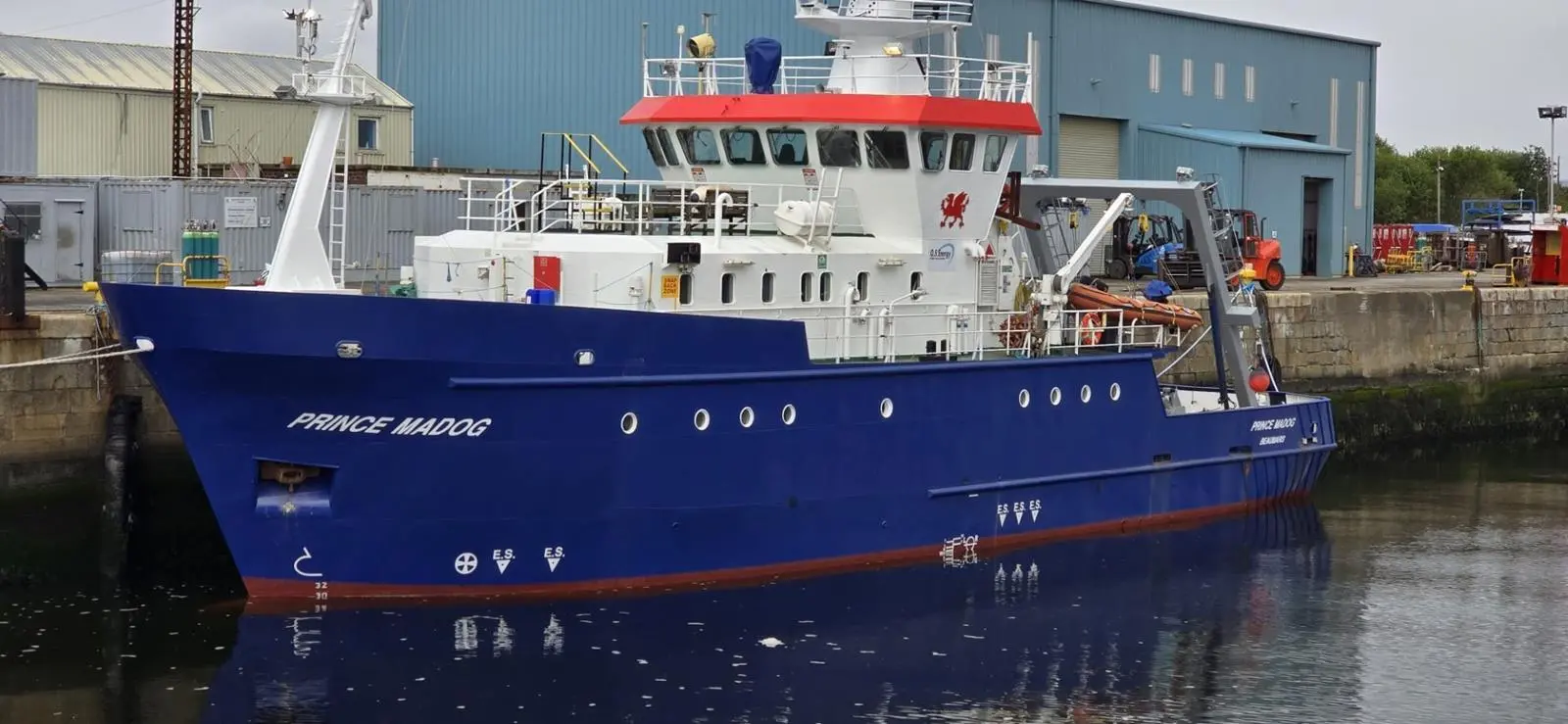
”Madog is a shared vessel,” Lekkas says. “It’s co-owned and operated by OS Energy and Bangor University. They have access rights for part of the year to carry out operations for the university, which are eight-hour day surveys of cockle beds and other things like that.”
“It seems appropriate to fit a completely clean propulsion system for those operations because of what they’re doing,” he says. “They’re involved in marine conservation, so you try to limit that environmental impact.”
Those relatively short, predictable survey operations are ideally suited to battery-electric propulsion supported by hydrogen fuel cells, but the vessel will retain conventional propulsion for longer transits.
“When the vessel needs to transit longer distances, you can’t really rely on hydrogen because you don’t have enough fuel capacity,” he says. “But once you’re there, you can carry out the localised operations that you need.”
The Lloyd’s Register ShipRight Risk Based Certification framework also offered the flexibility needed for a project that sits outside conventional rule books.
“Fundamentally, that risk-based route was one of the only options that we could really go down because there wasn’t enough of a prescriptive framework that we could align our system to,” he says.
Unlike a conventional machinery installation, every aspect of the hydrogen system had to be examined in terms of how risks could be eliminated or reduced.
“It’s a very nuanced project,” he says. “It’s a specific size of vessel and it’s a retrofit. We’re trying to put something onto a vessel that wasn’t designed for it. Without those considerations, you could potentially introduce additional risks from an operational perspective and for the ongoing certification of the vessel.”
Rather than working to a rigid checklist, the engineering team examined the complete installation.
“We could really only approach it from a risk-based perspective, acknowledging as much existing guidance and regulation as possible, ensuring the risks were covered at a detailed design level and from the overall operational perspective.”
Physical adaptations
The retrofit itself has demanded extensive structural alterations.
The first phase involved reconfiguring machinery spaces to accommodate the battery installation and associated electrical equipment.
“They changed all of the engine room compartment, installed the battery compartment, removed old equipment and replaced it with smaller, more compact equipment to create the space for the high-voltage electrical systems,” Lekkas says.
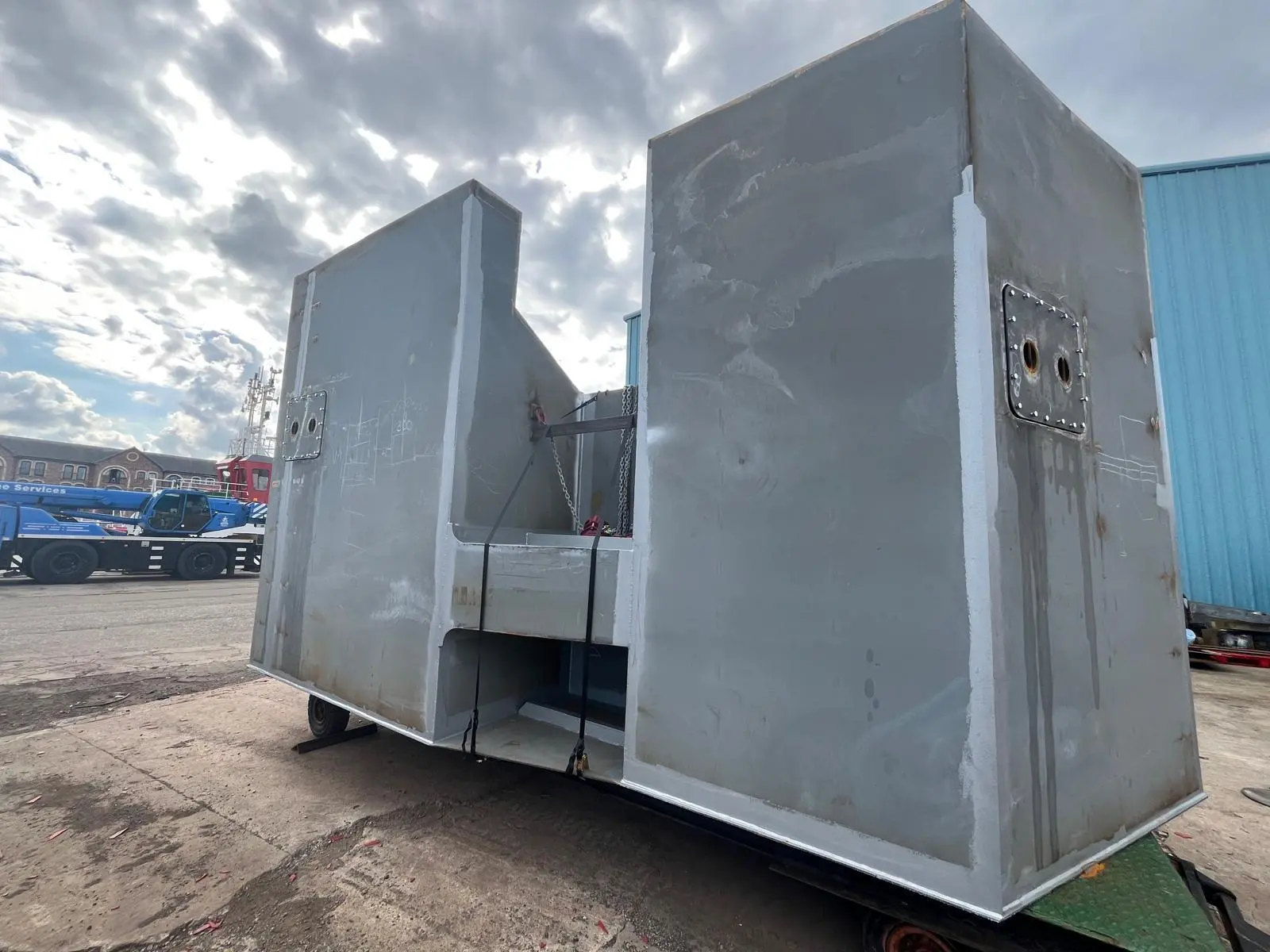
The work also involved cutting sections of the vessel to remove machinery and prepare for the next stage of construction, which centres on a purpose-built fuel cell room positioned on the forecastle deck.
“The fuel cells are in storage, ready to go,” says Lekkas. “Everything has to be approved before we can even put these systems on the vessel.”
Retrofitting, he says, bears little resemblance to designing a hydrogen-powered newbuild.
On a new vessel, fuel tanks, ventilation systems and machinery spaces can all be designed around hydrogen from the outset. Existing vessels impose constraints that simply cannot be engineered away.
“At the time, the rules for implementing hydrogen below deck were still very unclear. That limited the footprint available to us.”
Those constraints also influenced one of the project’s most important engineering decisions: choosing compressed gaseous hydrogen rather than liquid hydrogen.
Although liquid hydrogen offers significantly greater energy density by volume, it introduces cryogenic storage and boil-off management issues.
“In this case it came down to fuel availability and price,” says Lekkas. “Gaseous hydrogen is easier to produce, more readily available and the refuelling philosophy is already much better understood.”
Liquid hydrogen, he explains, creates an entirely different set of engineering challenges.
“It’s always boiling. You’ve got continuous boil-off gas that has to be managed, so it’s a completely different safety philosophy.”
By contrast, compressed hydrogen could be integrated into a simpler storage and bunkering system while making use of an increasingly established supply chain.
The onboard hydrogen installation has been carefully sized around the vessel’s research role.
Fuel needs, risks and costs
Sea trials conducted early in the project enabled the design team to establish the vessel’s energy requirements for zero-emission operation.
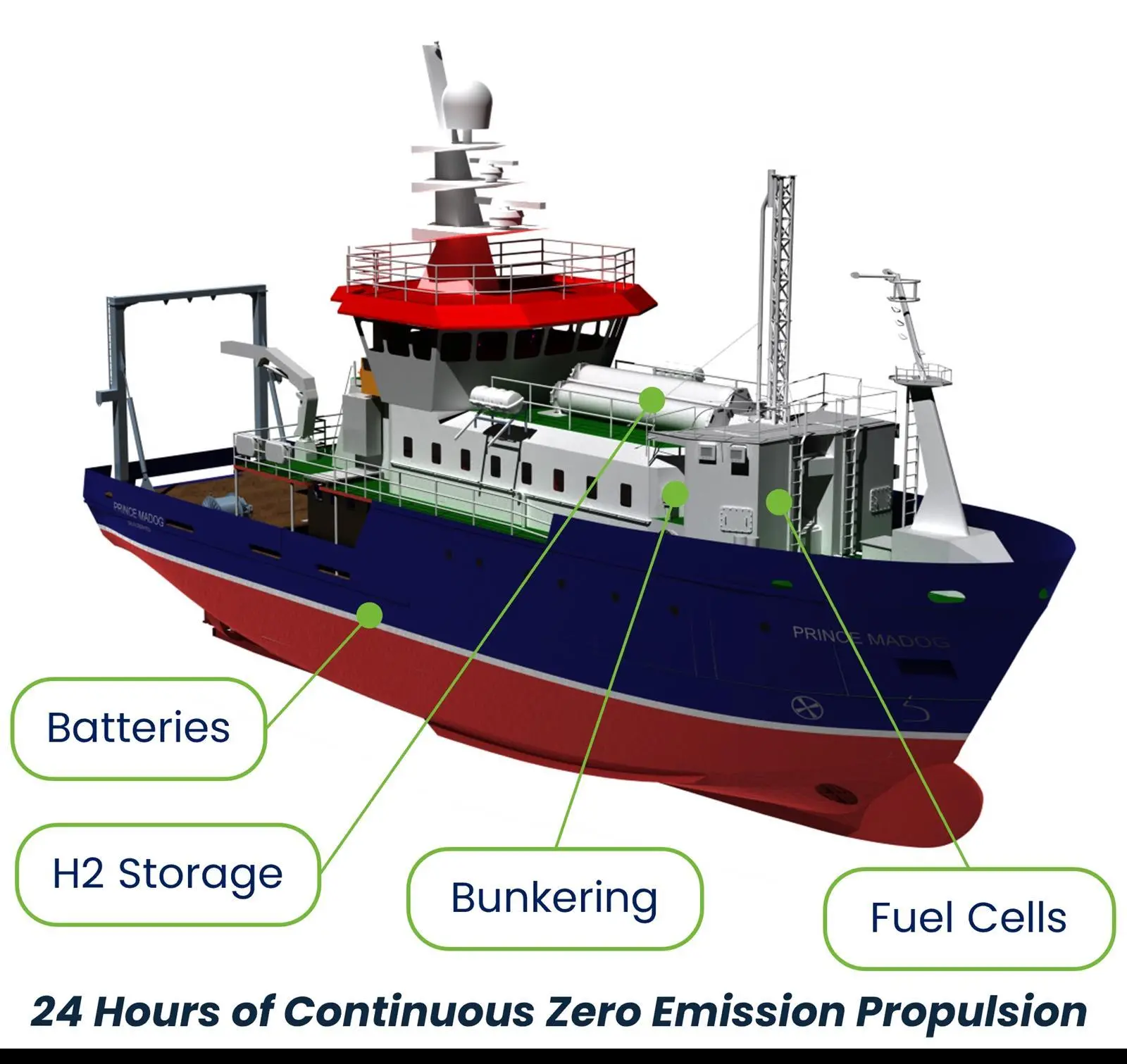
“The approximately 180 kilograms of gaseous hydrogen we’re storing onboard will give the vessel 24 hours of operation, which is equivalent to three days of eight-hour survey work,” Lekkas says. “For the compactness and the limited footprint that we had to work with, that’s quite a good achievement.”
The hydrogen system forms part of a wider energy management architecture linking batteries, fuel cells and electric propulsion motors.
“The main control system asks for energy. The battery management system then requests power from the fuel cells, which in turn draw hydrogen from my system. Most of that happens very passively, but there are a lot of checking and control safety functions operating in the background.”
While the technology itself is complex, Lekkas believes public perceptions of hydrogen often exaggerate the risks.
“Avoiding what’s often fearmongering around hydrogen, it’s like anything else,” he says. “It’s how you educate yourself, how you use it and how you’re careful with using it.
“People have been refuelling petrol and diesel vehicles for many, many years. At some point somebody had to de-risk that process.”
Modern hydrogen systems, he says, rely on multiple layers of engineering protection.
“There’s so many safety-critical layers to the control systems, the operations and the equipment that the actual risk of the medium is very, very negligible.
“There are always hazards and risks. Those risks can be managed and mitigated if they’re thought about carefully enough.”
Commercial considerations are as important. Lekkas believes maintenance requirements will be lower than for conventional machinery because of the reduced number of moving parts, but every retrofit presents its own engineering challenges.
That’s why Ecomar approaches each project individually rather than offering a standard package.
The company’s hydrogen package has nevertheless been designed with future applications in mind.
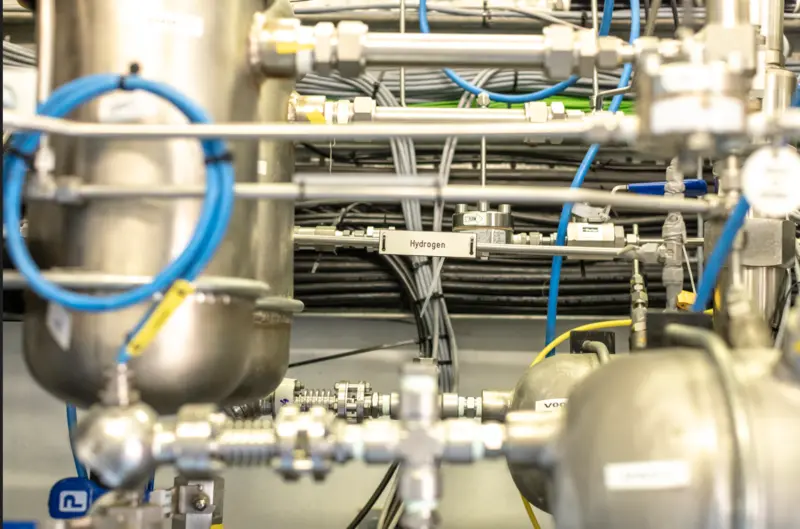
“The heart of my hydrogen system is the gas-handling system. It’s a very small, compact unit, and I’ve focused a lot of effort on making everything fit into one space,” he says. “You could also couple these units together. If one module can supply eight fuel cells, you simply scale that up for larger ships.”
Following the EV road
Whether hydrogen becomes a mainstream marine fuel will depend on infrastructure, economics and fuel availability, particularly for deep-sea shipping.
But Lekkas believes projects such as Prince Madog perform a vital role by demonstrating what can be achieved today rather than what may be possible decades from now.
Ultimately, he says, the industry is undergoing the same cultural shift experienced by electric vehicles a generation ago.
“It’s an emerging market. Somewhere we’ve got to try and do something that’s better for the environment.”
For Ecomar, that does not mean promoting hydrogen above every other alternative. It means applying engineering judgement to match propulsion technology with operational reality.