





Malta gets a high performance Voith tractor
Tug Malta, a subsidiary of Rimorchiatori Riuniti of Genoa, Italy, has taken delivery of the high performance Voith tractor tug Spinola. The vessel was built by Astilleros Armon of Navia, Spain, and is the second of a pair delivered to the parent company.
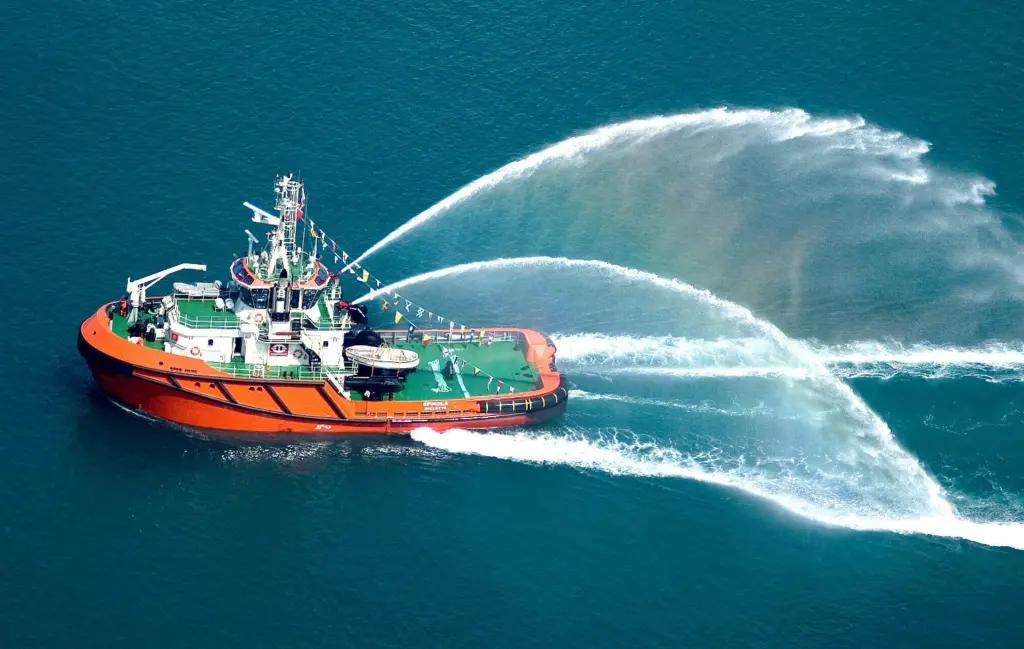
This is the latest AVT 36/80 Class tug designed by Robert Allan Ltd and follows the
Messico
, delivered early in 2008.
Spinola
incorporates significant changes from the previous vessel and is suitable for a wide range of duties including harbour towage and ship handling, coastal towing, salvage, escort, fire fighting and oil spill response duties. The tug is also equipped for heavy duty anchor handling, an unusual facility for a Voith tractor.
This latest addition to the Tug Malta fleet meets the class requirements for RINA and measures 36.65m in length overall, with a beam (moulded) of 13.40m and a draft for harbour operations of 6.1m. Design features of this latest AVT36/80 class tug include a full raised forecastle running nearly half the length of the tug to provide a high standard of accommodation and the best possible seakeeping capability for operation in exposed conditions.
Substantial fendering in the form of hollow ‘D’ moulding provides protection along the forecastle and main deck sheer lines. The stern has fenders suitable for push-pull operations, comprising a 450mm diameter cylindrical moulding above a row of 450mm ‘W’ block mouldings. ‘W’ block type fendering is also used at the bow.
A large aft deck is heavily reinforced for anchor impacts, and the entire deck is rated for a uniformly distributed loading of 5 tons per sq/m. The latter incorporates a removable escort towing fairlead, to ensure a clear deck for non-towing activities, and the deployment of oil dispersant spray equipment. This second tug of the series embodies some significantly different features required specifically to facilitate anchor handling. These include wider stern lines to take a 3.50m wide,1.30m diameter stern roller, a set of flush mounted tow pins and shark jaws, and additional tugger winches.
Tank spaces are provided to accommodate 194 cu/m of fuel oil, 96 cu/m of reserve fuel, 74 cu/m of potable water, 8.7 cu.m of engine lubricating oil, 10 cu/m of VSP oil, 18 cu/m of fire fighting foam, 2 cu/m of chemical dispersant and up to 233 cu/m of recovered oil.
Main propulsion comprises a pair of MaK 8M25 diesel engines, each rated 2,640 kW at 750 rpm (totalling approximately 7,174bhp), with each driving a Voith model 32R5-265-2 cycloidal propeller. On trials this combination delivered a sustained bollard pull of 81.6 tons, and a free running speed of 14.1 knots. The indirect escort steering force is estimated at 115 tons at 10 knots, and indirect braking estimated at 147 tons at 10 knots. The operating range at economical cruising speed is estimated to be at least 3,000 nautical miles.
Fire-fighting is to Fi-Fi 1 standard, complete with water spray and dewatering eductor.
The main towing winch is a waterfall style, double drum type with a single horizontal warping head. The upper drum is capable of storing 1,000m of 56mm steel wire rope. A lower ‘split’ drum carries two synthetic towlines, one of 250m for escort work and a 150m line for ship handling. Located in the hold is a hydraulically powered storage reel capable of holding up to 1,000m of spare 56mm steel wire rope. An alternative towing connection can be made using an 80 ton radial arm tow hook, and a 25 t/m knuckle boom crane aids the handling of salvage and general stores and work on deck.
Spinola has been outfitted to the highest standards for a crew of up to 14 persons. Accommodation on main deck level includes three two berth cabins, four single cabins, a galley, mess, galley stores, workshop, oil lab, locker room/lobby, and deck store. The deckhouse at forecastle deck level includes four single cabins for officers. All cabins are of a generous size, and boast en-suite facilities. An engineer’s stores and laundry facilities are located below decks.
Noise levels throughout the crew accommodation were recorded in the range of 60 dBA, achieved through utilisation of advanced methods of isolating main propulsion machinery, as well as high grade insulations and floating floors. The wheelhouse is designed for maximum visibility, with a single control station providing maximum visibility fore and aft over the work decks.
Related Articles
 TUGS & SALVAGE
 EQUIPMENT
 MARINE CONSTRUCTION