![MaritimeJournal[Seawork]](https://www.maritimejournal.com/wp-content/uploads/2026/09/MaritimeJournalSeawork.svg)






Dredged clay transformed into coastal protection blocks
The Port of Esbjerg is turning dredged seabed material into a building blocks that brings circularity to flood defence.
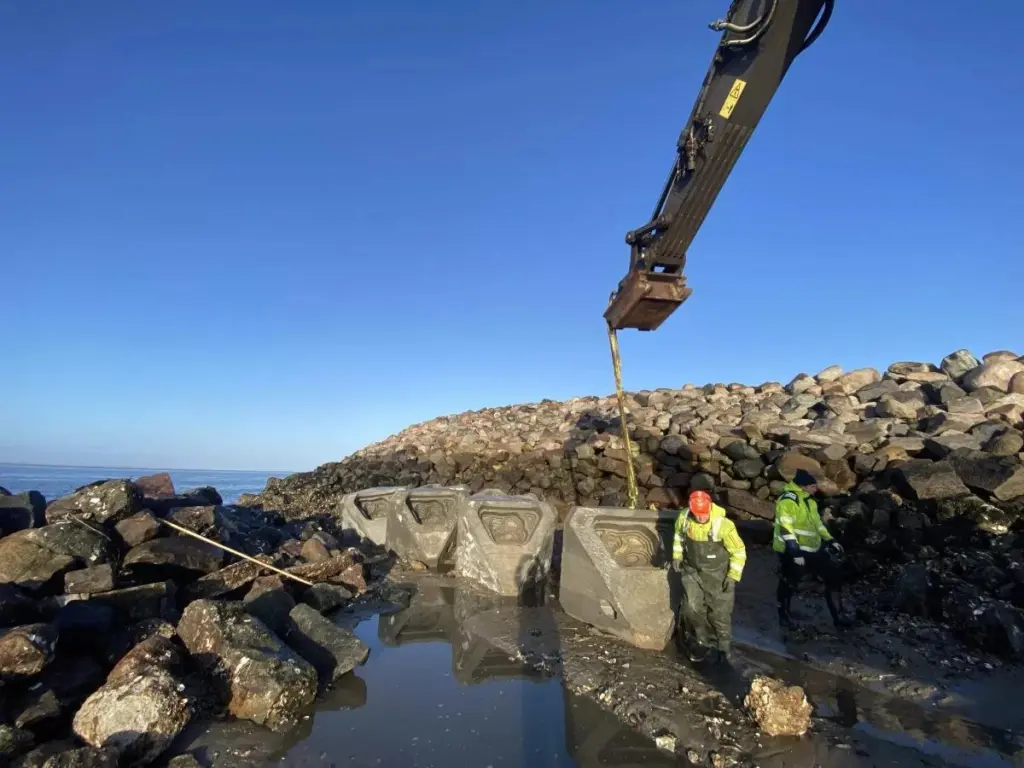
As part of ongoing expansion and maintenance work, large volumes of clay are routinely dredged from the port to maintain sufficient depth for shipping and offshore operations. Traditionally, such material would be treated as waste or relocated offshore.
However, the port has developed a circular approach that reuses the clay to make interlocking blocks – called ’Coastalock’ units – designed for coastal protection and infrastructure projects.
The Coastalock blocks, designed by Israeli firm ECOncrete, are manufactured by processing and stabilising the dredged clay, transforming it into durable units that can be used in breakwaters, embankments and other marine structures. By re-purposing material already extracted from the seabed, the initiative reduces the need for quarrying new raw materials such as rock or concrete aggregates.
The production of Coastalock blocks also minimises the environmental impact associated with transporting and disposing of dredged material, while simultaneously creating a useful end product.
The blocks themselves are designed with a modular, interlocking system that allows for flexible deployment in a variety of coastal engineering applications. Their form enables stability under harsh marine conditions, including strong waves and currents, making them suitable for protecting port infrastructure as well as nearby coastlines.
The blocks have been engineered by ECOncrete, which designs and provides what it calls a bio-enhancing additive for the concrete mix, while the port carries out the casting itself.
“Coastal protection and port infrastructure require robust structures with high durability and stability,” says Philippe LeBlanc, Business Development Director at ECOncrete. “We have helped customers worldwide develop solutions that also promote biodiversity. In Esbjerg, this is the first time we are utilising dredged sediment from the harbour directly in the construction.”
The Port of Esbjerg says the project demonstrates how ports can play a key role in advancing circular economy principles within the maritime sector. By viewing dredged material as a resource rather than a by-product, the port is able to close a loop that would otherwise involve significant environmental and financial costs, it believes.
The project is particularly relevant as the port continues to expand its role as a major hub for offshore wind. Increased activity in the renewable energy sector has driven demand for both infrastructure development and sustainable practices, placing greater emphasis on solutions that combine operational efficiency with environmental responsibility.
The Coastalock concept has the potential to be scaled and adapted for use in other ports and coastal regions facing similar challenges with dredged material. The Port of Esbjerg sees this as an opportunity to share knowledge and contribute to wider industry change.
“When we can combine port infrastructure and coastal protection with a healthier marine environment by utilizing sediment from maintenance and dredging in the fairway and the port, there is potential that extends far beyond Esbjerg,” says Dennis Jul Pedersen, director of the Port of Esbjerg.
Related Articles
 INDUSTRY NEWS
 MARINE CIVILS
 MARINE CIVILS