Salvors face mixed bag of challenges
Incidents involving groundings, collisions, typhoons and of late, victims of war, all affecting vessels large and small, along with the more pre-planned work of wreck removal continue to present challenges for the people whom no ship owner or insurer wishes to pick up the phone to, but are always there – the commercial marine salvage industry. Peter Barker rounds it all up.
Piraeus-based Tsavliris Salvage started out in the mid 1920s with a wooden, coal-burning, 10hp tug. While it has operated dry cargo ships, it is the towage and salvage sector across the world that it is generally associated with.
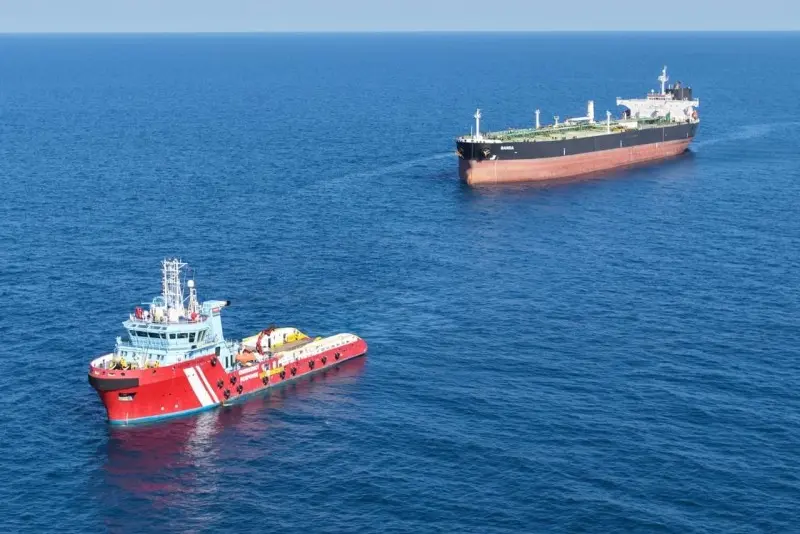
The family-owned business reports a busy Q3 2026, including an operation involving risks beyond the usual perils when the 105,576dwt crude oil tanker Banda was struck by a drone, around 70 miles south-west of Novorossiysk in the Black Sea.
The drone struck Banda’s aft section leading to an explosion and fire in the engine room that flooded up to sea level, disabling the vessel. The fire spread to the accommodation and Tsavliris was soon involved with the response, on the same day dispatching the AHTSs Aigaion Pelagos and SPM Sailor (121tbp and 152tbp) along with a salvage team, equipment and supplies.
Salvors inspected the vessel, stabilised the situation and restored conditions for Banda’s crew including provision of a portable generator and making necessary repairs to the accommodation.
Tsavliris said Banda was ‘towed around for a considerable time’ awaiting nomination of the redelivery location, eventually being safely handed over at Istanbul, Turkey after a five-week operation that was finished without any pollution or environmental damage.
Shallow waters, changing depths and strong currents make navigating Argentina’s Parana River particularly challenging, Japan P&I Club reporting vessel groundings averaging 15 per year, including bulk carriers transporting agricultural commodities and minerals.
Tsavliris is a regular responder to these incidents and was on hand when the 63,500dwt bulk carrier Aeriko grounded in ballast condition in the river. Two local tugs, Brutus and Argentino I, were dispatched from their homeport in Rosario and with a salvage master in attendance successfully refloated Aeriko, which was towed to an anchorage at Arroyo Seco.
Hermes has been a traditional name for tugs over the years and Tsavliris’s local tug of the same name proved an ideal tool when the motor yachts Caroline II and God’s Gift separately ran aground near Cape Drepano, Greece.
Both were successfully refloated by Hermes and while not on the same scale as large ship casualties, careful planning involving bunker removal, dive inspections and scouring were still required to minimise financial losses and prevent pollution.
“These achievements underscore our commitment to rapid response, technical expertise and environmental stewardship, reinforcing our position as a trusted leader in the global salvage industry,” said Tsavliris.
Collisions
Athens-base Five Oceans Salvage has been involved in a major salvage operation in the Gulf of Kutch, India following collision between the
bulk carriers Kmax Emperor and True Mariner, which was anchored. Kmax Emperor was laden with 86,000 tonnes of coal and suffered a rupture to the port side of its hull near the engine room, resulting in the compartment flooding and the vessel being immobilised with a stern trim of more than seven metres.
The Gulf of Kutch is home to a Marine National Park and Marine Sanctuary with protected coastal habitats that the Indian authorities maintained a close watch over throughout.
At its peak, around 60 people were involved on site including salvage masters, engineers, naval architects, divers, electricians and oil-spill response personnel, afloat assets including tugs, crane barges, dive support vessels, cargo barges and specialist pollution response equipment.
The four-week operation involved restoring power to the vessel, removal of bunkers, partial dewatering of the flooded engine room, recovery of oily substances and temporary hull repairs to around eight metres above the waterline. With the vessel stabilised the entire cargo was safely discharged and Kmax Emperor redelivered to its owners.
“The project demonstrated the importance of effective collaboration between salvors, local specialists and authorities when responding to complex maritime emergencies in environmentally sensitive locations,” said Five Oceans Salvage.
Florida-based Resolve Marine responded to a collision between two bulk carriers, in the Singapore Strait. The fully laden vessels remained locked together and drifting following the collision, Resolve Marine along with local tugs managing to separate the vessels.
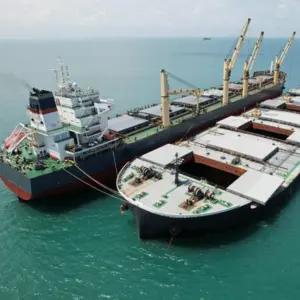
Attention then turned to one that was carrying 200,000 tonnes of iron ore and experiencing water ingress into a ballast tank and the cargo hold. The iron ore-laden vessel was moved to a safe anchorage in Malaysia, where Resolve carried out a round-the-clock, ship-to-ship lightering operation in what were reported as ‘challenging conditions’.
With around 78,000 tonnes of ore safely trans-shipped the vessel was moved again to a discharge berth at another Malaysian port where the remaining sound cargo was discharged. After wet, damaged cargo was recovered from the flooded hold the vessel departed for repairs in China with Resolve personnel onboard to monitor the voyage.
An interesting task for Resolve was its role in the UK government’s strategy for managing the ordnance-laden SS Richard Montgomery WW2 Liberty shipwreck in the Thames Estuary. Using diamond wire saws, Resolve removed the three remaining steel masts still visible above water as part of the monitoring and response activities for the wreck (see https://www.maritimejournal.com/news/vessels/bomb-laden-wwii-wreck-to-have-masts-removed-after-82-years/ )
Close to home
Marine salvage is a global industry, responders regularly attending incidents far away from their home base, so it is almost a bonus when salvage assistance is required on the doorstep. This was the case for Terneuzen-based Multraship Towage & Salvage when the Danish roro vessel Primula Seaways ran aground in Westbuitenhaven, Terneuzen following engine problems.
Swift action was required to restore safe navigation and working with URS Nederland, Multraship deployed its Damen ASD Tug 2810 Multratug 9 (60tbp), which worked together with Boluda’s VB Cavalier (47tbp) to refloat the vessel and secure it safely in the Westbuitenhaven. Multrasalvor 4, a 43-year-old salvage ship stalwart from Multraship’s fleet, was then involved with an underwater inspection that found no leakage or significant damage to Primula Seaways, allowing it to continue to Ghent escorted by two tugs.
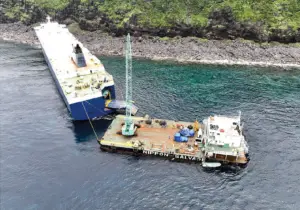
A challenging situation confronted Nippon Salvage when the Japan-flagged roro cargo vessel Niraikana II grounded heavily south of Tokyo. Sitting on a gently sloping rocky seabed the vessel created substantial ground forces, compounded by breached double-bottom tanks rendering the ballast system inoperable and preventing conventional weight-reduction measures.
An initial re-floating attempt with a three-tug combination, including Nippon’s 2004-built Koyo Maru, was unsuccessful, the salvage further challenged when two typhoons passed close to the site. Preventative work prior to the typhoons included transferring bunkers to internal tanks, releasing pressurised air and securing Niraikana II to the shore.
Despite the powerful Kuroshio current a salvage barge removed fuel and cargo as part of the lightering operation, following which Nippon’s 1998-built (and similarly named) Koyo Maru joined the other tugs for the re-floating operation. Two weeks after grounding, and on the last day of the spring tide window, the vessel was re-floated.
“The successful re-floating of a grounded vessel is always a complex operation, but overcoming severe weather, strong currents and significant technical challenges makes the achievement even more remarkable,” said Nippon Salvage.