![MaritimeJournal[Seawork]](https://www.maritimejournal.com/wp-content/uploads/2026/09/MaritimeJournalSeawork.svg)





Europe orders wave of beach restoration projects
As fears about rising sea levels grow, countries are protecting their coastlines with sand replenishment projects. Here is a taste of some of the ongoing works.
At the heart is obviously the Netherlands, whose very name means ‘Lower lands’, with 26% of its land mass under sea level.
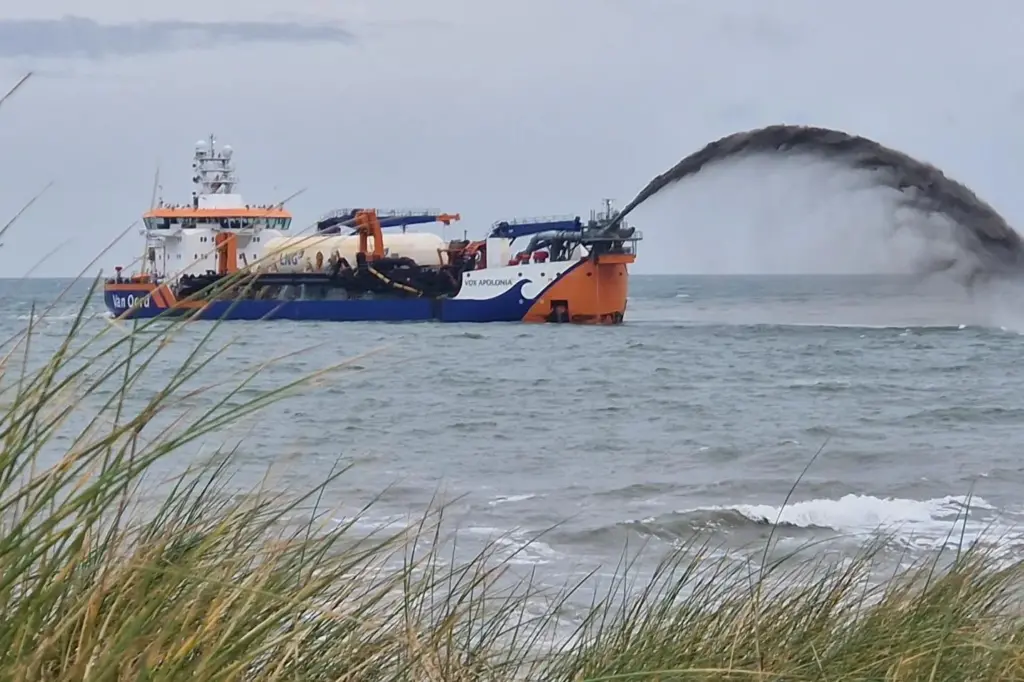
Marine contracting giant Van Oord is often tasked with the work, and at the moment is deploying one of its trailing suction hopper dredgers to deposit 1 million cubic metres of sand onto and in front of Banjaard Beach, in the Noord-Beveland of the Netherlands.
The €8.6 million replenishment will be done by a vessel, says Van Oord, that will run on Bio-LNG for the first time in the Netherlands.
This beach is one of three that will be replenished by Van Oord, the others being Goeree Westkop and Heemskerk, as part of the Coastline Care programme, which aims to strengthen the Dutch coastline with regular sand deposits.
“Bio-LNG is produced from sustainable bio-based materials, including organic household waste and agricultural waste. The bunkered fuel is certified under the ISCC EU certification system, which ensures compliance with the European Union’s legal requirements for sustainable fuels,” says Van Oord.
Portuguese projects
Two notable projects are being undertaken in Portugal.
A million cubic metres of sand will be added to 6.6km of the Caparica coastline at a cost of €8.6 million, according to the Portugal News. The project is to begin imminently, lasting around two months.
In January, the paper says, the government said it would spend another €20 million ’in priority coastal protection projects’ to stabilise cliffs, protect coastal infrastructure and reinforce the most vulnerable beaches.
“The measures ‘combine advanced engineering with nature-based solutions, promoting climate adaptation and sustainable coastal management’,” it says.
Over on the holiday spot of the Algarve, at Quarteira-Garrão, €13 million has been made available to protect 6.6 km of coastline from erosion by dredging sand from an offshore borrow site and pumping it onto the beaches. The public tender was opened in late August/early September 2025, and the contract is expected to be awarded and works completed before the end of 2026.
United Kingdom
In the UK, £7 million (€8 million) is regularly spent on annual beach replenishment in Lincolnshire, an eastern county which, like the Netherlands, is below sea level.
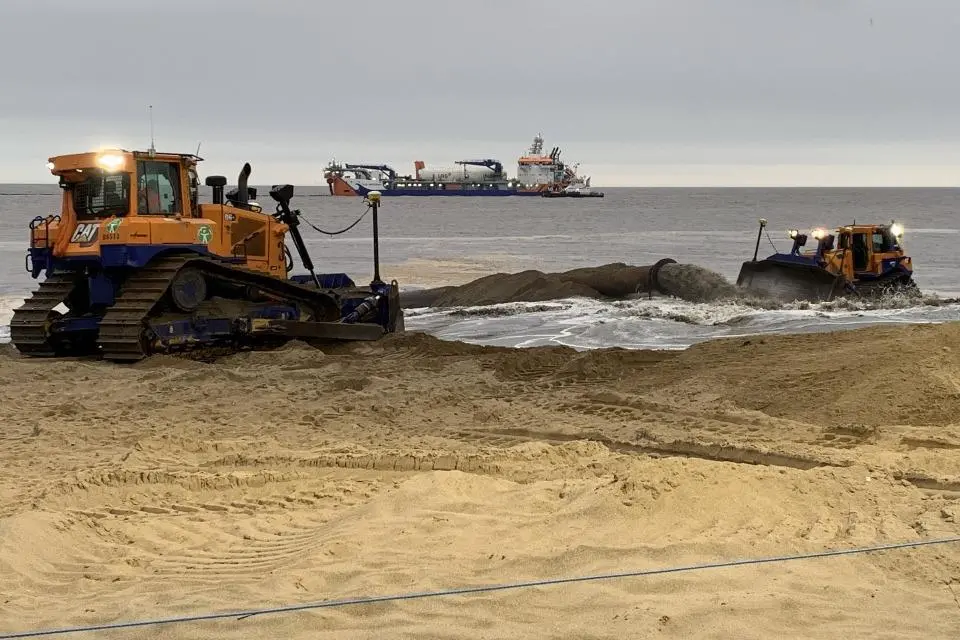
Experts Van Oord have been called in again this year, and in fact the £7 million is just a fraction of £2.65 billion that has been committed by the government for flood protection works.
“Replenishing the sand means that the beaches, instead of hard defences like sea walls, take the brunt of the waves’ force and energy,” said Deborah Higton, Flood Risk manager at the Environment Agency.
“This reduces the amount of damage and erosion to those hard defences and lessens the risk of water overtopping them.”
Related Articles
 INDUSTRY NEWS
 MARINE CIVILS
 MARINE CIVILS