


Financing agreed for Europe’s largest inland port
Financing has been agreed for what will be Europe’s largest inland port – and a port that will be run largely on hydrogen, developers say.
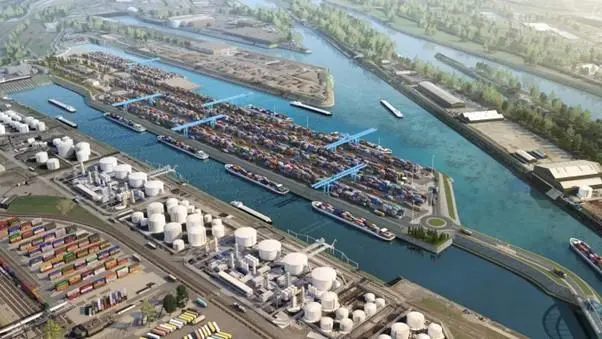
The amount agreed to pay for engineering and infrastructural changes at Duisburg Gateway Terminal (DGT) has not been revealed, but it will be built within the International Port of Duisburg, which sits on Germany’s Rhine River.
Logistics partners and port operators making up the DGT in an international joint venture have agreed borrowing terms from the KfW IPEX Bank for the port, which will have an area of 235,000m² and will allow goods to be handled trimodally between ship, rail and truck.
The shareholders of the JV are Duisburger Hafen (the port), Swiss railway operator Hupac, Dutch intermodal container transport firm H.T.S. Intermodaal and PSA Belgium Holdings, the Belgian port group.
The hydrogen element will be enabled with a ‘Enerport II’ project, ‘in which hydrogen-based energy conversion is to be implemented in the Port of Duisburg, and as many processes as possible are to be electrified’, say developers.
A warehouse will also be built on the DGT premises to be used as a storage facility for hazardous chemicals as an alternative to inland storage vessels when water levels on the river are low.
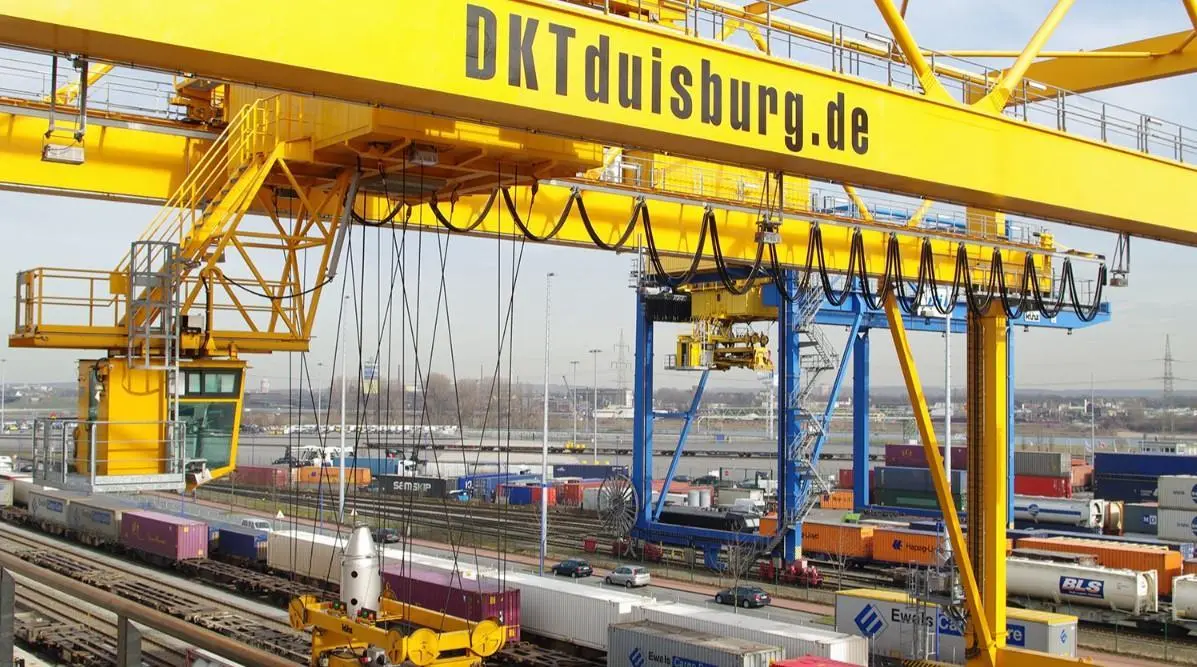
“At the same time, the warehouse will become a transshipment site for tank containers filled with hydrogen or the precursor ammonia. From here, hydrogen is supplied to smaller industrial companies, which, unlike large customers, cannot be connected to a pipeline for the time being,” say the developers.
Duisburg Port handles the equivalent of 3.6 million containers a year, largely transported on inland waterway barges and by railway to the main seaports in Belgium and the Netherlands. Sea-going river vessels travel directly between Duisburg and short sea destinations in northwestern Europe and the Mediterranean region.
The port says it handles more than 50 million tonnes of goods a year, with more than 20,000 ships calling at the port. The public harbour facilities stretch across an area of 7.4 km², including 21 docks covering an area of 1.8km² and 40km of wharf.
The Rhine, one of Europe’s most important waterways, links the Port of Duisburg directly with the sea ports of Amsterdam, Rotterdam and Antwerp as well as the European inland waterway and canal system.
Related Articles
 MARINE CONSTRUCTION
 MARINE CONSTRUCTION
 MARINE CONSTRUCTION