![MaritimeJournal[Seawork]](https://www.maritimejournal.com/wp-content/uploads/2026/09/MaritimeJournalSeawork.svg)





First steel cutting for Belgium’s offshore energy hub
Construction of the high-voltage alternating current (HVAC) structure for Belgium’s offshore energy hub has begun, following on from the installation of the first caissons for the structure last month.
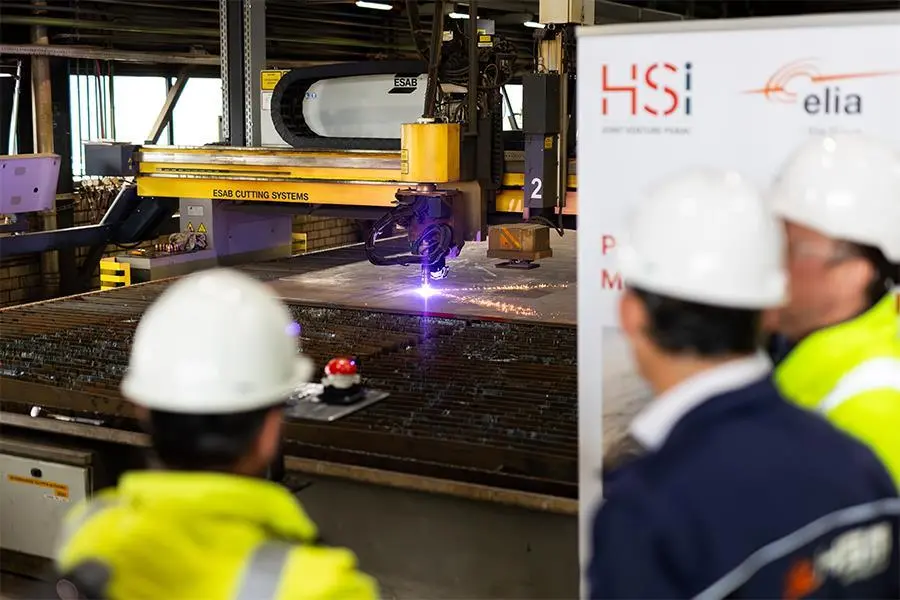
A first steel cut ceremony at HSM Offshore Energy’s yard in Schiedam, the Netherlands, has signalled the start of HVAC works for the Princess Elisabeth Island – the world’s first artificial energy island located 45 km off the Belgian coast.
“The start of the construction of the island’s HVAC infrastructure shows that the project is progressing steadily—even as we adapt its next phase in line with new market realities,” said Frédéric Dunon, CEO of Elia Transmission Belgium.
“Elia remains fully committed to delivering Belgium’s offshore energy hub that will strengthen our country’s future electricity supply.”
Cornerstone project
When completed, the hub will channel at least 2.1 GW of offshore wind energy to the mainland and is seen as a cornerstone in Europe’s energy transition and Belgium’s electrification strategy.
The HVAC modules – including substations and a facility module – are being built by the HSI Pemac consortium (HSM Offshore Energy, Smulders and Iv-Offshore & Energy) under an EPCIC contract awarded by Elia.
Engineering and prefabrication are split between Belgian and Dutch sites, with final assembly due to take place in Schiedam and Vlissingen.
The complete HVAC infrastructure will include 330 km of 220 kV subsea cables, enabling high-capacity transmission of offshore wind power.
This milestone comes just weeks after Belgium’s government announced a revised, cost-conscious strategy for the hub’s HVDC phase.
Work has been going ahead on the energy hub despite unresolved issues with rising HVDC infrastructure prices which many speculate may cause at least three years’ delay in project completion.