





New concrete substructure certified for floating wind
DNV has certified the concept for a floating concrete substructure for offshore wind by German developer BayWa r.e.
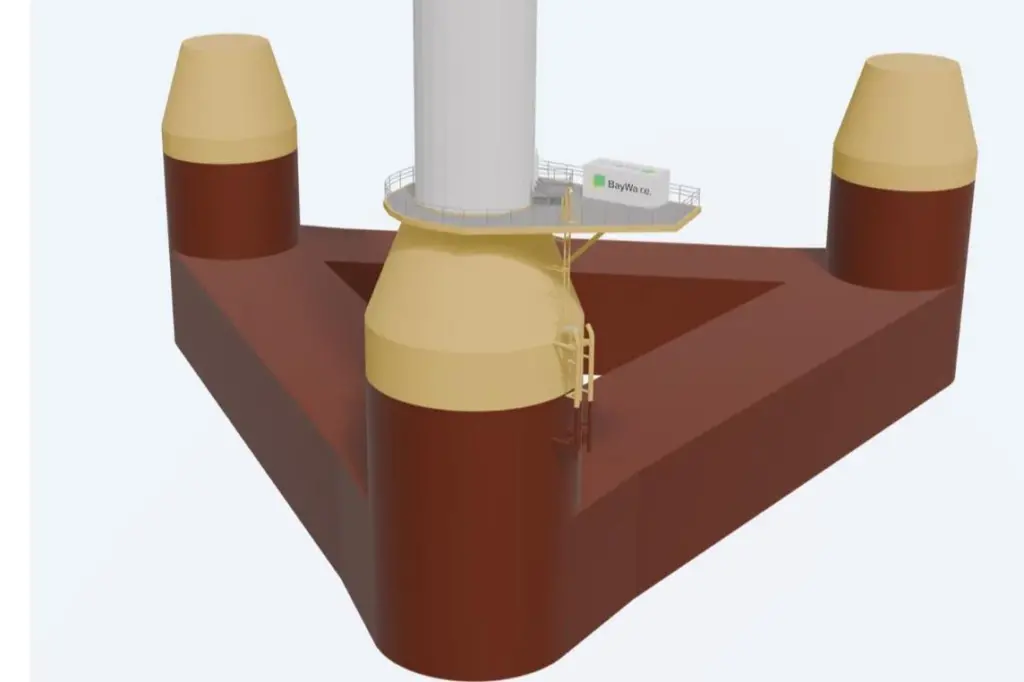
The company has so far not released any further details of the BayFloat structure, other than calling it a ’ground-breaking floating wind semi-submersible concrete substructure and mooring system design’, which has been validated using a 22MW ‘generic reference turbine’.
The company says floating wind is ‘a viable solution for harnessing wind energy in deep waters where traditional fixed-bottom turbines are not feasible’, and it says the concept has been co-designed with civil engineering firm Ramboll.
“We are thrilled to have received concept certification from DNV. This milestone is a testament to the hard work and dedication of our team and our engineering consultant, Ramboll, who supported us in progressing our original patented concept through its development and optimization,” said Ricardo Rocha, Technical director Offshore Wind.
“The certification not only validates the maturity of BayWa r.e.’s proprietary floating wind turbine substructure concept, BayFloat, but also demonstrates its readiness for industrial-scale deployment. It further underscores BayFloat’s potential for project-specific optimisation, enabling adaptation to existing port infrastructure and locally available supply chains in a cost-efficient manner.”
The certification is being treated as a significant milestone in the development of BayWa r.e.’s floating technology, and the next step will be to build and monitor a reduced scale version of the structure to demonstrate the design’s ‘constructability and industrialisation’, paving the way for large-scale deployment.
Citing a report by Renewable UK, BayWa r.e. says the global pipeline for floating offshore wind had grown to 266GW by the end of last year.
Related Articles
 MARINE CONSTRUCTION
 MARINE CONSTRUCTION
 MARINE CONSTRUCTION