

Shrinking sea: Europe’s marine engineers called in to save Caspian ports
While ports around the world prepare for rising sea levels, those on the shores of the Caspian Sea face precisely the opposite challenge.
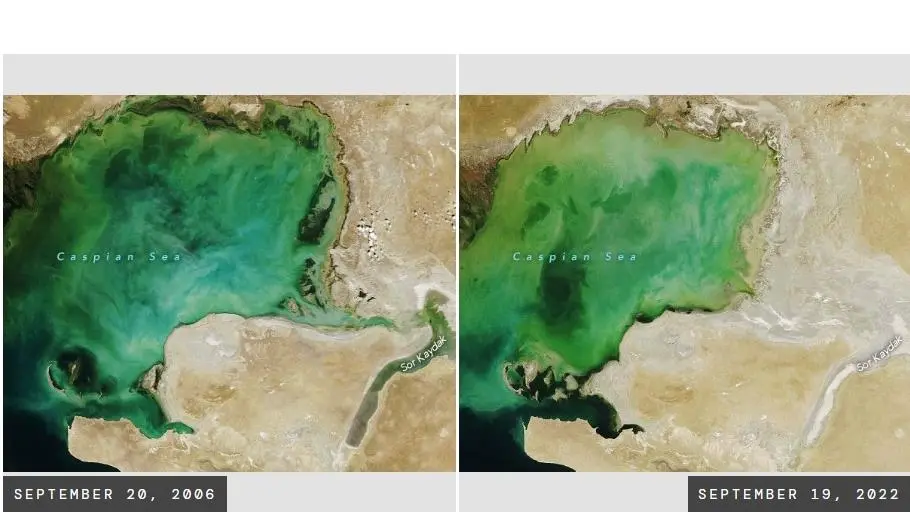
Satellite observations from NASA show that the Caspian has been shrinking steadily since the mid-1990s, with rising temperatures increasing evaporation from the world’s largest enclosed body of water. Because the northern Caspian is exceptionally shallow, even relatively modest falls in water level expose vast areas of seabed, reduce navigable depths and force ports to adapt.
Maintaining navigable ports is becoming one of the region’s biggest engineering challenges – especially with the ongoing development of the so-called ‘Middle Corridor’, a railway line that links China to the European rail network with a 500km ferry crossing across the Caspian Sea at its heart.
Every container travelling between Kazakhstan and Azerbaijan must cross the Caspian by sea, making the region’s ports and ferry terminals the corridor’s critical bottlenecks.
As water levels fall, maintaining navigable channels through dredging and hydrographic survey is not just a local maintenance issue but a prerequisite for one of Europe’s emerging trade routes.
European response
European expertise is already influencing the Caspian’s port adaptation programme, from Belgian dredging contractor Jan De Nul’s work at Kuryk to Dutch engineering and shipbuilding input at the Port of Baku.
Belgium’s Jan De Nul was awarded a design-and-build contract by Kazakhstan to deepen Kuryk Port’s terminals, turning basin and access channel. According to the Paris-based Organisation for Economic Co-operation and Development (OECD), the project removed more than 1.7 million m³ of material – much of it hard rock – and increased water depths to 8.5 metres, restoring the ability of vessels to sail fully laden.
Also in Kazakhstan and one of the region’s principal commercial ports, Aktau is planning extensive dredging alongside berth improvements and hydrographic surveys. Government planning documents indicate that projected dredging volumes have increased following revised forecasts of future Caspian water levels, illustrating how climate projections are now influencing engineering design and project budgets.
In Azerbaijan, the Port of Baku is actually at Alat, around 70km south-west of the capital Baku, where it serves as the country’s principal maritime gateway on the Caspian Sea and a key hub on the Middle Corridor.
Designed by Dutch engineering consultancy Royal HaskoningDHV, the purpose-built port has been developed in phases to accommodate growing freight volumes while providing room for future expansion.
Alongside increasing capacity, maintaining navigable depths has become an equally pressing priority. The port has announced dredging of its approach channel, turning basin and berth pockets as part of wider expansion works aimed at increasing annual container handling capacity from 150,000 TEU to 260,000 TEU.
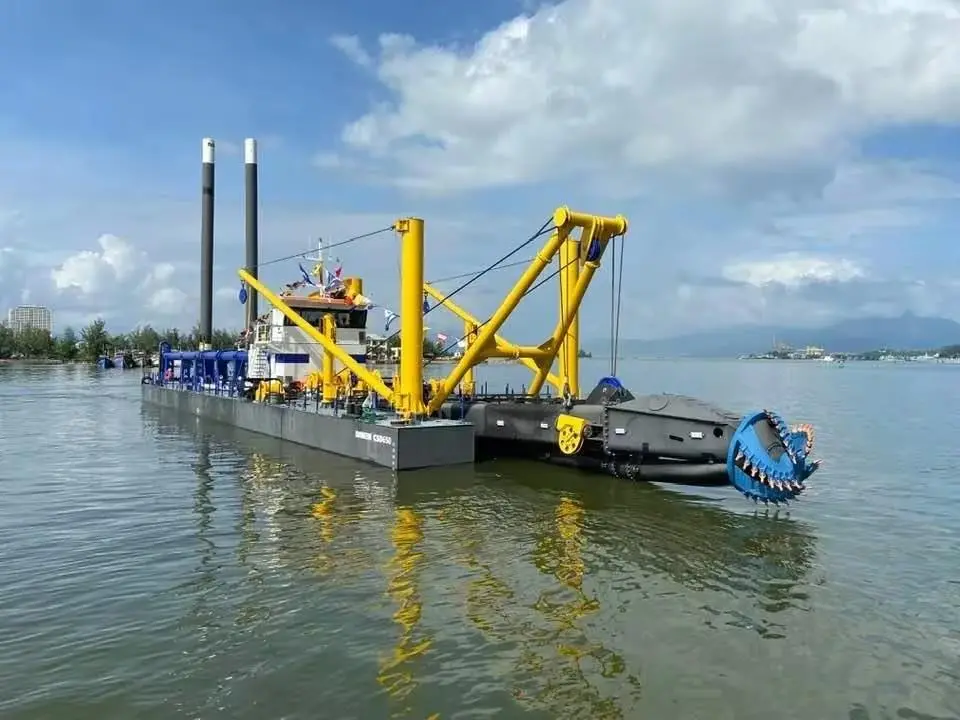
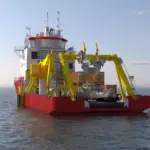
To strengthen its dredging capability, the port had a tripartite agreement with Baku Shipyard and Dutch shipbuilder Damen to build the cutter suction dredger Engineer Soltan Kazimov for the works needed, the first dredger of its type to be built in Azerbaijan using a Damen design.
The port describes the vessel as having “strategic importance in addressing navigational challenges caused by the lowering of the Caspian Sea level.”
Nearby, the Dubendi Oil Terminal completed a campaign removing more than 250,000m³ of sediment during 2024 to maintain tanker access.
Landlocked
Unlike the world’s oceans, the Caspian is a landlocked inland sea. Its water level is governed by the balance between river inflows – principally the Volga – rainfall and evaporation rather than global sea level.
While global sea levels are reported as rising, the Caspian has been retreating for almost three decades.
NASA’s satellite data shows significant shoreline retreat across the shallow northern basin, where areas that were once navigable are now dry land. Azerbaijani officials estimate the sea has fallen by around 2.5 metres over the past 30 years, while Azerbaijan President Ilham Aliyev has described the situation as ‘catastrophic’ because of its implications for ports, offshore energy infrastructure and coastal communities.
European expertise on the waterfront
Also working across the Caspian ports is the Organization for Security and Co-operation in Europe (OSCE), a 57-nation intergovernmental body that has set up a Promoting Green Ports and Connectivity in the Caspian Region programme, part of which will be delivered by the Italian firm RINA and Hamburg Port Consulting (HPC).
Originally set up to improve the efficiency and sustainability of ports along the Middle Corridor, the programme has increasingly had to confront the more fundamental challenge of how to keep Caspian ports operational because of the falling water levels.
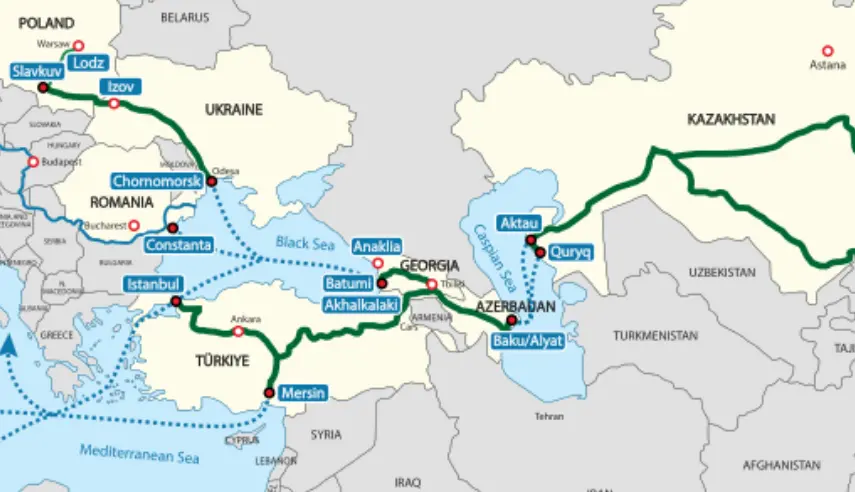
The OSCE programme covers five ports along the Middle Corridor, but the most immediate engineering challenges are concentrated at the four Caspian ports of Baku, Aktau, Kuryk and Turkmenbashi.
The appointments of RINA and Hamburg Port Consulting reflect growing demand for specialist expertise in helping ports understand how changing environmental conditions will affect future operations.
The project includes climate risk assessments, renewable energy studies, environmental monitoring, digital twins and institutional development, but many of these activities ultimately support practical engineering decisions.
Digital twins can model navigation channels and vessel movements under changing water levels. Environmental monitoring informs dredging strategies and sediment management. Climate modelling helps determine how port layouts, berths and access channels may need to evolve over coming decades.
A growing opportunity for marine engineering
The Caspian may be geographically distant from Europe, but its engineering challenges are becoming increasingly relevant to European marine contractors, consultants and survey companies.
Maintaining navigation channels, redesigning port infrastructure and undertaking ever more sophisticated hydrographic surveys are all disciplines in which European companies have decades of experience.
If water levels continue to decline, the region is likely to require sustained programmes of maintenance dredging, bathymetric surveying, sediment management and infrastructure adaptation.
For contractors, that represents a significant long-term market. The Caspian Sea is also an example of how a changing climate does not produce the same engineering problem everywhere.
Related Articles
 OTHER NEWS
 MARINE CONSTRUCTION
 MARINE CONSTRUCTION