![MaritimeJournal[Seawork]](https://www.maritimejournal.com/wp-content/uploads/2026/09/MaritimeJournalSeawork.svg)






VIDEO: Advisor hired for world’s first ship tunnel
Technical advisors have been signed up to work on Norway’s plans to build the first ship tunnel in the world.
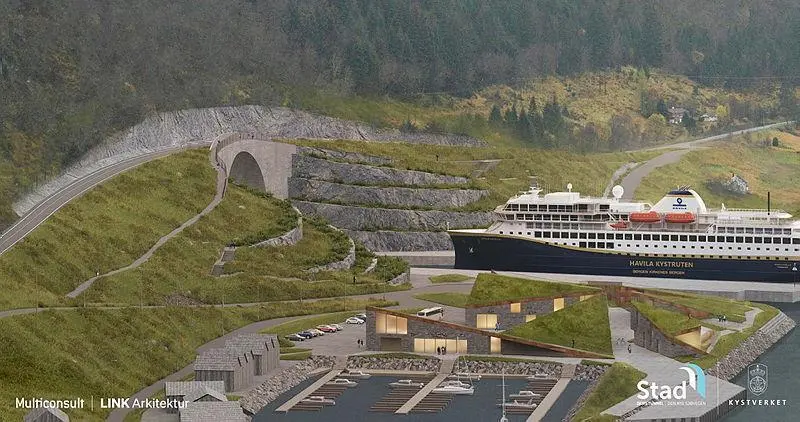
The Norwegian Coastal Administration has contracted COWI, a Danish consultancy, to ‘be an important technical partner in the process of procuring and constructing the world’s ship tunnel’, says project manager Terje Skjeppestad, Norwegian Coastal Administration.
It is the first successful tender announced for the €195 million project, which was first considered some 150 years ago, in 1874.
The Stad peninsula, or Stadlandet, sticks out into a harsh, windy stetch of sea that sits where the North Sea ends and the Norwegian Sea begins.
It is the only peninsula between Stavanger and Honningsvåg that goes out into open sea without any archipelago to break waves, and as such has been the site of countless shipwrecks and fatalities over the years, in 1594 recording 15 sinkings with up to 600 deaths.
The waters are so challenging that seafarers have been known to pull their vessels 4.5km over the peninsula on land, climbing 240m high mountains using timber logs, rather than risk the ocean route.
Tunnel works
To create a safe passage for ships in the region, designers selected one of three options – a tunnel at the narrowest point of the peninsula that will be blasted out of mountain along a length of 1.7 kilometres.

“A tunnel was selected for this new route in preference to a normal canal because the route had to pass through 300-metre mountains which would have made a canal impossible,” said Stad Ship Tunnel Project Manager Terje Andreassen.
The tunnel, between the Moldefjord and Kjødepollen, will have a water surface width of 26.5 metres and height of 50 metres, allowing larger vessels to safely navigate past Stadlandet.
“The tunnel will be constructed first by drilling horizontally and using explosives to dig out the roof section of the tunnel,” say the project developers. “Once the roof has been secured with bolts and anchors and Shotcrete applied, the rest of the tunnel will be dug out to a level of 12 metres below sea level with rock dams holding back the water.”
The stone blasted from the mountain in digging the tunnel – estimated to be about 5.4 million cubic metres’ worth – will be used to build piers and commercial areas around the tunnel entrances, and other facilities in the region.
Architecture and design firm Snøhetta has designed the entrances, and the company’s early plans for the tunnel show sculpted tunnel openings and a bright LED lighting system for the tunnel interior.
“We have previously served as the design lead on the world’s longest suspension bridge,” said COWI project leader Espen Viddal. “Projects that are the longest, largest and first of their kind are something that excites us and that we want to be a part of.
“We have the experience and expertise, especially in tunnel operation and rock caverns, which we believe aligns well with the Stad Ship Tunnel project.”
Construction of the Stad Ship Tunnel will begin next year, with hopes of completion in 2030.
Related Articles
 INDUSTRY NEWS
 MARINE CIVILS
 MARINE CIVILS