


Milestone reached in engineering project
New engineering methods are being used to cut costs and provide safer navigation. The developments have come about through collaboration between aids to navigation supplier Hydrosphere and ABP Southampton which manages and maintains the navigation lights and buoys in Southampton Water, UK and its approaches.
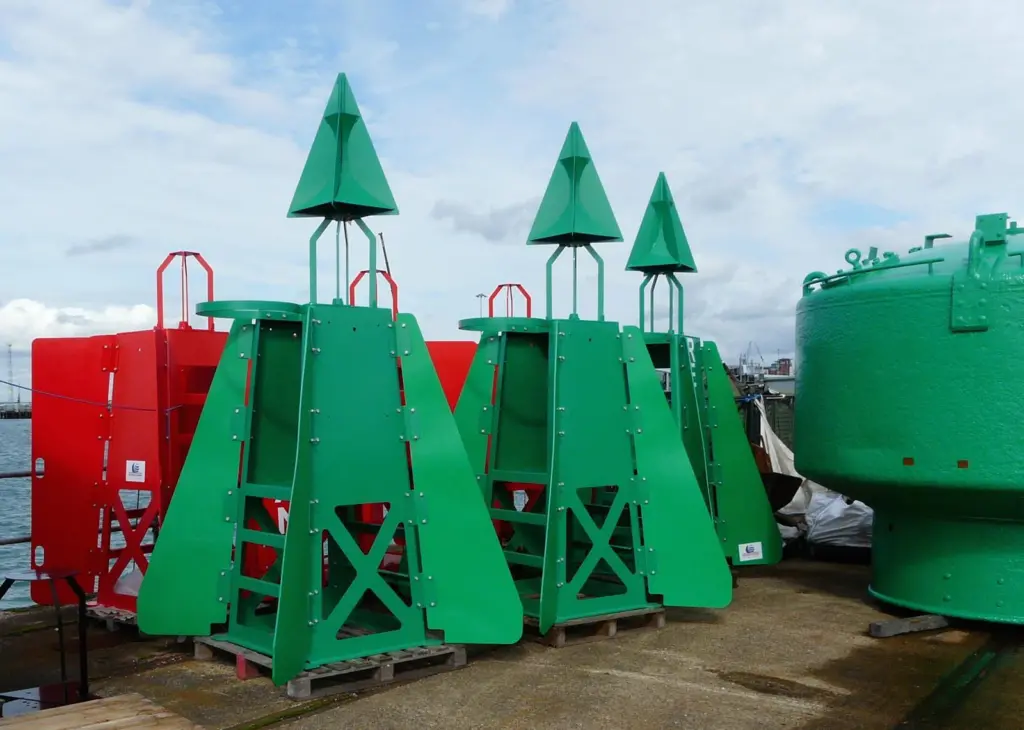
“Many of the buoys are made of steel and are getting a little old. ABP has been patching them up and gradually moving over to plastic buoys,” explained Hydrosphere director Andy Reid.
“So far we’ve supplied more than half a dozen complete buoys. We were also asked if we could supply just the upper section to fit onto refurbished steel hulls.”
This principle has been used on several navigational aids including the Calshot Spit light float which had its original base refurbished with a new superstructure supplied by Hydrosphere.
“We’re gradually adapting all our buoys when we get funding,” explained Maik Weidt, Port Hydrographer at ABP Southampton. It’s a new strategy from us to refurbish the buoys. The old superstructure is being cut off and a new superstructure put on. The design has been amended by us, it’s been a very interesting engineering project.”
“Where the hull is in a good condition, we’ve put on more visible daymarks,” added Mr Reid. “We’ve used a marine grade aluminium for the superstructure which is lighter and easier to handle.”
Being able to replace the top section has had many benefits for ABP including financial, saving the organisation around £12,000 a buoy, explained Mr Weidt.
“It’s had a great impact for us and has been driven by cost-savings. It’s been a collaborative effort,” he said.
All the new buoys and superstructures use the latest technology and require less maintenance than the ones they are replacing. In repainting terms alone, the new buoys will save ABP vast amounts of time and money – the steel hulls required repainting every four years and the new polyethylene buoys will maintain their colour for 15 years in British latitudes.
They are also lighter in weight – the old buoys weighed around eight tonnes, the new ones are around three tonnes.
Solar powered self-contained lanterns have replaced the older battery pack systems; the new buoys also have anti skid decks, cages, handholds and safety hoops for harnesses.
“A variety of the buoys have been replaced. We’re improving the visibility and safety of the structures,” explained Mr Weidt. “There are 48 buoys in total and we’re half-way through our improvement programme; we’ve reached a milestone. It’s a multi-year project.”
By Katina Read
Related Articles
 VESSELS
 MARINE CONSTRUCTION
 VESSELS