![MaritimeJournal[Seawork]](https://www.maritimejournal.com/wp-content/uploads/2026/09/MaritimeJournalSeawork.svg)


Navaids light first floating wind turbine
Tideland Signal has supplied Norway’s Statoil ASA with a comprehensive package of aids to navigation to warn shipping in the vicinity of its revolutionary Hywind floating wind turbine.
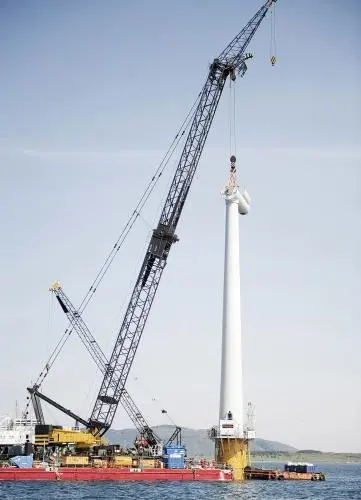
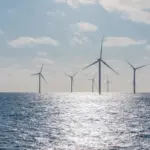
Hywind, the world’s first full scale floating wind turbine designed for deployment offshore, is part of a 400m NOK project. It features a 2.3MW Siemens turbine with three blades of 80m diameter, mounted on a spar buoy. It can be located in waters ranging from 120m to 700m depth in order to take advantage of optimum wind and environmental conditions, also obviating the need for foundations, which are extremely expensive at depths greater than 30m to 50m.
The structure is based the proven technology of a concrete semi-submersible, familiar in offshore oil and gas installations around the world. The tower, rising to 65m above sea level, is marked by three Tideland MLED-155 Syncrolan, single-lift light stations, each with a range of 5 NM. They are mounted on stainless steel pedestals at 120° intervals around the circumference of the tower at a height of 15m and are quipped with 48 hour battery back-up.
Tideland’s MLED-155 is designed for use with an external power source, in this case solar, and offers minimal maintenance requirements and a service life of seven years on station in the most demanding environments. Long-life LEDs and high integrity electronics housed in a tough UV resistant polycarbonate enclosure ensure that lantern will not need to be opened during its service life and, when buoy mounted, will even withstand being submerged in salt water.
In the Hywind application, it is fitted with a yellow MaxiHalo 60 multi-code LED flasher, sunswitch and onboard GPS to synchronize the flash code.
Hywind was assembled at Åmøyfjorden near Stavanger and is located 10 km offshore from Karmøy. The two year test programme, which feeds electricity into Norway’s national grid via a submarine power line, is designed to prove the concept of capturing wind energy in deepwater environments and to test how wind and waves affect the structure.
The floater, built by Technip, consists of a steel cylinder filled with a ballast of water and rocks. It extends 100m beneath the seas surface and is attached to the seabed by a three point mooring spread.
Related Articles
 VESSELS
 MARINE CONSTRUCTION
 VESSELS