




Nearshore wireline CPT
Wireline Cone Penetration Testing has proven itself in deep offshore investigations but according to Kim Hodgson, nearshore projects manager at Lankelma (a UK-based wireline CPT specialist), this investigation technology has also been shown to be a viable alternative to traditional top-push techniques for nearshore projects.
While wireline downhole Cone Penetration Testing (CPT) systems have proved popular for deep water investigations, when it comes to nearshore projects, contractors tend to opt for land-based top-push CPT rigs deployed on jack-up platforms or shallow water vessels.
The reasons are clear: top-push equipment, methodology and the data produced are familiar to engineers, operatives and clients and it is relatively simple matter to adapt the approach for overwater investigations. However, downhole CPT systems can deliver data to a high quality similar to that obtained by top-push and, in some cases, at double the production rate, claims Hodgson.
Traditionally, nearshore investigations involve drilling a conventional borehole to take samples and SPTs, with a CPT carried out within a metre or so of each borehole location. Multi-purpose downhole tools mean testing and sampling can be carried out in the same borehole, allowing SPTs to be replaced by the more accurate and detailed CPT. If required, the CPT data can be converted back to a SPT n value, although it should be noted that CPT data can be used directly in design.
Overall, this means downhole systems are far quicker than top-push in deep boreholes (more than 30m), with production rates of up to 40m a day – double that of top-push – and show a marked improvement over top-push in being able to cope with harder, more variable geology. So, while technique is perhaps more expensive, the additional costs are far outweighed by the savings achieved in shortening investigation programmes.
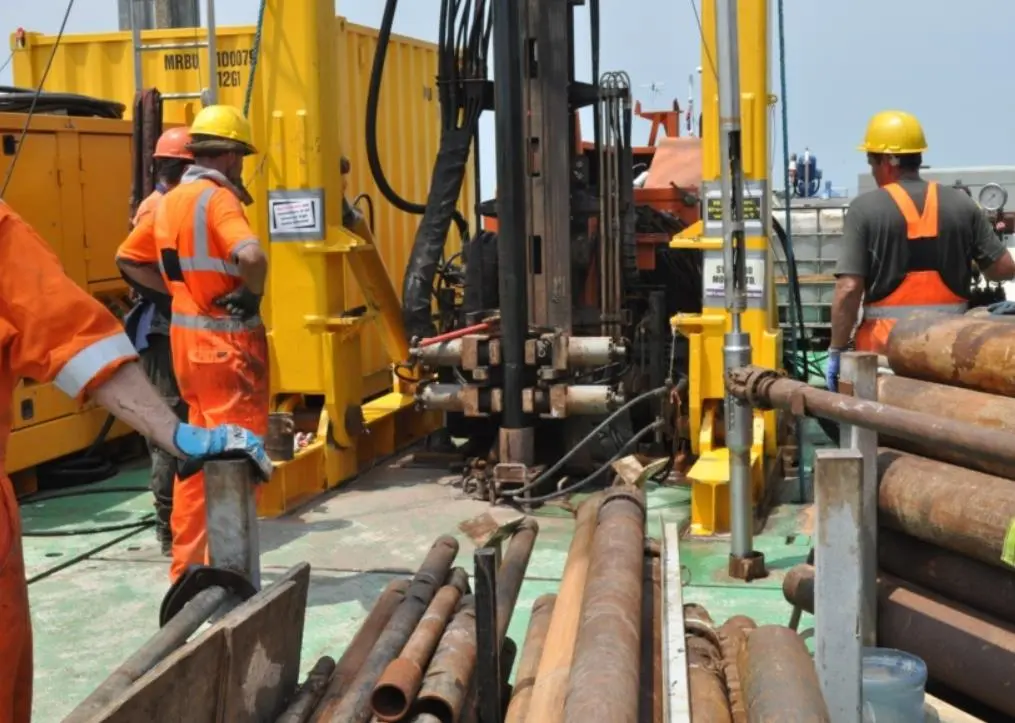
Over the past couple of years, Lankelma has been developing and trialling a new downhole CPT system that can carry out testing and sampling in conjunction with rotary coring from fixed jack-up platforms. The Wison-APB system, suitable for both offshore and nearshore investigations, and its specially-designed 15m high derrick, can be disassembled to fit inside a standard 40ft (12.2m) shipping container.
A major challenge when carrying out CPT over water is that marine sedimentary sequences, in particular, tend to comprise very soft alluvium overlying highly variable materials of differing strength, including rock strata.
The upper soft material does not give sufficient lateral support to prevent rods bending in a top-push system. If a hard layer is encountered, then the entire drill string needs to be withdrawn and the supporting casing advanced by drilling before running the CPT rods back to the base of the hole. This is particularly time consuming at greater depths. Top-push CPT also often requires the installation of two sets of casing through the water to the sea, river or lake bed to ensure that the rods are not affected by water flow.
On the other hand, as downhole systems are deployed through a single drill string, set-up times are significantly reduced. The tool is simply lowered into the borehole via an umbilical cable (including data exchange cabling) with an electrical constant tension winch and carries out the test. And, if hard layers are encountered, the tool can be withdrawn quickly to allow drilling or coring.
The entire operation is controlled from topside and, as with top push CPT, viewable in real time on deck by the engineer.
The ability to withdraw the downhole tool quickly minimises downtime in the event of a breakdown and makes it easier to check, maintain and replace CPT cones, improving data quality. In fact, data quality in downhole systems is comparable to top-push. Even though the test is not continuous, tests can overlap to gather continuous data for the entire investigation depth.
The Wison-APB system was used alongside top-push CPT with great success on a major nearshore investigation in Venezuela last year, giving Lankelma the opportunity to compare the performance of the techniques.
The 10.8km Puente Nigale will be the second crossing of Lake Maracaibo, Venezuela’s largest lake. The road and rail link, between Santa Cruz de Mara and Punta de Palmas, is being built by Brazilian contractor Odebrecht and was designed by consultant Cowi.
Lankelma, working for Venezuelan engineering consultant and contractor Geohidra, carried out CPTs and sampling up to 10km offshore in 10m to 15m of water, reaching a maximum depth of 70m in the underlying mudstone. Results will be used in the design of the bridge foundations.
Lankelma completed 60 boreholes, including 1,150m of CPT (555m using top-push and 595m with the Wison downhole system). Investigations were carried out from the company’s jack-up platform Sandpiper, using the Wison-APB system and a Dando 9000 Multitech drilling rig with Geobor S rotary coring system.
Lankelma claims the average metreage rate achieved by the downhole system was about 50% higher than the top-push CPT on boreholes over 40m deep. The maximum rate achieved by the downhole system was 16% higher than the highest achieved by the top-push CPT.
While this is a relatively small data sample and clearly ground conditions, weather, equipment and operative performance all have an effect on production rates, the results of the Venezuela investigation demonstrate that, given the right conditions, downhole CPT can achieve metreage rates nearly double those of top-push.
The development of reliable and accurate wireline downhole CPT equipment for nearshore ground investigations offers many advantages for these challenging projects. Not only can this approach produce high resolution data for use in modelling and design, claims Lankelma, but it also provides an effective way to test highly variable ground much more effectively (and much faster) than traditional top-push CPT.
By Jake Frith
Related Articles
 ACCESSORIES & EQUIPMENT
 MARINE CIVILS
 MARINE CIVILS