New RAstar tugs join Milford Haven tug fleet
Svitzer’ s new tug fleet, being formed to serve the entire needs of the new LNG terminals and existing oil berths at Milford Haven in Wales is rapidly taking shape. Once fully commissioned the fleet will include nine brand new tugs and six new line handling vessels, making it one of the largest and most powerful tanker handling fleets in the world.
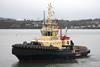
At the end of 2008 the project took several major steps forward with the arrival of four new tugs and the opening of new headquarters facilities in Pembroke Dock.At the heart of the new fleet are six RAstar Class high performance terminal/escort tugs built to a unique design from the well known Canadian design team Robert Allan Ltd. All six tugs were ordered from Freire Construcciones Navales of Vigo, Spain and to date three have been delivered. The first to arrive, Svitzer Waterston, arrived during the summer months but was unfortunately damaged in a grounding incident and is still undergoing repairs. A sister ship, Svitzer Lindsway, arrived late in November and the largest of the fleet, the Svitzer Kilroom, in mid-December.
The contract with Freire comprised six vessels built to two distinct RAstar designs, five 34m RAstar 3400 Class and one 39m RAstar 3900. Due to differences in major machinery and performance requirements there are also two machinery variants in the 34m tugs. Three will have General Electric main engines, Schottel propulsion units, and a minimum bollard pull of 92 tons. The remaining pair has Niigata engines, Z-Peller propulsion units, and a minimum bollard pull of 80 tons. The most powerful vessel is the 39m tug Svitzer Kilroom, which has the same basic General Electric/Schottel machinery but rated to achieve a bollard pull of at least 112 tons.
The RAstar design represents a truly unique development in offshore tugs. A highly developed hull form incorporates a significant outward flare (or sponson) on the sides of the upper hull. When the tug is heeled over under the influence of towline forces during an escort operation, the ‘downhill’ sponson is submerged and a large righting force is generated to improve the stability, thus increasing the towline force. In addition, the hull has a large foil shaped skeg, also designed to provide increased indirect forces. Although these hull and appendage design features were initially developed to provide increased escort performance, the seakeeping characteristics have also, fortuitously, shown very significant improvements over more conventional hull forms. The RAstar hull form also provides dramatic reductions in roll amplitude and roll accelerations, thus providing a much safer and more comfortable platform for crews, who are now being asked to conduct docking operations at LNG terminals and similar installations in sea states of up to 3m significant wave heights. Extensive model tests indicate that the roll accelerations of a RAstar hull are about 60% lower than in a typical hull form.
Maritime Journal was invited to visit Svitzer Lindsway, the second RAstar to arrive, and see the new facilities opened by Svitzer in Pembroke Dock. Among the first impressions when going onboard was the massive beam and careful attention to detail. The RAstar 3400 tugs have an overall length of 34m, a moulded beam of 14.50m and a maximum operating draft of 6.55m (to the underside of the propulsion units). Svitzer Lindsway is built in accordance with Lloyd’s Register of Shipping requirements for a Lloyd’s X 100A1 Escort Tug, Fire Fighting Ship 1 (2400M3/hr) with water spray, XLMC, UMS, 1BS, NAV1 notation.
The tug has a raised foredeck and a very large, clear, afterdeck. Towing bits and a quick release tow hook are fitted but only the 39m Svitzer Kilroom has a winch aft. There is sufficient space and the deck is strengthened to enable a towing winch to be retro fitted if required. It is interesting to note that many of the features that have proved popular aboard the highly successful RAmparts 3200 class from Robert Allan have been incorporated in this new design. The fendering is a good example. Particular attention has been paid to the bow and forward shoulders where protection is required during push-pull operations. A water spray lubrication system is fitted to prevent friction damage to the bow fender and make relocation easier while ‘pushing on’.
A Rolls Royce Marine towing winch (TW 2250/850/AW 22U2 H), combined with an anchor windlass is located on the fore deck, with a capacity for 250m of 76 mm diameter high performance fibre towline. The four speed winch incorporates the render and recover facilities required for escort work and can be controlled from the deck or in the wheelhouse. A touch screen display enables line tension and length to be preset by the tugmaster.
Svitzer Lindsway has a pair of General Electric GE 7FDM 16 engines generating a total of 7,880 bhp (2 x 2,900kW) at 1,000rpm (MCR). Power is transmitted to Schottel SRP 3030 CP fully steerable propulsion units incorporating controllable pitch propellers. This installation gives the tug a bollard pull of well over 100 tons pulling ahead and an almost identical figure pulling astern (exceeding the contractural 92 tons by about 10%), with a maximum free running speed of 13.7 knots at 85% MCR.
Auxiliary power is provided by a pair of Cummins gensets, each rated 180 kW and a smaller 40 kW harbour set enclosed in a sound proof casing.
The FiFi 1 fire fighting capability is provided by a pair of main engine driven pumps, each rated 1,400m3 per hour, which serve a pair of Kvaerner monitors and a self protection waterspray system.
Considerable attention was paid throughout the design process to alleviate the propagation of noise and vibration. This includes the essential resilient mounting of the main engines, isolation of all exhaust system components and the extensive use of visco-elastic floating floors throughout. The shipyard executed all these requirements exceptionally well, and the reward is an extremely quiet ship throughout, as indicated by the following noise level results at full power: wheelhouse – 62 dBA and crew cabins – 57 to 59 dBA.
The wheelhouse is designed to provide maximum all round visibility from a single split type master console. A comprehensive navigational and communications outfit is installed, meeting the standards for GMDSS Area A3.
The accommodation is to a very high standard for a crew of potentially up to ten persons. Two spacious officers’ cabins are located on the main deck, each with private en-suite facilities, and below decks are four double cabins, two of which also have private en-suite facilities. The fully equipped galley serves a large common lounge/mess area.
Also arriving in Milford Haven were the first two of a trio of Svitzer ‘Stretched M’ or ‘Wick’ class tugs constructed in China by the Qingdao Qianin Shipyard. Named Gelliswick and Musselwick, the 33.4m, 80 tons bollard pull tugs had only just arrived at the time of the MJ visit and were in the process of being ‘tidied up’ after an arduous delivery voyage made longer by the need to choose a route avoiding piracy problems in the Gulf of Aden. A third Niigata powered tug of the same type, the Watwick, will arrive shortly.
Once the new fleet is complete the tugs will be deployed as follows; Svitzer Kilroom and Svitzer Lindsway and all three ‘Wick’ class vessels will be dedicated to the South Hook LNG terminal. Svitzer Waterston will become the dedicated escort tug for the Dragon LNG terminal supported by the Svitzer Caldy, Svitzer Romsey and Svitzer Haven. The last named trio will also be used to provide towage services at the local oil berths.
Svitzer has moved its Milford Haven headquarters to a refurbished office building on the former Royal Maritime Auxiliary Service site in Pembroke Docks. The new facility includes a tug and tanker handling simulator for crew training. A spacious crew mess, wash rooms and lecture facility capable of housing 120 persons has also been established in a separate building. Once completed, this new base will also include mooring and maintenance facilities for the new fleet, including the six newly built line handling boats.