![MaritimeJournal[Seawork]](https://www.maritimejournal.com/wp-content/uploads/2026/09/MaritimeJournalSeawork.svg)






New SSAS Cures Maritime Security Headache
The Tracs-Ships Security Alert System (SSAS) launched by Thales Navigation Ltd has overcome a major problem being faced by port authorities world-wide. The unit is based on a Thales Inmarsat-C tracking unit that has been refined to exceed the IMO specifications for SSAS units. As a result, the Tracs-SSAS introduces a unique feature that can provide land-based security organisations with ship movement information that has been unobtainable until now.
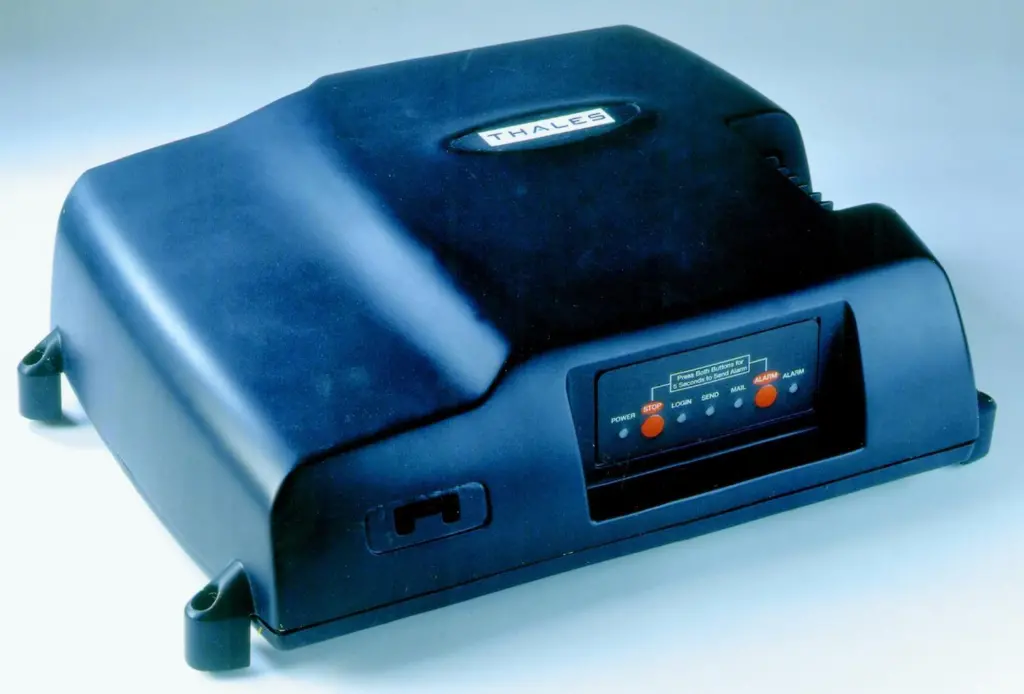
The SSAS specifications have been created by the International Maritime Organisation to help protect seafarers and their vessels against piracy and acts of terrorism. Between July and December 2004 all SOLAS registered vessels must be fitted with a SSAS unit that automatically transmits an alarm message via Inmarsat-C from anywhere in the world when a button is pressed. Once activated, the Thales SSAS unit will continue to transmit the vessel’s GPS location so that it can be tracked and, hopefully, intercepted by the security authorities.
The Thales Tracs-SSAS exceeds these capabilities by tracking and storing the vessel’s location continuously regardless of whether an alarm button has been pressed. As with conventional SSAS units, the vessel location information will only be transmitted to the designated authority when it has been activated. However, the stored information can be called-up and made available to the shipping company for its own management purposes and, more significantly, it can also be called-up by a Coast Guard or security organisation wanting to verify the ship’s port of origin.
The Tracs-SSAS unit functions continuously without any operator input and maintains a continuous record of the ship’s position and speed for up to two years. The download facility now means that a port authority can check the previous activity of a visiting ship without requiring any input from its crew or even their knowledge that it is happening.
This information has not been available to port authorities until now even though it is regarded as being crucial to verifying the security status of a visiting ship.
Deviations from predicted route, unusual changes in speed and other forms of erratic behaviour revealed by the data will draw the attention of the interrogating security authority and highlight the ship as a target for closer investigation.
Although considerable optimism is being placed upon the introduction of the Automatic Identification System (AIS) by the end of 2004, it is widely expected to prove ineffective as an aid to national security.
Designed as an anti-collision device, the AIS does not contain any record of the ship’s movements prior to its activation by another interrogating AIS unit. It may declare a port of origin but this could be difficult to verify and give no indication of the route taken after departure.
The only equipment capable of providing a record of sailing activity has, until now, been the Voyage Data Recorder.
These expensive installations are becoming widely used with the installation timetable due for completion at the beginning of 2004. They store very large amounts of data relating to all aspects of the ship’s operation and although some models offer the capability of remote data downloading for in-house management or training purposes, the volume of information supplied far exceeds the requirements of a port security officer.
The Tracs-SSAS is most likely to be used in conjunction with the ship’s AIS which will provide the first contact with the port’s shore-based security.
The identification data provided by the AIS will enable the port controllers to decide whether additional information is required from the ship and to download route data from the Tracs-SSAS if necessary.
MJ Information No: 18728
Related Articles
 ACCESSORIES & EQUIPMENT
 ACCESSORIES & EQUIPMENT
 OTHER NEWS