




New vessel, new yard, new technology
“To start with we went to our commercial marine boatbuilders and asked them to forget what they were doing today, but rather what they wanted to achieve,” said Martin Jackson of Marine Industrial Transmissions (MIT).
“Without fail all of them wanted fuel and environmental savings.”
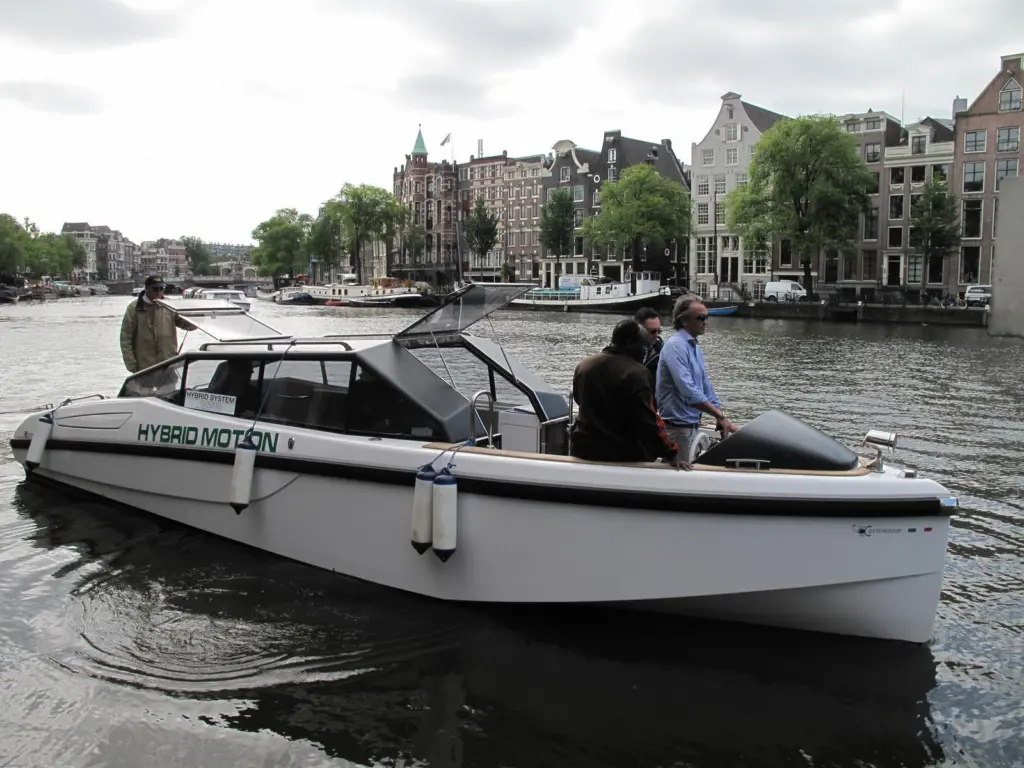
It all came together with the very first Seatech hybrid inland waterways vessel. It’s not just new itself, it’s the launch vessel for the Italian Sea Technologies marine dockyard in Sarnico, Italy and so it’s got something to prove.
This original build is being kept by yard owner Fausto Columbi, a colourful character who has been, in his time, director of the Canteiri Riva yard and founder of the DP Officine Nautiche yard with designs like the DP Open range. However, the 9m, 100 hp model is being aimed at the water taxi, ferry and public utility craft market as it can cut emissions in environmentally sensitive areas.
But Mr Columbi is keeping true to his roots and rather than the less hydrodynamic and squarer hulls often found on inland vessels it’s got an extremely modern keel that reduces wave movement, having a fine nose coupled with an extremely deep chine.
However, it’s down inside the hull that the real magic happens. MIT and Transfluid have worked together for around two decades and Mr Jackson explains the companies had been turning over ideas on marine hybrids for a while. By the time the Seatech build came along, it was obvious there were a lot of efficiency gains that could be tied in “especially since the hybrid system allows for a very flexible power output with diesel-only mode, electric-only mode or both together, with the batteries charging automatically when the engines are running”.
Mr Jackson admits one benefit came as a surprise: “We discovered by pure accident that if you calculate the time that the engines are on full load versus the time spent on partial load, hybrids almost always offer a potential drop in engine size, just because you can run the slightly smaller engines much more efficiently, topping up with a boost from the electric motors when higher power is needed.”
Further, the Transfluid-MIT hybrid system is both very scalable and flexible, allowing for anything from CPPs to waterjets: the company has an eye on the barge, tugboats and cargo vessels “as there’s a big gap in the hybrid market between the 250hp and 1,500hp power ranges”.
Surprisingly, the installation takes up very little room, fitting snugly along the Seatech vessel’s shallow 0.8m hull beneath the deck. The hybrid unit is integrated with the clutch which sits between the Bimotor enhanced FPT S30 diesel engine and MIT’s HTM700 hybrid transmission, with a 20kW electric motor fitting neatly in parallel. Italian Propellers did a lot of work on the shaft and stern gear to bring together the two different propulsion systems in the most effective way, helping to give the boat it’s 12 knot speed under diesel power.
The 100aH battery array, supplied by Kaitek, is of the lithium iron phosphate (LiFePO4) variety, as this kind of chemistry brings together safety and a good performance to cost ratio, having a 3,000 cycle lifespan as well as the ability to take up a fast charge and a fairly forgiving temperature range: the whole being integrated with Kaitek’s own management system which does the important job of balancing the charge in the cells. This array means the boat will run on the electric motors at 6 knots for over two hours.
It does work: the demonstration run around Amsterdam’s waterways started up on diesel, then switched over to electric running: suddenly there was eerie quiet, no noise or vibration came through the floor to show we were still under power – until it carried out a neat manoeuvre around a sightseeing boat.
Finally, just how expensive is it? Martin Jackson admits “you are probably looking at an extra 30% for the system, over a traditional installation” but he adds for some it will be worth it, as although deck space on this vessel is a little short, the others in the range could easily take on deck gear, supported by the hybrid’s ability to run hydraulic pumps and air compressors from an integrated power take off.
By Stevie Knight
Related Articles
 ACCESSORIES & EQUIPMENT
 ELECTRICAL SYSTEMS
 VESSELS