





New wharf for the ‘RRS Sir David Attenborough’
A new wharf has been completed on the Sub Antarctic island of South Georgia partially to accommodate the UK’s brand new polar research vessel.
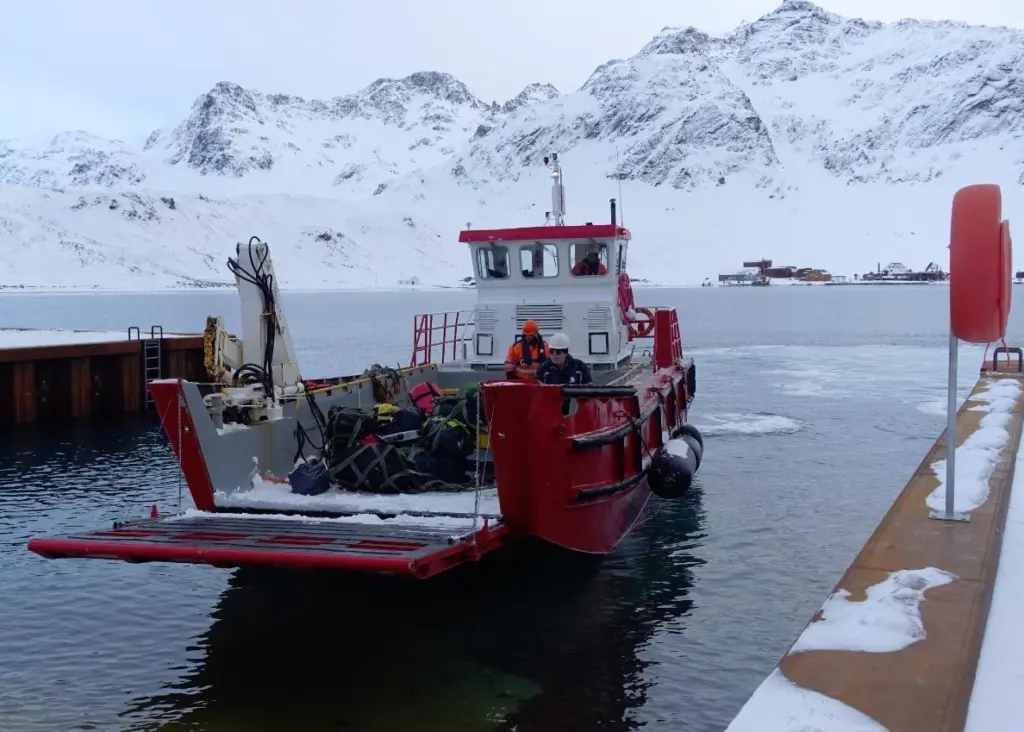
Surrounded by spectacular scenery, dominated by mountains and glaciers, construction has completed on the new £11million wharf, dolphin and slipway to serve the King Edward Point Research Station (KEP).
The new wharf was commissioned by the Natural Environment Research Council (NERC), the Foreign & Commonwealth Office (FCO) and the Government of South Georgia & the South Sandwich Islands (GSGSSI). The sub-Antarctic research station is owned by the GSGSSI and operated on their behalf by British Antarctic Survey (BAS).
The structure was completed on time for Shackleton Day, a special bank holiday in South Georgia. The commemoration marks explorer Ernest Shackleton’s historic 1300km journey in an open boat across the Southern Ocean from Antarctica to South Georgia.
Over two years of meticulous planning meant the wharf was completed in just 108 days – three weeks ahead of schedule. This is a remarkable achievement, as constructing on this sub-Antarctic island means that every nut and bolt had to be sent in a single shipment from the UK. The nearest builders’ merchant is thousands of miles away.
The new wharf represents an essential upgrade to the station’s infrastructure. It enhances both safety and efficiency of ship operations for the new polar research vessel, the RRS Sir David Attenborough and the GSGSSI fisheries patrol vessel, the MV Pharos SG. The expanded capability will ensure that BAS and GSGSSI are able to continue their world-leading interdisciplinary research and monitoring, vital to the sustainable management of this globally important wildlife haven.
Protecting the environment was a key consideration at every stage of the planning and construction process. To minimise the footprint on the seabed, the new wharf was designed as an extension to the pre-existing wharf. A new retaining wall wraps around the former structure. The new mooring platform enables much larger vessels to dock and brings resilience against sudden weather changes. The refined layout maintains safe berthing and mooring operations for vessels up to 130 metres in length. Slipway upgrades facilitate the launching of small boats in a wide variety of tidal conditions.
As Technical Advisor to BAS, Ramboll provided the initial concept design and was onsite to supervise the construction, while BAM developed the detailed designs and constructed the new facility. Turner & Townsend also provided cost management for the project.
To limit weather delay, the team developed innovative solutions such as a bespoke conveyor to backfill the new mooring platform from the shore. The construction also necessitated the close collaboration of a wide range of experts, including a specialist dive team from Marine Civil Solutions; they inspected the seabed, removed obstructions and placed precast concrete slabs and burning sheet piles underwater.
The new wharf and slipway will also be used to operate Government harbour patrol boats, rigid inflatable hull boats, scientific survey boats and workboats
By Jake Frith
Related Articles
 OTHER NEWS
 MARINE CIVILS
 MARINE CONSTRUCTION