![MaritimeJournal[Seawork]](https://www.maritimejournal.com/wp-content/uploads/2026/09/MaritimeJournalSeawork.svg)


Apprentice Watermen take to the sea
On a bright and blustery day in early June, 24 apprentice Watermen took to the lower reaches of the River Thames on a ‘familiarisation’ cruise aboard the Gravesend based pleasure boat Princess Pocahontas.
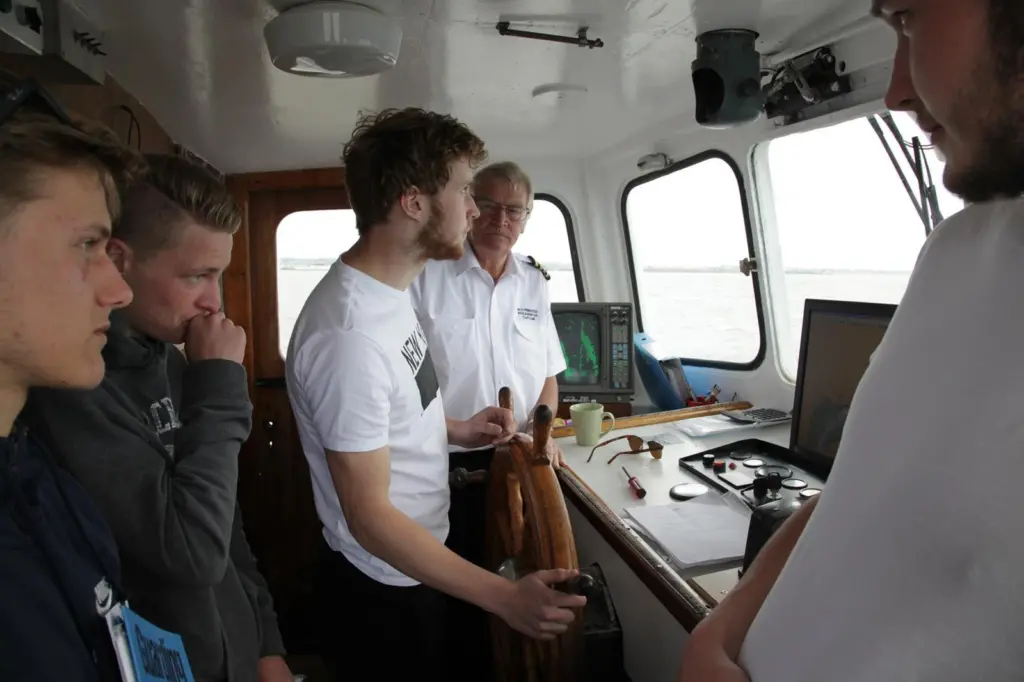
Sailing from Gravesend to Whitstable the youngsters were armed with their Task Record Books and introduced to the basics of Steering by Compass, Chartwork, Rules of the Road and Collision Regs. Organised by the Lighterage Committee of the Company of Watermen and Lightermen, this estuary trip is one of three outings scheduled each year, with others taking in the Lower, Middle and Upper reaches of the London river, along with a river walk during the Richmond lock draw off.
These educational trips are also social events aimed at bringing together people who work in different sectors such as towage and passenger vessels. For this cruise the Princess Pocahontas was kindly supplied on an expenses only basis by the owner/ operator John Potter, himself a Waterman and Freeman of the River Thames. The organiser Alex Hickman, Training Officer for the Company of Watermen and Lightermen, claims the events help make a bond between the river workers which, in his words, leads to “A friendly river, which is a safe river.”
Several retired and current Watermen were also invited, to inspire the apprentices and bring some context and colour to the event. Since the first such cruise organised four years ago the number of apprentices taking part has increased from seven to 24. “The growing numbers reflect the appetite to learn,” says Mr Hickman. “There are about 120 apprentices currently in the system and if we can attract nearly one quarter of the intake on a working day that is not bad going.”
Apprentice Watermen must spend at least four years afloat in order to earn their Freedom, which used to provide them automatically with a licence to work the river but which must now be accompanied by the relevant Boatmaster Licence. Their education continues at Watermens Hall where revision sessions are held on Chartwork, Ship Management, Passage Planning, Rules of Road, Marpol and Solas.
The provision of extra time in the classroom has helped to increase the pass rate for the BML Licence from one in eight to 10 out of 14 for 2014 and 2015 respectively. The requirements to become a Thames Waterman include a BML Tier 1 Level 2 plus the MCA local knowledge endorsement and either Towing and Pushing or Passenger endorsement. In addition, apprentices are examined at the end of their training period on the extended local knowledge for the whole tidal Thames from Teddington to Lower Hope Point, near Gravesend. This is a more challenging oral exam including the naming and location of Watermen’s steps, causeways, campsheds, piers, jetties, outfalls, bridges, other river features and traffic patterns.
During this year’s cruise an elderly passenger was taken ill and the Pocahontas had to make an unscheduled stop at Sheerness where a paramedic had been called to attend by the local lifeboat. This episode showed the youngsters the correct procedure for a medical emergency, which is to notify the Coastguard and head for the nearest landing accessible to an ambulance. Although taken to hospital for checks the patient was soon released and sent on his way home.
The Lighterage Committee was set up 12 years ago to bring Watermen and Lightermen together to socialise and work together. Alex Hickman was heavily involved in the protests and objections to the new BML, which many believed would diminish the value of the important local knowledge for which watermen are renowned. “There was a spell of disenchantment after the BML superseeded the Watermens Hall qualification,” says Mr Hickman. Although the BML was the winner, he believes some small concessions and the raised awareness did show that Watermen had made an effort and had “achieved some hidden victories”.
To realise their aims several Freemen began to organise fund raising events such as the Steve Faldo memorial barge drive, in honour of the skipper of the ill-fated Marchioness, held during the annual Thames Festival, which invites amateurs and a women’s team. The big event of the Watermen’s year is the Transport On Water (TOW) barge drive, run every June or July from Greenwich to Westminster. Other functions include charity dinners and lunches at the Union Jack Club, where some 150 people have attended; and a fund raising bike ride for four riders from the source of the Thames above Lechlade to Southend cycled in the week following the cruise. Other Watermen and friends joined in from Teddington with Shane Brookes recording a record time of 9hrs.41 mins for the tidal stretches.
The Committee also invests in merchandising items, such as caps and T-shirts for resale to river workers. These funds help to pay for the familiarisation cruises and surplus cash is used to fund sail training voyages such as a recent trip for two apprentices on the Eye of The Wind square rigger and another this September from Liverpool to Cardiff. The youngsters also have the opportunity to learn the traditional skill of barge driving under oars.
As these apprentices are all employed, their companies must release them for these outings although, during this busy time of year for passenger boat companies, some of them are obliged to take leave time. Historically, tug companies have been less inclined to take on apprentices although there has been a change of attitude recently. One young lad working on Cory Environmental’s fleet of lighterage tugs was overheard chatting with a retired tug man who talked about the technique for towing six Baco barges into Tilbury. To indicate the value of the experience another appreciative apprentice remarked “The knowledge of the longer river shows us how different the sea conditions can be in the estuary.’
By Graeme Ewens
Related Articles
 ACCESSORIES & EQUIPMENT
 OTHER NEWS
 ACCESSORIES & EQUIPMENT