![MaritimeJournal[Seawork]](https://www.maritimejournal.com/wp-content/uploads/2026/09/MaritimeJournalSeawork.svg)




Bags of answers for crucial tests
It’s a Catch-22 situation: load-bearing deck structures require regular testing but when it comes to man handling solid weights into things like lifeboats, for example, it becomes a scary proposition.
Chris Sparrow of Unique Seaflex explained that on-deck testing of equipment to 110% or 125% of the rated capacity “is fairly commonplace”. In space-restricted applications such as the testing of lifeboats and gangways, he said that the traditional (and still used) method is to load the structure up with sandbags: and while it’s obvious, it needs to be borne in mind that this equipment is being pushed beyond its rated working limits.
But this loses a large amount of time and labour in transportation; moreover, one or two people’s weight has to be added to that overtest margin – and in the case of a lifeboat davit, “you are looking at someone inside to help manoeuvre the bags, especially as they often have to pass through a fairly restricted opening”.
This last point won’t be lost on those keeping abreast of the davit and hoist failures that have already cost a number of lives: the MV Thomson Majesty lifeboat exercise fall killed five crew members and injured three others in 2013, and only at the end of last year a crewman died when a rescue boat on the Coral Princess dropped with him inside it. So, said Mr Sparrow, it is resulting in “a massive move toward the testing of davits and lifeboat hoisting gear remotely via the use of waterbags”.
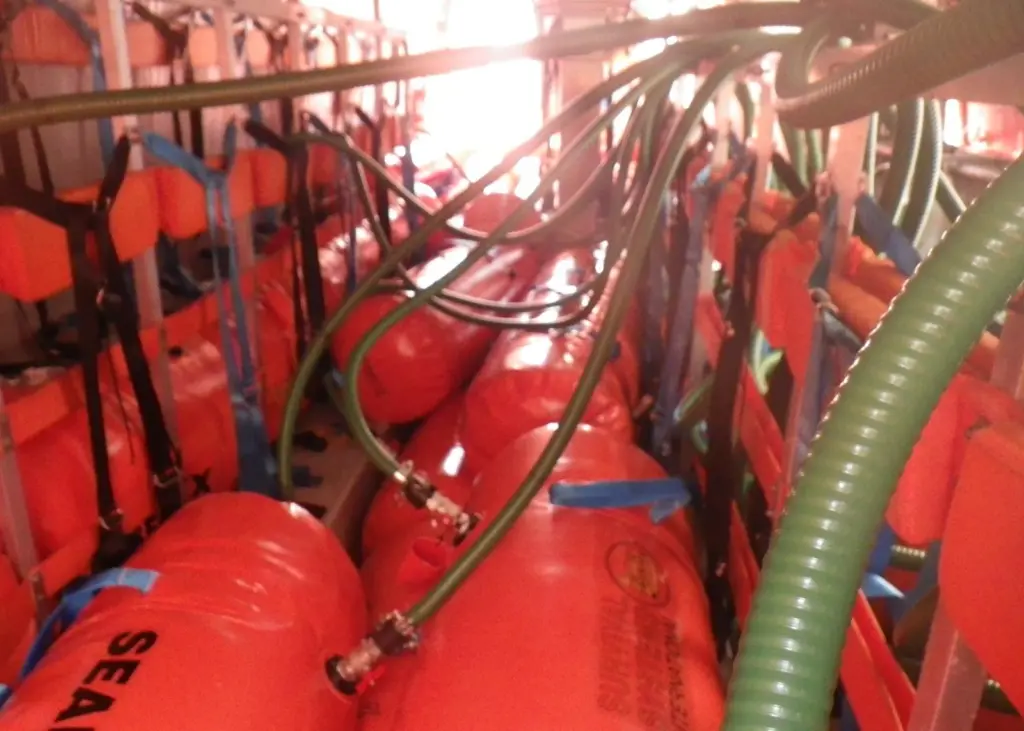
It’s neat: a prepacked lifeboat test kit provides up to 16 bags with a capacity of 375kg each. This comes ready to be filled and discharged via an air driven double diaphragm pump which can fill up to seven bags simultaneously. After the test, it takes very little to pump the water back out again, flake down the bags and put them back into the transit box.
It’s an efficient solution for load not just for lifeboats, but for derricks, cranes and gangways which all need regular load-testing: a variety of round, cylindrical and mattress shapes allows different structures to be loaded evenly and up to 70 tonnes of waterbags can pack into a single transit crate. These are filled remotely via a network of inlet valves and pipelines from standard hydrant outlets and even a 35 tonne bag can be emptied in just 13 minutes.
But back to the central issue of lifeboat safety: “It’s best to keep people out of the active test zone,” said Mr Sparrow. “As a crewman, I’d be much happier positioning a water bag inside on zero load then filling up remotely by hosepipe than lugging in the fiftieth sandbag.”
Visit Unique Seaflex at this year’s Seawork International on stand A261.
By Stevie Knight
Related Articles
 OTHER NEWS
 ACCESSORIES & EQUIPMENT
 ACCESSORIES & EQUIPMENT