![MaritimeJournal[Seawork]](https://www.maritimejournal.com/wp-content/uploads/2026/09/MaritimeJournalSeawork.svg)





Capable ‘girls’ for Titan
Two solid, capable ‘girls’ have won SMT CEO Fabio Berto’s heart. Like many good relationships, it’s the result of working steadily through the issues with tenacity – and a little extra creativity.
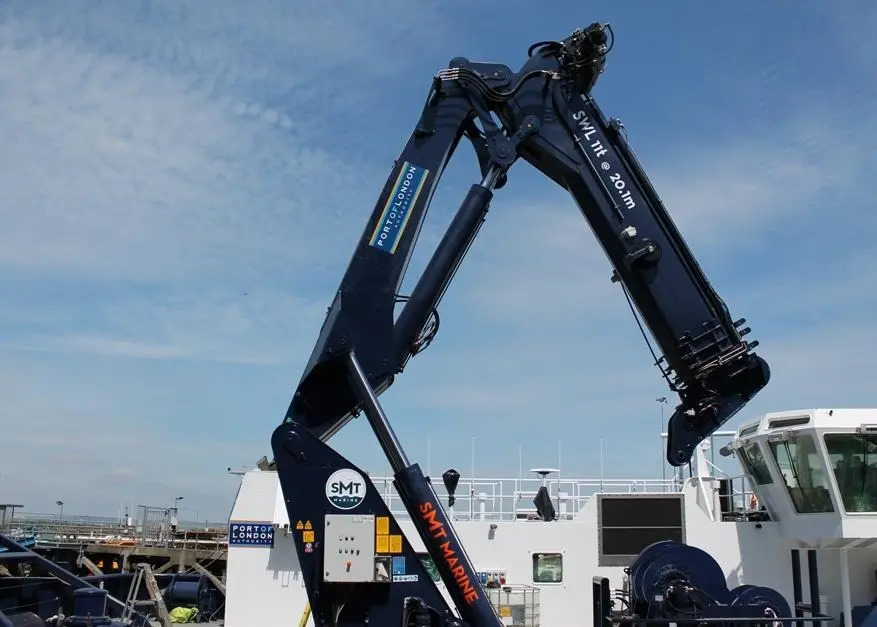
The ‘girls’ are the two, completely unique cranes sitting proudly on the PLA’s latest vessel, nicknamed ‘Lola’ and ‘Juliet’ by the Italian crane manufacturer. The affair hasn’t been straightforward: competing requirements for London Titan resulted in a pair of “absolutely original” cranes explained Mr Berto.
On one hand, there’s the necessity of reaching up to around 20m while on the other there’s a restricted 6.2m air draft: the PLA has to be able to get Titan underneath the Thames’ low bridges as well as being able to work over the top of them.
Further, these ‘girls’ are also a part of Titan’s overall strategy: much has to be movable, partly because of the air draft restriction and partly because of the vessel’s broad remit – they are necessary for picking up and dropping two 18m spud legs into the channels that run vertically through the vessel and also for slotting the vast, 120 tonne capacity A-frame into place on the bow.
So, the solution is a pair of heavy duty SMT Marine KTBO 11/20.1 knucklebooms with three telescopic extensions: they are LR certified to lift 11 tonnes at 20.1m (with hook) and 35 tonnes at 7.5m (using the fixed hook on the booms’ tip), and also give Titan the option of working with grabs that can be fastened by a pin and hydraulic quick couplings.
But most important is the way these ‘girls’ can keep a low profile: the design combines a centerline lift with being able to sit right down onto the deck. It’s a useful trick that comes from an ability to completely retract the hydraulic cylinders, something which also helps to shield the components from the environment.
Although powerfully built with a pair of 210kW powerpacks feeding the hydraulics, Lola and Juliet don’t lack sophistication. Radio controlled with LCD displays, the load and radius indication isn’t built up by using load cells but instead comes from information gathered directly from the hydraulic cylinders’ own pressure maps, the gain in real-time accuracy helping safety and extending the crane’s lifetime.
Further, the robust design goes all the way to the detail: nickel-chromium plated cylinder rods, offshore paint system, AISI 316L pipes and fittings complete the supply and keep ‘the girls’ fresh.
The difficulties, as Mr Berto will attest, has resulted in something strong and enduring. “I’m absolutely in love with both of them,” he admitted.
We’ll be looking at London Titan in more detail in a future Maritime Journal Vessel Launch feature.
By Stevie Knight

Related Articles
 ACCESSORIES & EQUIPMENT
 OTHER NEWS
 ACCESSORIES & EQUIPMENT