![MaritimeJournal[Seawork]](https://www.maritimejournal.com/wp-content/uploads/2026/09/MaritimeJournalSeawork.svg)





Catch 22 for cold weather kit
Resolving issues around the winches for the ‘Neil Armstrong’ research vessel proved quite a puzzle, Hitesh Patel of US based Allied Systems told MJ.
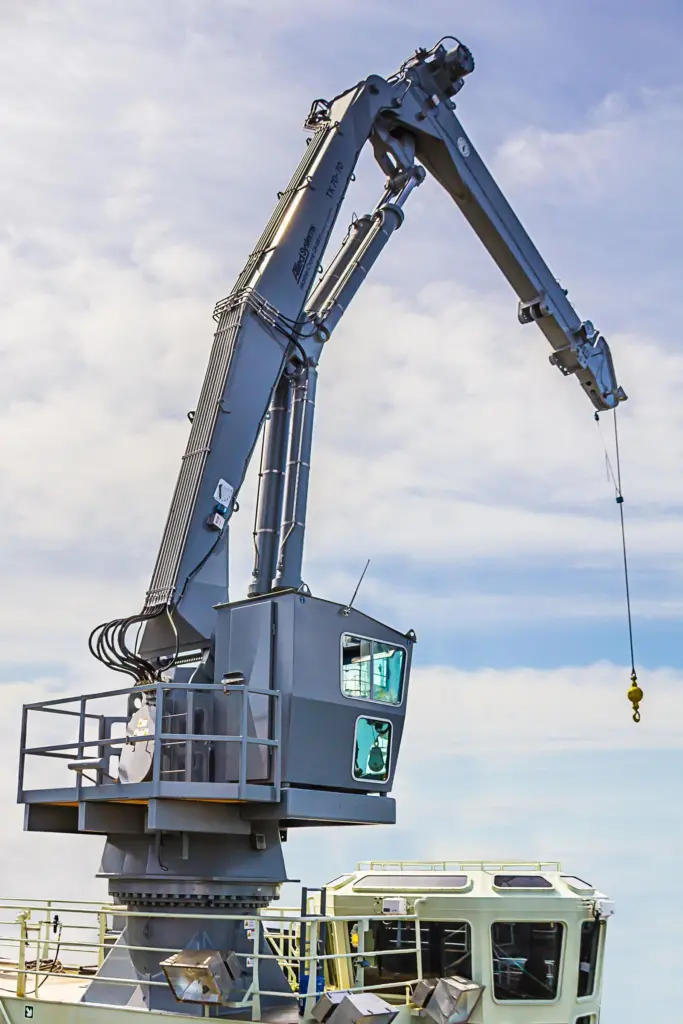
Both Neil Armstrong and its sister Sally Ride have an array of oceanographic research equipment which needs to be deployed in extreme conditions and so the kit, which included a pair of marine cranes (along with A-frame, davit, handling systems and hydraulic power units) had to overcome a number of hurdles. Unfortunately, the more usual solutions were caught between divergent demands.
Firstly, the winches for the cranes needed to stand up to extreme cold as well as being rated for personnel lifting as well as loads: the ABS classification society stipulated a redundant braking system that would act directly on the drum in case of gearbox failure.
Further, ABS also demanded the materials along the load path should meet low temperature Charpy tests – a low temperature impact assessment. Now this was a problem, said Mr Patel as “there were no winch manufacturers that could meet this requirement”.
He explained the nub of the Catch 22 situation: gearbox manufacturers do not Charpy test their components, and even so, manufacturing a gear train from pre-tested components would prevent heat treating the gears afterwards “as this changes the metallurgical properties, potentially making it more brittle and completely nullifying the Charpy results”.
He went on: “There are a few reasons for heat treating a gear, the primary one is for improved surface hardness to prevent wear where the teeth mesh, the second is for improving the strength of the tooth against fatigue failure.” Mr Patel added if this isn’t an option, then there is a lack of realistic alternatives: unfortunately, there are few materials that can meet those same cold temperature requirements. If you can’t make it tougher, he explained, then you are left with enlarging the gears to give more contact area where the teeth mesh – the same going for the tooth profile which needs to be compensated for the loss in fatigue strength.
He pointed out this creates its own snags: “Imagine a three-stage planetary gear train: if each gear had a 30% increase in size, the gearbox would get dramatically larger.” And with an already big gearbox to provide the necessary 18,144kg (40,000lb) line pull, the design simply could not afford the additional size and weight.
However, the Allied design team “stepped up to the plate” to fill in the gap left by the other winch manufacturers. “The result was an all-new design in which we implemented a complex heating system to maintain the temperature of the drive train, preventing brittle failure at subzero temperatures.”
He concluded: “We are now the only company in the world that offers a cold weather, personnel rated winch approved by ABS.”
By Stevie Knight

Related Articles
 ACCESSORIES & EQUIPMENT
 OTHER NEWS
 ACCESSORIES & EQUIPMENT