![MaritimeJournal[Seawork]](https://www.maritimejournal.com/wp-content/uploads/2026/09/MaritimeJournalSeawork.svg)






Chill test at sixty below
Reliability is a prerequisite for the type of rugged motors that lie at heart of marine winches – but while even normal support operations are demanding, icebreakers like the ones being built in Russia’s Vyborg yard add another layer of complexity.
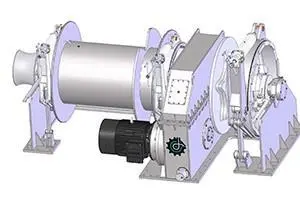
A total of eight Hoyer motors – four 15kW and another four of 37kW output – are being fitted to the 252kN (25.7 tonne pull) Fluidmecanica M-250 anchor winches installed onboard the two latest Aker Arc 130A vessels. These support ships will be used by Gazprom Neft for operations in Russia’s remote Novy Port: the challenge here is the cold – these motors need to operate in ambient temperatures that can reach as low as minus 50°C.
While there’s usually no issue during working cycles, the trouble starts “when normal motors are kept switched off in low temperatures for extended periods”, Tuomas Bejstrup-Jäppinen of Hoyer told MJ. Damp bearings or oil can freeze inside moveable parts and lock them up; of course when you switch these motors on again and they try to rotate the result can be nasty: “If it can’t move freely, a motor will tend to burn out,” he explained.
Therefore the manufacturer replaced several vital components. Bearings were changed, the lubrication switched to Aeroshell’s formulation, oil seal rings were substituted for those made from Teflon and seals and other gaskets swapped for materials which could cope with the extremely cold temperature. Interestingly, the cooling fan blades were exchanged for an aluminium version, plastic being vulnerable to snapping below minus 30°C.
To prove meet the criteria set by the Russian Maritime Register of Shipping (RMRS), Hoyer worked with test institute DELTA to put the motors through a tough chill assessment: as Mr Jäppinen explained, the motors needed to be tested not just to the maximum but a bit over in order to give a certain margin for workability, therefore the test bed took the motors another 10°C degrees lower – to minus 60°C. “We put the motor in a climate chamber where we left it switched off for 24 hours in minus 60°C, and then went back to switch it on again. It worked flawlessly,” said Erik Jensen from DELTA.
After the approval test and classification, the motors were delivered to Fluidmecanica, and from then they went on for installation aboard the Vyborg Shipyard. Despite the need for modification, preparatory work and the chill test, the motors were delivered in record time – in fact it was less than six weeks from the signing of the order. All in all, it’s been pretty fast work, especially since this is the first time Hoyer has cooperated with DELTA. Given another, similar contract the process could now be concluded even more quickly.
By Stevie Knight

Related Articles
 ACCESSORIES & EQUIPMENT
 OTHER NEWS
 ACCESSORIES & EQUIPMENT