![MaritimeJournal[Seawork]](https://www.maritimejournal.com/wp-content/uploads/2026/09/MaritimeJournalSeawork.svg)




Davits challenged by bigger workboats
Onboard workboats have steadily grown in size, and likewise, their launch and retrieval systems also have to rise to the challenge. But there’s more to it than immediately meets the eye.
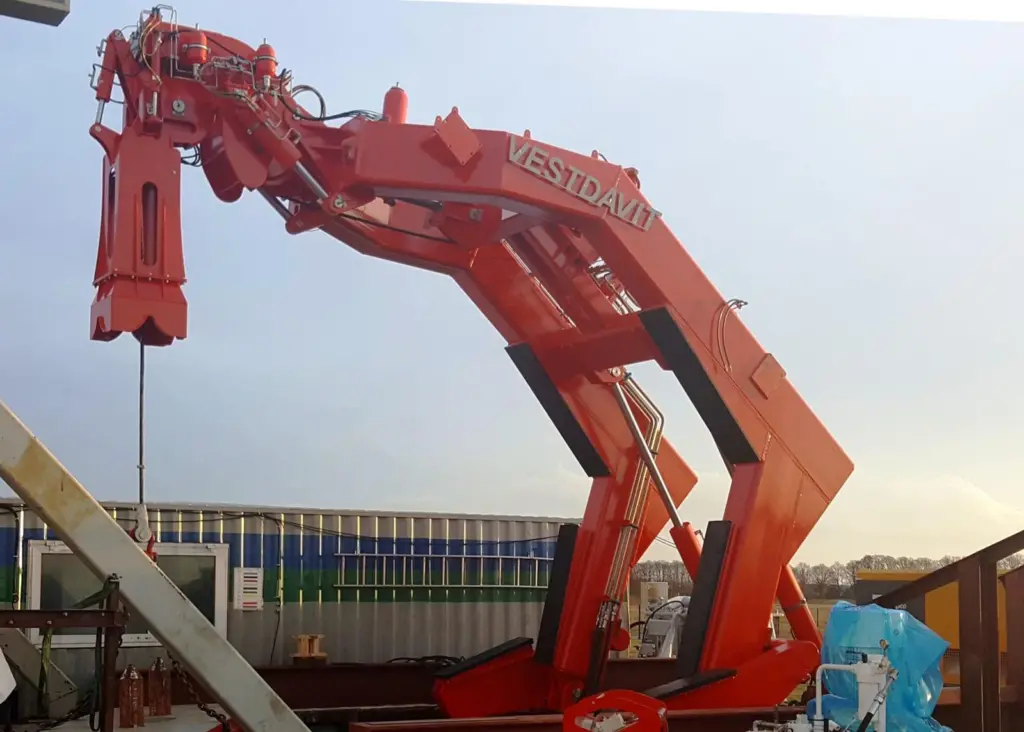
When Vestadavit recently installed its largest ever, single-point davit for over-the-side boat handling, it entailed a good look at the underlying hydraulics explained development director Atle Kalve.
The first of these PAP-16000 A-frame units has been installed on a 58.5m offshore vessel, destined to begin ‘specialist’ operations around Northern Europe at the end of the year.
Although many details of this ship are still under wraps, it seems flexibility and pace are high on the agenda, including deployment of its five person crew boat. Therefore the requirement is for a safe working load of up to 16 tonnes and fast launch and recovery with a line speed of 45 m/min.
However, as Mr Kalve explained, while most ordinary davits will draw around 50kW, adequate to lift a 7m or 8m RIB at the specified rate, it is a long way short of the demand from the PAP-16000 – after all, this new unit has been specifically designed to lift workboats up to four times the weight of a standard RIB.
As a result the power consumption also increases “roughly fourfold, in fact, to 200kW” said Mr Kalve. In turn, “this demands oil feed-rates beyond the specification of the standard piping” he added. Rather than switching to a more expensive option, Mr Kalve explained that the preferred solution for the PAP-16000 has been to replace the single line with a dual pipe solution.
Interestingly, the DNV GL approved PAP-16000 can handle workboats in conditions up to sea state 5. Importantly, load sway and pendulum motion has been mitigated through guiding arms and a sophisticated, tri-axial, motion compensated docking head, equipped with hydraulic shock absorbers and a self-tensioning system.
This ensures control of the workboat at all stages of the operation and the result, according to Vestadavit, is to allow fast launch and recovery and better crew safety even in severe sea states.
One final note: the issue, according to Atle Kalve, is not simply a question of size. He explained that while this first offshore ship had sufficient beam for the total 27 tonne load (including the davit’s 12 tonne weight) to result in only a couple of degrees of heel, “stability is becoming an issue” for narrower vessels.
He added Vestadavit has a number of offerings that can help, including slimmer profile or telescopic davits and dual point solutions.
By Stevie Knight

Related Articles
 ACCESSORIES & EQUIPMENT
 OTHER NEWS
 ACCESSORIES & EQUIPMENT