![MaritimeJournal[Seawork]](https://www.maritimejournal.com/wp-content/uploads/2026/09/MaritimeJournalSeawork.svg)



Different needs, different build
When it came to designing a new offshore access system that would satisfy various clients’ needs “it was like trying to mix a car, a bicycle and a train”, Herman Groot Beumer of Barge Master told MJ.
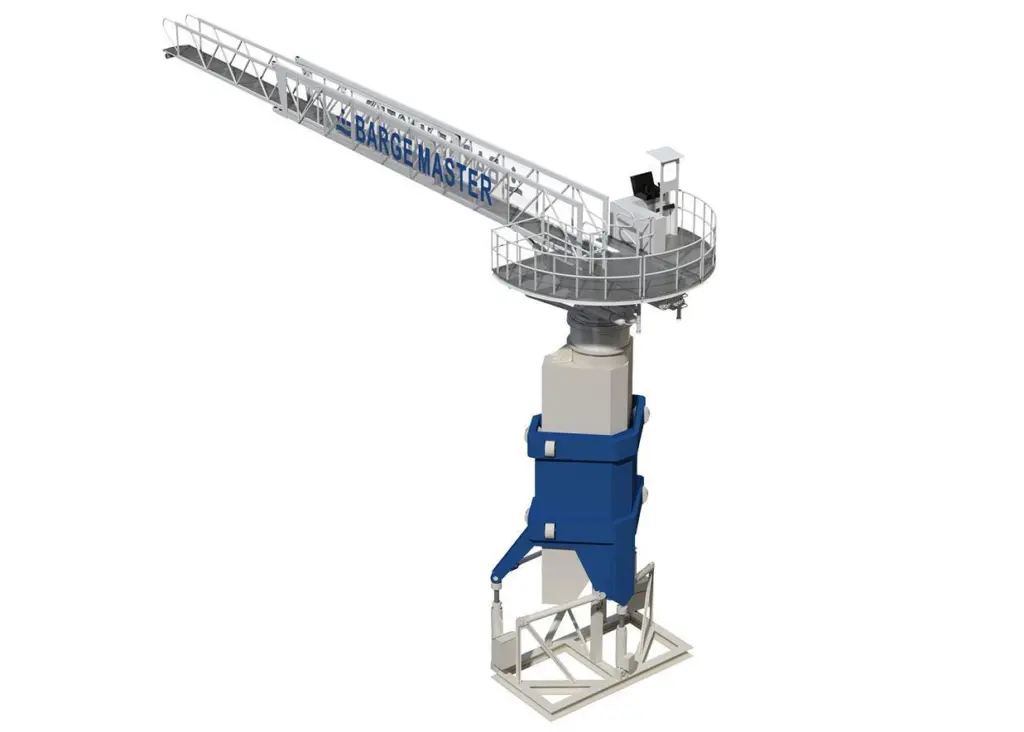
“We initially struggled simply because we couldn’t seem to combine our customers’ requirements into one design,” he explained.
The answer was – don’t. Instead of the more usual development path, the company hit on the idea of a modular build process. This provided an answer that could be adapted, case by case, and moreover, one that could be pretty tightly configured to individual operations.
Probably the most important ‘flexible’ option offered by this new development refers to how far the gangway can go in dealing with significant wave height. Contractors have extremely varied requirements for motion compensated systems: it is not just regional conditions that fuels this disparity, it’s the operations themselves. For example “even though the unwritten standard for the North sea is 2.5m this means very different things depending on where the access system is positioned on the deck” explained Mr Groot Beumer.
Simply, putting the equipment at either end of the vessel can present a wildly different case to the more stable amidships position. However, there is a lot of pressure on this central area for slightly more ‘sensitive’ elements, therefore accommodation, moonpools and so on have a better claim. Further, Mr Groot Beumer pointed out most people would prefer to place a gangway at the edge of the vessel to stop it having to reach across the deck.
To answer this issue Barge Master created two main options: one basic gangway that will work in up to 3m significant wave height, and another with more capacity that will open up the operational window to an impressive 4.5m: “This means it can be placed either at the extremes of bigger ships or on smaller ships that are less inherently stable.”
Further, as not everybody wants everything it’s important to tailor the build to the operation and Barge Master have an eye on where support operations may have somewhat higher cost restraints – the offshore wind industry still lags behind oil and gas despite the latter’s troubles. So, the 4.5 m wave-capable gangway compensates for roll, heave and pitch, while the 3.0m swh version compensates for heave and roll but not pitch.
Another option pertains to length: the normal gangway is around 19m plus or minus 4m which allows it to be extended in all out, but there is also a 23 m version, (again with the 8m variation) giving even wider flexibility.
Safety is paramount: the operation screens not only show the last hour’s conditions, it also calculates the trend and predicts the seastate for the waves ahead: this takes some of the guesswork out of the equation as the operator will get a clear signal well ahead of time if work should stop – or simply not begin.
Further, Barge Master has worked very hard with GL on the failure case: Mr Groot Beumer explained that motion compensation, unlike other types of equipment, can’t just have the plug pulled if there’s some kind of failure: this would result in the gangway suddenly being subjected to huge dynamic forces, “something that has to be avoided at all costs”, he said: “Everything has to be shut down in a controlled manner.”
Therefore the design has built in redundancy on many levels. As you’d expect the hydraulic actuating cylinder valves are twinned, but further, the cylinder has an accumulator to guarantee continuation of the operation. “This means you’re operating on nothing less than double redundancy,” says Mr Grootbeumer.
He is very clear this redundancy is not about allowing the operator to continue working up to the last moment – it’s about keeping a margin of safety: “If you lose one aspect of the system then it’s time to begin shutting down operations while everything is still under control.”
By Stevie Knight
Related Articles
 ACCESSORIES & EQUIPMENT
 OTHER NEWS
 ACCESSORIES & EQUIPMENT