![MaritimeJournal[Seawork]](https://www.maritimejournal.com/wp-content/uploads/2026/09/MaritimeJournalSeawork.svg)





Hybrid crane marks the way forward
There’s a new 150 tonne knuckleboom crane that can actually generate far more energy that it will consume during a lowering operation.
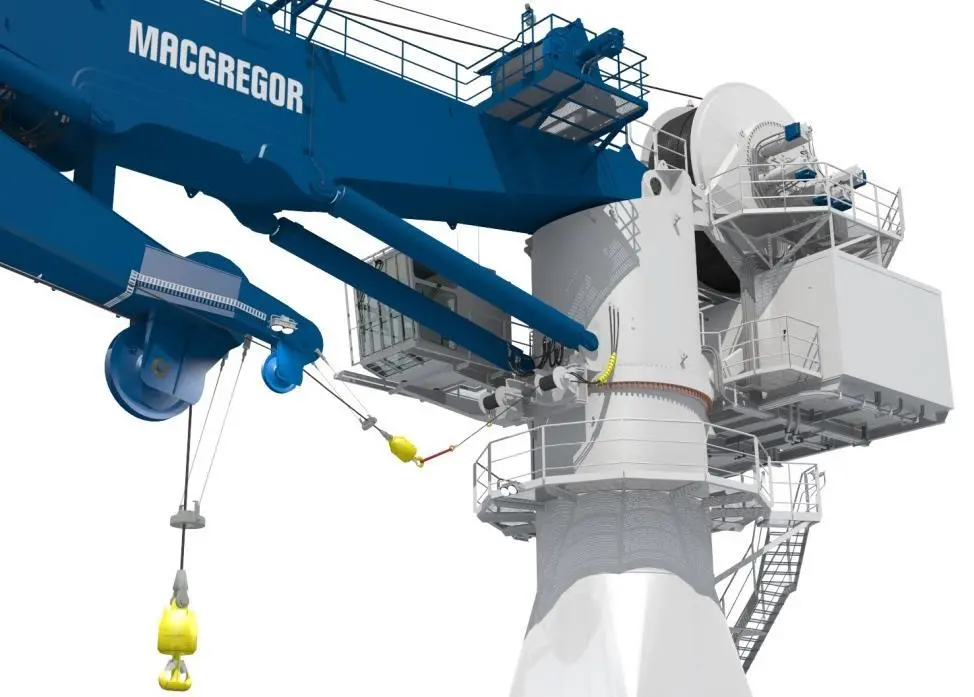
Aiming squarely at the latest high-end hybrid vessels it can recapture energy from the electric winch’s lowering motion that would otherwise be lost. As Baard Alsaker of MacGregor said, the idea springs from an ongoing reconsideration about how power can be most effectively handled onboard working boats: “These days a crane is not just a single piece of equipment. It’s a whole system,” he explained.
So, although it provides an interesting alternative for traditional vessels, it’s going to yield most in the way of energy savings when installed on a modern vessel equipped with battery banks. However, while this may sound as if it will put pressure on the investment, Mr Alsaker also points out that where lifting is at the heart of operations it could actually reduce the genset power requirement.
As innovative as that is, there’s a lot more to the design: “Knuckleboom cranes have certain abilities very useful for a working vessel,” said Mr Alsaker but this meant looking at each movement and seeing what kind of solution is most appropriate.
For instance, taking a step back to look at the overall picture, the lack of electrical actuators that can deliver the required force to the jib means some movements that are still best carried out hydraulically – although the cylinders benefit from MacGregor’s ‘leak free’ design.
Surprisingly, the crane has taken a leaf out of the automotive industry’s book to gain an efficiency advantage. “We could see that the electrically powered hybrid cars had an automatic start-stop function so that when you are not driving, the motor shuts down… it was relevant because for most of the time during a typical subsea lowering operation the wire is in the water – and the jib is motionless. So we asked ourselves, ‘why not simply stop the hydraulic power unit (HPU), that drives the jib and slewing motion?’. If the crane operator makes a control demand that involves the hydraulic actuators, the HPU immediately starts up again.”
MacGregor is offering its new semi-electric crane with a SWL of 150 tonnes because this is currently the most popular size in its market segment at present, but, importantly, the technology is generic, so if it catches on, other cranes will become available. Mr Alsaker also noted that the bigger the crane is the more can be expected to gain from the semi-electric technology, especially as ship design will focus increasingly on integrating all power consumers in one common system to store and retrieve energy.
Mr Alsaker concluded: “While it can take less than two years to build a vessel, that vessel will be in service for 20 to 30 years. A little more initial capital expenditure can deliver decades of reduced operational costs.”
By Stevie Knight

Related Articles
 ACCESSORIES & EQUIPMENT
 OTHER NEWS
 ACCESSORIES & EQUIPMENT