![MaritimeJournal[Seawork]](https://www.maritimejournal.com/wp-content/uploads/2026/09/MaritimeJournalSeawork.svg)






Inside the box, evolution for inertial technology
For those of us who look at a black box and wonder why the fuss, it’s useful to chat to someone who understands why a recent microelectronic breakthrough will make a big difference to motion compensated access.
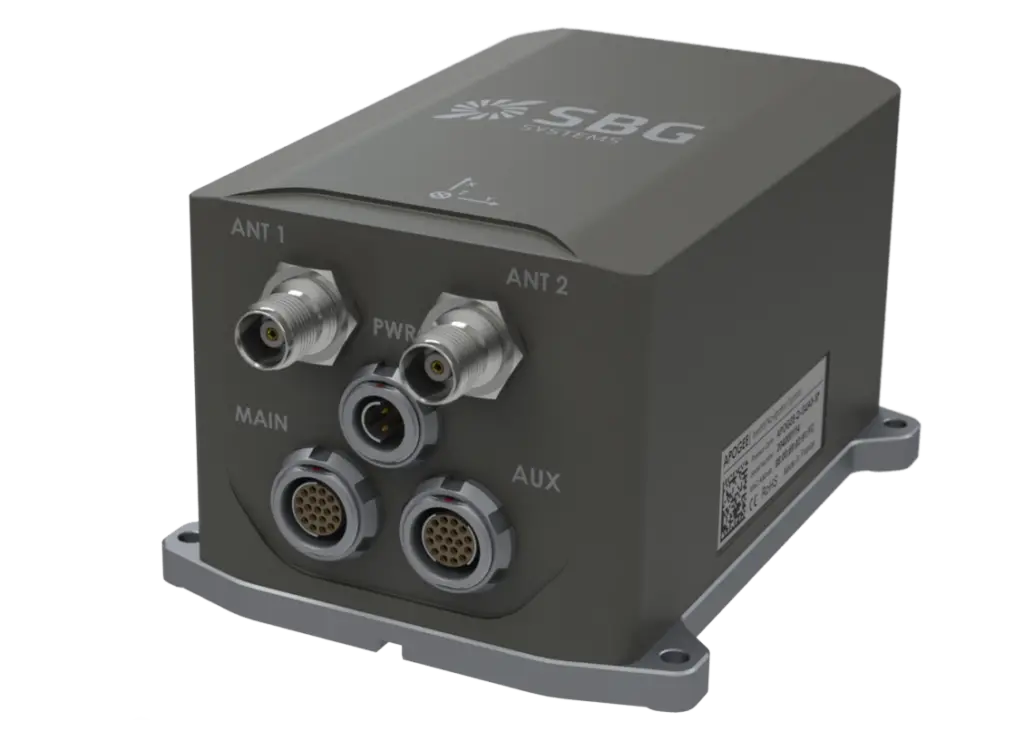
It all comes down to the MEMS, Raphael Siryani, co-founder of SBG Systems, told MJ.
Micro-Electro-Mechanical Systems (MEMS) “take more design, but less manufacturing time than the previous generation of inertial units” he explained which, if efficiently carried through from the drawing board, results in price-competitive systems.
Certainly the Apogee series, the latest out from SBG, is looking at taking on Fibre Optic Gyro (FOG) systems on their own turf: these rely on earth rotation to deliver headings, have a reputation for precision – and are very, very expensive.
But before now MEMs systems had a few limitations with accuracy: fine for the more straightforward compensation needed by, for example, survey equipment but not quite good enough for access systems. After all these are not just dropped vertically but need to extend out from the sides of the vessel toward a fixed structure.
Therefore the field has been dominated by FOG systems, because, as Mr Siryani explained, you need to pinpoint surge and sway along with the other movements in real time.
It’s trickier than it seems: “When you are only measuring the vertical axis, while there will be some effect, the accuracy of your roll and pitch won’t impact it enormously. But if you also try to compute surge and sway, you quickly find that even a very small roll and pitch error dramatically decreases the total accuracy,” he said. Mr Siryani admitted that previously, although MEMs systems got right down to 0.05° of accuracy, “this isn’t quite enough for access systems which need to have roll and pitch accurate to at least 0.01°”.
However, it seems the latest rounds of innovation has brought together the new generation of MEMS gyroscopic and accelerometer sensors, tri-frequency GNSS receivers and state-of-the-art data fusion algorithms all of which combine to provide “a robust alternative” that gets over the accuracy issue.
So now, the Apogee D unit not only comes within 0.02° of heading, 1cm position and 5cm heave precision, it also achieves 0.008° accuracy in roll and pitch in real-time too “putting it well within the 0.01° needed for gangways” said Mr Siryani.
Will it get a foothold against the well-established systems in place? Mr Siryani believes so, and it’s not just price: despite FOG technology’s reputation they are subject to a slow oscillation on heading, take a while to get aligned and lose accuracy the further away from the equator you go “necessitating a much higher specification gyroscope for northerly regions” he said.
Although Mr Siryani is coy about names, he admitted there were already “a few commercial trials” already underway.
By Stevie Knight
Related Articles
 ACCESSORIES & EQUIPMENT
 OTHER NEWS
 ACCESSORIES & EQUIPMENT