![MaritimeJournal[Seawork]](https://www.maritimejournal.com/wp-content/uploads/2026/09/MaritimeJournalSeawork.svg)





LifeCraft closer to approval
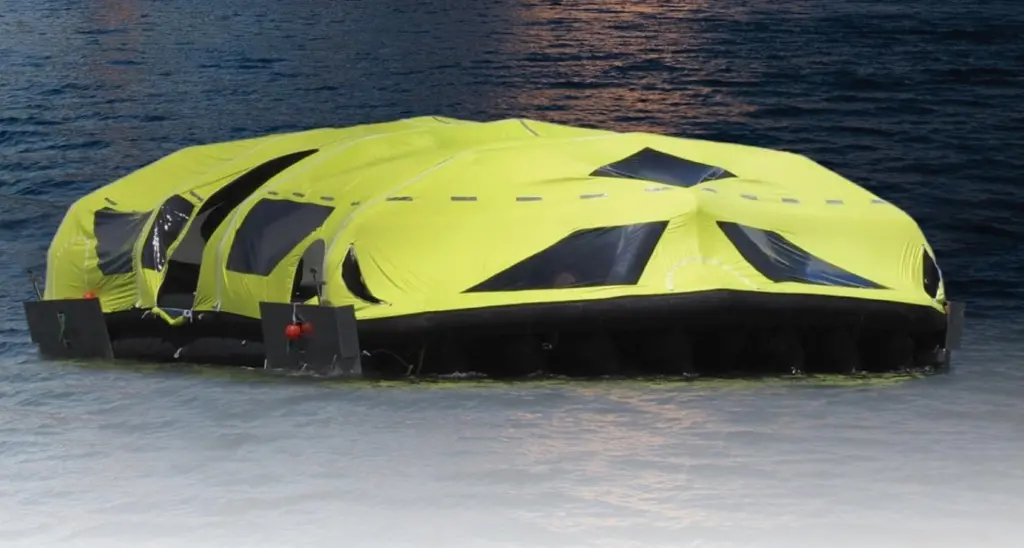
Viking Life-Saving Equipment has taken an important step on the road to gaining approval for the Viking LifeCraft, its innovative alternative life-saving appliance (LSA) for passenger ships.
The concept was presented to the International Maritime Organization’s Sub-Committee on Ships Systems and Equipment in London on 25th March, with the full support of the Danish Maritime Authority. More than 180 delegates stayed beyond the day’s normal business to hear from Niels Fraende, Viking Life-Saving Equipment vice president and Henning Luhmann, Meyer Werft head of naval architecture.
With full prototype testing of the LifeCraft nearly complete, the audience heard that the system has been performing in line with expectations. Mr Fraende said the approvals process for the alternative LSA had been ‘a challenge’, but added that progress had been made by taking a practical approach to IMO guidelines (MSC 1/Circ. 1455, MSC. 1/ Circ. 1212 and SOLAS III/38).
The company aims to secure the first approvals from flag states by the end of 2015.
The LifeCraft design initiative has its roots in the EU ‘Safecraft’ safe abandoning of ships project, started in 2004. Essentially, he explained, LifeCraft is a hybrid lifeboat/liferaft system, designed to combine the advantages of both solutions. Self-propelled, with four battery-powered electrical motors, one at each corner, each survival craft unit is fully equipped as a lifeboat, with a fire retardant canopy and a simple steering system that offers a high degree of maneuverability.
Each craft has capacity for 200 persons in an ergonomically-designed and secure seating arrangement that is also intuitive and flexible. Tests have demonstrated that the construction is highly stable in sea states up to Beaufort 6+, Mr Fraende pointed out, while rapid acceleration and high bollard pull makes it easy to pull clear of the mother vessel. The launching and embarkation arrangements mean that four units can be stored on deck in a storage container or integrated into the shipside, operated by gravity and stored mechanical power to provide a controlled descent with minimal handling by crew members.
Each LifeCraft system has four ‘escape ways’, with capacity to evacuate 1,816 persons in 30 minutes. However, Mr Fraende pointed out that as a four LifeCraft arrangement would have maximum capacity for 800 persons, there is a capacity safety factor of 2.27, and therefore 800 people can be evacuated in just 15 minutes.
Follow up questions focused on weight, battery life and performance under difficult conditions. Mr Fraende confirmed that the LifeCraft offered a doubling in capacity in equivalent weight terms and that life expectancy time for modern batteries is 10 years.
Kent Molsted Jorgensen, Viking Life-Saving Equipment manager, rules and regulations, commented: “As we move towards getting approval for this innovative life-saving system, we need to raise awareness of its capabilities and advantages within a wider community. I am greatly encouraged by the universally positive response from Sub-Committee delegates
By Jake Frith
Related Articles
 OTHER NEWS
 ACCESSORIES & EQUIPMENT
 ACCESSORIES & EQUIPMENT