![MaritimeJournal[Seawork]](https://www.maritimejournal.com/wp-content/uploads/2026/09/MaritimeJournalSeawork.svg)


Multi-purpose WIG craft
A team of Russian developers has been working on the creation of a multipurpose sea-going ekranoplan, (the Russian name for a Wing-In-Ground-Effect craft, or WIG) which they say could contribute significantly to the speed of seaborne traffic and Search and Rescue response times.
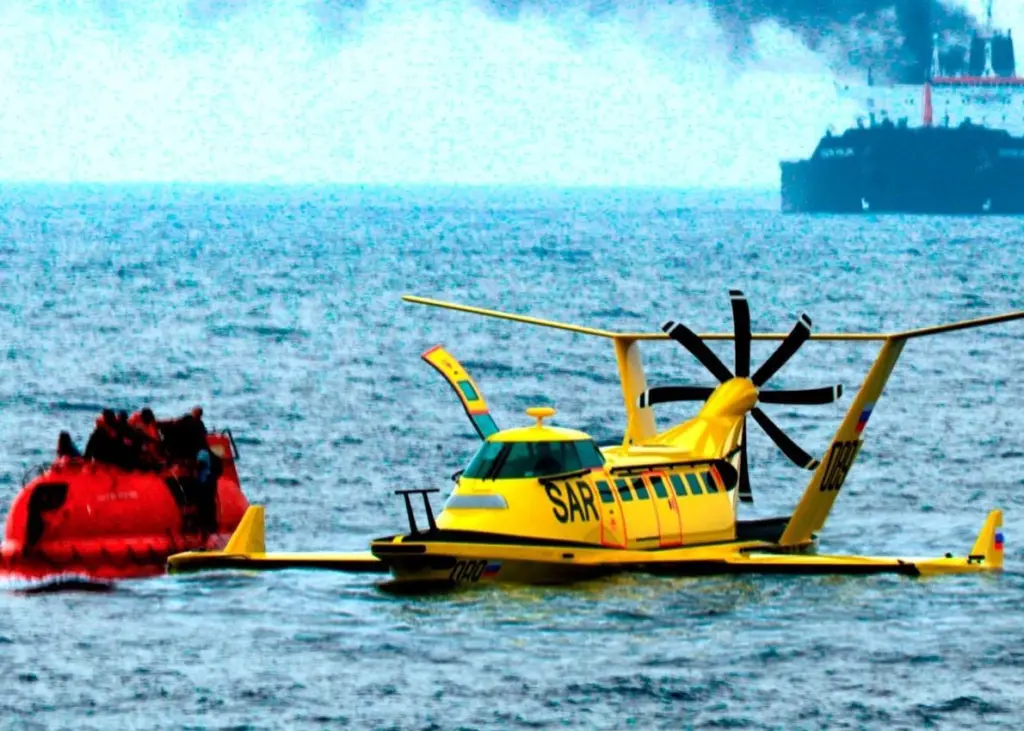
The project, which has been announced as unique will be presented by MariNet, the National Technological Initiative (NTI) working group, on the sidelines of the International Exhibition NEVA-2017 in St Petersburg, September 19-21.
Specialists of RDC Aqualines will provide a concept, basic and production design, engineering, construction and commissioning of the WIG vessel, known as the EP-15 series ekranoplan. It will have the following general characteristics: Length: 16.5 m; Displacement: 5.5 tonnes; Capacity: 15 people.
The EP-15 will be designed for high-speed cargo and passenger transport, and search and rescue duties providing an operational speed of up to 200 km/h, on 50 – 300km long sea routes.
The ekranoplan does not require any dedicated infrastructure and certification is carried out according to the Russian Maritime Register of Shipping rules.
WHAT’S IN A WIG?
A Wing-In-Ground effect vehicle, or WIG, can also be known as a WISE (Wing-In-Surface Effect) aircraft, or in Russian- ekranoplan. It is believed they were first developed in the Cold War for mainly military purposes by the USSR behind the secrecy of the iron curtain. Civilian versions are basically a boat with stubby wings and an air propeller, using the ground effect that aircraft feel when gliding close to the ground (or water) to travel at high speeds, more economically and with a lower power requirement than aircraft in free flight. The principle works because the low-mounted wings are getting most of their lift from air compressed between them and the surface, rather than just from the usual (free flight) lift through the usual pressure differential known as Bernoulli’s principle.
Some have been built on hovercraft, so work at slow speeds as a hovercraft, and at higher speeds as a WIG. Others are much more like seaplanes, and also work as conventional aircraft as they have wings large enough and of the required profile and configuration to allow stable, free flight away from the influence of surface effect.
The Soviet Union were interested in large ekranoplans, both for military transport (heavier loads could be carried with half the fuel usage) and more chillingly as platforms to potentially fire short range nuclear warheads into Western cities, having travelled to the vicinity under the cover of radar.
Google ‘Caspian Sea Monster’ or ‘ekranoplan’ to find out more on this very interesting chapter of Cold War military history.
I must confess a personal fascination with these craft (which I also confess are on the outer fringes of MJ’s remit). Interestingly US-based hovercraft kit and plans provider Universal Hovercraft have produced a plywood kit WIG based on an 18 foot hovercraft powered by a Subaru 2 litre car engine. I can think of few more rewarding winter/ retirement projects than knocking one of those together.
By Jake Frith

Related Articles
 ACCESSORIES & EQUIPMENT
 OTHER NEWS
 ACCESSORIES & EQUIPMENT