![MaritimeJournal[Seawork]](https://www.maritimejournal.com/wp-content/uploads/2026/09/MaritimeJournalSeawork.svg)





‘Out of the box’ AHC
The very first client of the X-Wave ‘self-learning’ motion compensation system “took us at our word – and decided to use the kit straight out of the box… no sea trials”.
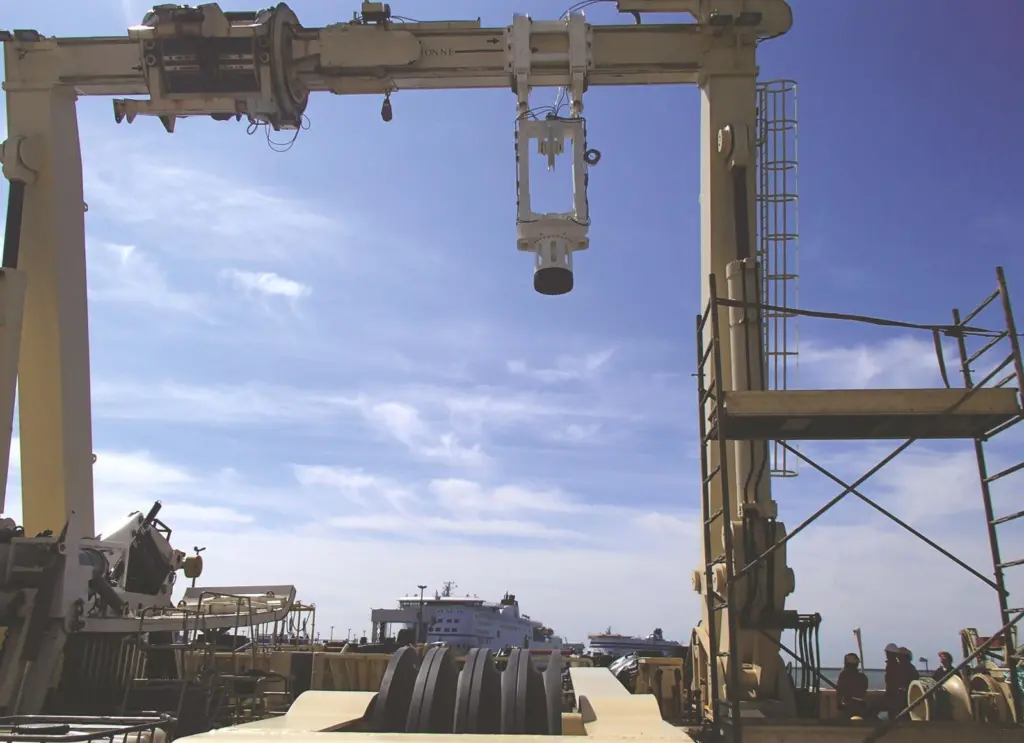
This, admits Paul Cairns of MJR Power & Automation who were a partner in the development of the system, was a little nervewracking for the initial commercial installation.
“However the client made it clear: they said ‘you’ve sold us this dream … so we are just going to run it and see if it does what you’ve told us it will do’. They didn’t allow for any ‘tweaking time’…just connected it up and switched on.”
Happily the system did exactly what was expected of it and though a little relieved, Mr Cairns wasn’t too surprised: “This is the goal after all: a kit with enough savvy to get going by itself.”
Importantly, it opens up the arena for vessels without a bespoke AHC (Active Heave Compensation System) to add this capability with very little fuss: cranes or gangways can be picked up from one vessel, put on another and in no time at all they will be working as well as they did on the first.
To outline just how different this self-learning, adaptive system is, Mr Cairns says that if you bolt a new crane onto a deck with this system onboard it will take just 30 seconds or so to get the feel for what’s needed before keeping the load on the end of the winch line motionless in the water.
How does it do it? “It’s down to the joy of physics,” he says. When it comes to the action of physical objects or waves and water you can’t predict too far ahead, “but you can see a few milliseconds into the future with some accuracy”.
So on one side it predicts wave form: it can sense the acceleration and how the heave is going to affect the ship, rechecking it every 100 milliseconds. Alongside this, the winch has it’s own algorithm explains Mr Cairns.
“As well as ‘seeing’ the coming wave form, the system knows just how long the winch control will take to respond to an order – the lag depends on things like the load, how much wire is paid out and so on. So it meshes the algorithm that’s tuned to the heave compensation system with the wave prediction model… and understands where it’s got to give the drive a bit more ‘oomph’ to the power output in order to get the winch into the right position, on time, to keep the load motionless.”
Usefully the X-Wave can be equally applied to the familiar hydraulic systems as well as electrical drives. More, the integral HES880 drive (developed by partner ABB) opens a path forward to store regenerated energy from the crane’s lowering actions in batteries or ultracapacitors, rather than just burning it off using a resistor bank, giving the system another layer of redundancy.
By Stevie Knight

Related Articles
 ACCESSORIES & EQUIPMENT
 OTHER NEWS
 ACCESSORIES & EQUIPMENT