![MaritimeJournal[Seawork]](https://www.maritimejournal.com/wp-content/uploads/2026/09/MaritimeJournalSeawork.svg)





Power for pull
The recently launched icebreaker ‘Murmansk’ is big and extremely powerful, but not all of that energy is simply centred on the propulsion.
Built in the specialist Arctech Helsinki Shipyard in cooperation with JCS Vyborg shipyard, project number 509 is a large beast measuring 119.8m in length with a 27.5m beam, designed to be able to operate in temperatures as cold as -40°С; it’s able to break 1.5m thick ice and still be capable of around 3.5 knots in 1m level ice. However, while the four main diesel gensets can pump out a total power of 27MW, only 17.4MW of this is for propulsion (via two 360-degree azimuthing thrusters) so the other 9.6MW of power is there to supply the other consumers – such as the deck equipment.
This is necessary because beyond icebreaking, it’s other main duties will be assisting heavy-tonnage vessels while transiting the icy waters of both Baltic and Arctic regions, as well as towing of vessels and other floating structures both in ice and in open water. Obviously it will be on hand to assist vessels in distress whether in ice or open water, and of course the vessel will also be used for fighting fires on floating facilities of all kinds.
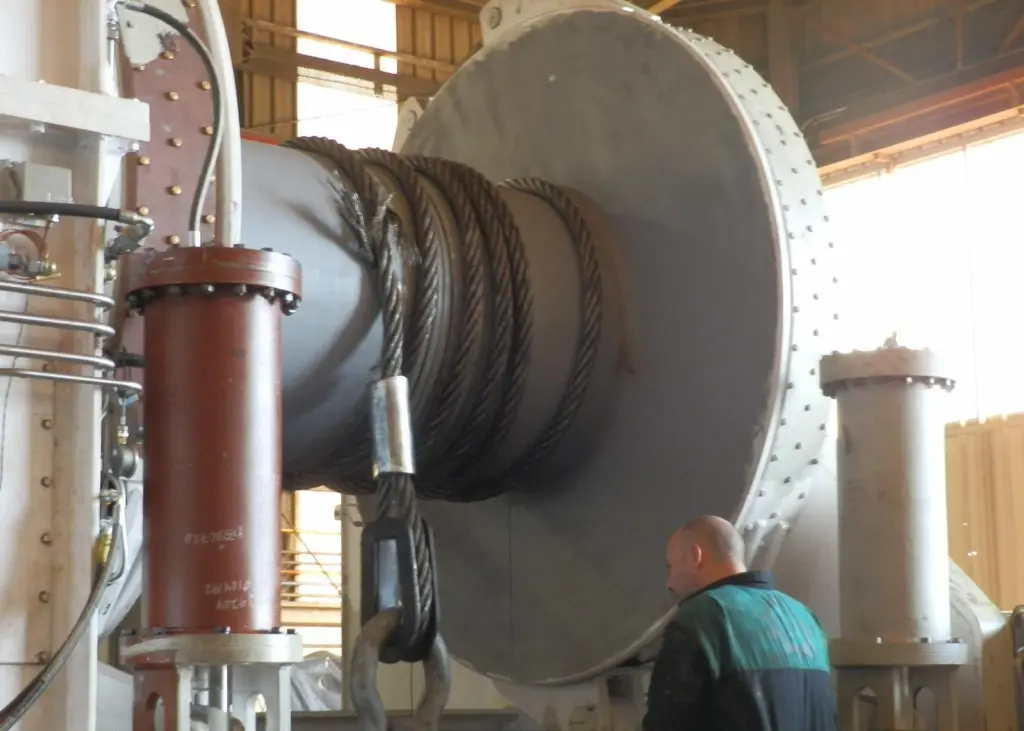
Therefore, Fluidmecanica’s supply order is large in every sense. The towing winch is of a twin drum cascade type with two gears, taking 700m of 70mm diameter wire with spooling gear on each drum. The first layer of the towing drum gives 45 minutes of continuous dynamic pull at 1,200 kN (122 tonnes) with a line speed of up to 8m/min. In second gear it has a higher line speed of up to 16 m/min at 350 kN – all with a highly efficient auto-tensioning device and a brake of 2,125 kN (217 tonnes). On the other hand, the holding force is up to 3,700kN, which amounts to 377 tonnes.
The deck equipment is also very capable of taking on the difficult conditions, being designed for an air temperature range of -40ºC to +35ºC . The winches are flexible too: one of the main features of the system is that both drums have a dedicated motor, explains Francisco Rivera of Fluidmecancia. So, unlike many winches which rely on a single motor, both drums can work at different speeds as well as either being in forward or reverse modes, lending the system more reliability and a higher safety and redundancy factor.
Complementing this, there are two auto-tensioned, electrically powered anchor-mooring windlasses running with 62mm diameter chain which have a maximum pull of 273 kN (28 tonnes). These are complimented by two further, auto-tension electric mooring windlasses with a nominal pull of 125kN (13 tonnes).
To complete the set there is also a three reel storage drum, with a pull of 50kN, to handle the towing rope and another twin reel drum for electric cable storage.
The vessel, which belongs to a series of three new buildings ordered by the Russian Ministry of Transport as part of its icebreaker renewal programme, will be delivered during early autumn this year.
By Stevie Knight
Related Articles
 OTHER NEWS
 ACCESSORIES & EQUIPMENT
 ACCESSORIES & EQUIPMENT