![MaritimeJournal[Seawork]](https://www.maritimejournal.com/wp-content/uploads/2026/09/MaritimeJournalSeawork.svg)




User feedback breeds better design
The Nautical Institute and CIRM (the France-headquartered international association for marine electronics companies) has launched a joint initiative to improve the usability of navigation and communication technology on board vessels.
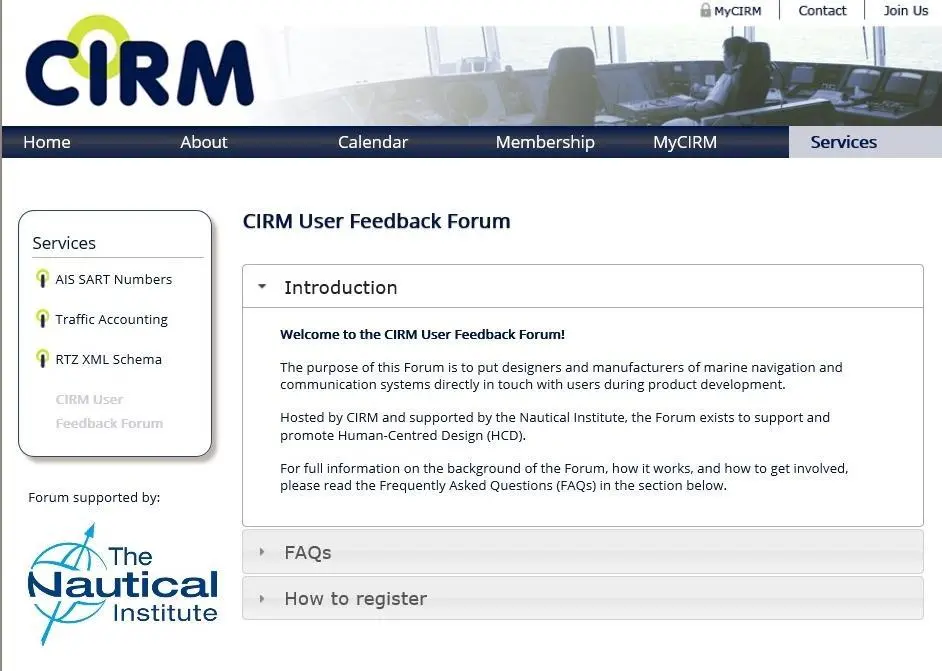
Speaking at the International e-Navigation Underway Conference in February, David Patraiko, Director of Projects for The Nautical Institute, and Richard Doherty, Chief Technical Officer for CIRM, announced the development of the CIRM User Feedback Forum.
The best way to achieve usability in a system, product or service is to ask users what they think at each stage of the design. This is the principle that underlies the concept of human-centred design (HCD). Applying HCD is a key goal of the International Maritime Organization’s eNavigation strategy.
“As a design concept goes, this all makes perfect sense,” said Mr Patraiko. “Many mariners are keen to offer feedback into the design process but struggle to identify how to.” Mr Doherty confirmed that CIRM members are willing to listen and of course will need to demonstrate this as outlined in the IMO e-Navigation HCD Guidelines. These issues were also confirmed during a recent EU funded Human Factors project CyClaDes (www.cyclades-project.eu).
To encourage mariners’ input, CIRM created the CIRM User Feedback Forum, which brings together willing seafarers and interested manufacturers to ensure that designs are validated using human-centred design principles. The Forum can be accessed at http://cirm.org/services/cuff.html
The Nautical Institute, which describes itself as the leading international body for maritime professionals, will encourage mariners from around the world to register as potential ‘beta testers’ for CIRM members’ research and development projects. The process is absolutely free for seafarers and confidential for the manufacturers. Training centres are also invited to become involved and to form relationships with manufacturers that may be interested in running trials.
“This is a golden opportunity for all mariners and trainers to improve the design of systems they may have to use in the future, while enjoying the process of working with the design teams,” said Mr Patraiko. The Nautical Institute also plans to publish case studies from these trials, which will spread the benefits to the whole industry.
By Jake Frith

Related Articles
 ACCESSORIES & EQUIPMENT
 OTHER NEWS
 ACCESSORIES & EQUIPMENT