![MaritimeJournal[Seawork]](https://www.maritimejournal.com/wp-content/uploads/2026/09/MaritimeJournalSeawork.svg)




Dredged materials treatment centre opens
Envisan France, the French environmental subsidiary of Belgium’s Jan De Nul Group, has inaugurated its Eco-Materials Production Centre in La Seyne-sur-Mer, the first centre of its kind in the Mediterranean area.
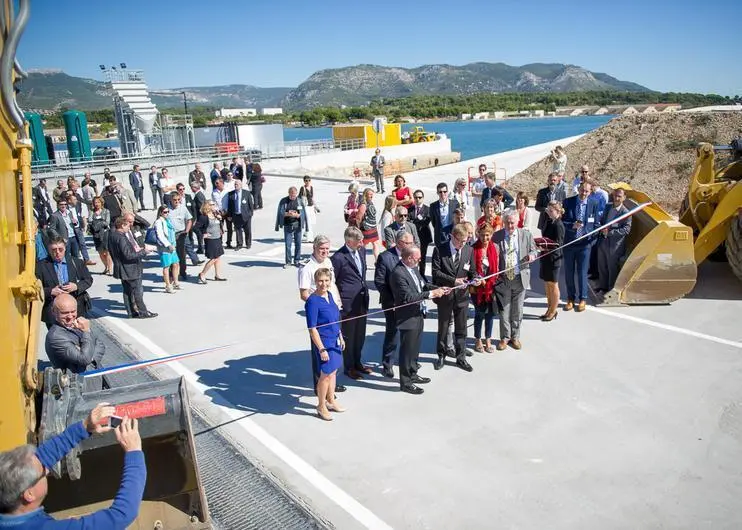
Addressing a gathering attending by regional and national political figures in late September, Envisan director Walter De Jonghe said: ‘We are very proud to introduce in France a new response for the treatment of contaminated sediments and soils.The mission of our new processing centre is the valorisation of non-submersible sediments originating from dredging operations, as well as polluted soils coming from groundwork sites in the construction and public works sector.’
The operators will call upon their Belgian experience, where legislation allows for sediments to be upgraded for use in the construction industry. ‘The centre is built on a 3.4 hectare site and can receive up to 160,000 m³ materials per year, added Walter De Jonghe. ‘The centre is designed to meet all applicable environmental protection standards and complies with the strictest traceability requirements. The centre is also fitted with its own water treatment plant.’
The centre is divided into different zones, each offering a phase in the processing flow. The dredged sediments are brought in by road or marine transport and are directed towards the pre-processing and lagooning zone for dewatering. Dewatered materials are then transported to a waterproof platform in the processing and temporary storage area, where further treatment can be carried out. After treatment, the eco-materials produced can be valorised in different applications.
The polluted soils can similarly be brought in by road or maritime transport in the temporary storage area. After screening, they are subjected to either natural treatment processes such as bioremediation, or more complex treatment methods such as physical/chemical treatment.
Materials requiring more specific treatment can be grouped, then forwarded to other appropriate processing centres. Treatment residues, such as plastic, metal, screening debris, green waste, etc, are sorted, grouped and sent to specialised recycling firms or, if none are available, to special waste storage facilities.
The centre offers several sediment and soil treatment techniques, including mechanical dewatering using filter presses, dewatering through active lagooning particle size separation (cycloning, de-sanding, screening), biological treatment and physico-chemical treatment.
Envisan obtained the operating permits for this installation with an environmental classification for a 20 year period, by prefectural decree on 28 November 2013.
Envisan France is a partner and co-funder of the SEDIMED research programme, which aims at lifting administrative and regulatory barriers, thus enabling the upgrading of sediments in construction works: roads, concrete structures, marine works and eco-modeled landscaping as well as sound- barrier structures. The new Eco-Materials Production Centre is thus well placed to partner marine work contractors, construction and public works, as well as decontamination specialists.
By Larz Bourne