![MaritimeJournal[Seawork]](https://www.maritimejournal.com/wp-content/uploads/2026/09/MaritimeJournalSeawork.svg)






A global push to scale up floating wind
A new partnership aims to advance the scale-up and drive the cost down for floating offshore wind projects through joint technology development and global standards alignment.
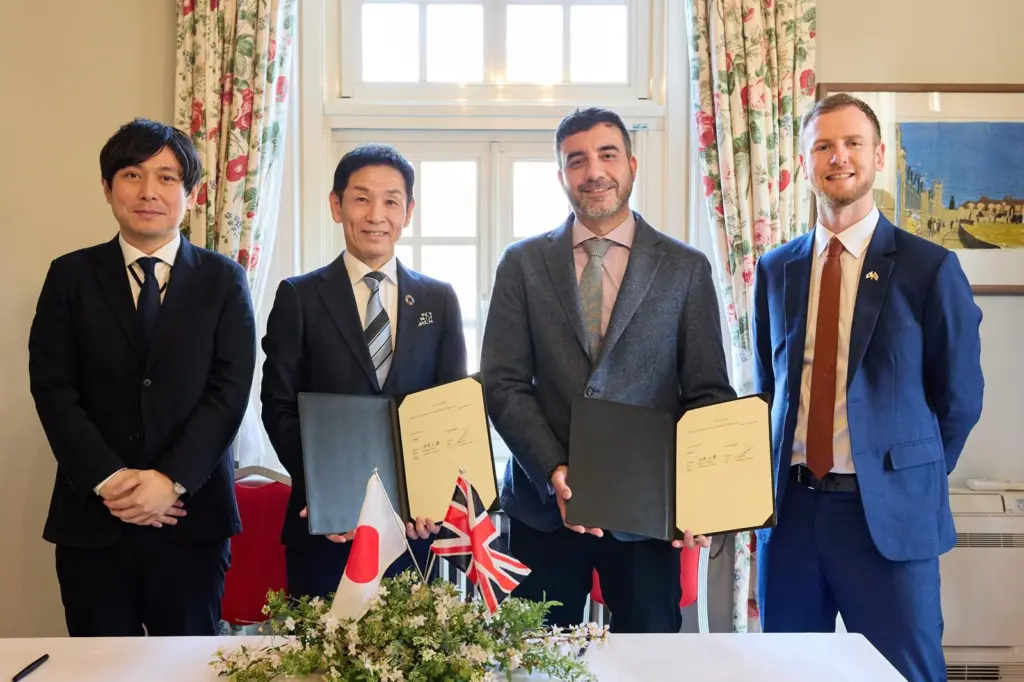
The Floating Offshore Wind Power Technology Research Association (FLOWRA) of Japan and Lloyd’s Register (LR) will collaborate to explore technology development in floating offshore wind, aiming to reduce costs, mitigate risks and accelerate deployment.
“Through our collaboration with Lloyd’s Register, we believe that we will be able to execute technological development in line with global standards, incorporating international standards and expertise in design, construction and operation and enabling Japan’s floating offshore wind technology to gain further trust in the global market,” said Masakatsu Terazaki, chairperson of FLOWRA.
“We strongly hope that this cooperation agreement will contribute to the development of floating offshore wind and contribute to the creation of a more sustainable future.”
floating offshore wind is greatly expected both domestically and internationally as a power source capable of utilising marine resources at the maximum extent with minimum environmental impact.”
Standard alignment
The agreement focuses on aligning innovation, safety and internationally recognised standards to support scalable offshore renewables projects, while strengthening expertise across design, marine construction and operational phases.
FLOWRA, a technical research association, works with overseas organisations to develop common foundational technologies for floating offshore wind.
Through this partnership, the organisation aims to incorporate international standards and technical expertise to enhance the credibility and global competitiveness of Japan’s floating wind sector.
LR will contribute its certification and energy asset assurance capabilities, supporting project developers in reducing technical risk and uncertainty.
The collaboration is also expected to optimise development costs and streamline project delivery across offshore renewables portfolios.
Manuel Ruiz, renewables director at LR, emphasised that closer cooperation with industry stakeholders will enable safe, scalable projects aligned with national and global energy transition goals.
Both organisations expect the partnership to accelerate floating offshore wind deployment in Japan and internationally, supporting a more sustainable future for the commercial marine and offshore energy sectors.
The eye-watering cost of floating offshore wind was laid bare at Oceanology International, with scientists admitting it was at least six times more expensive than conventional fixed-bottom turbines.
Consequently, the industry is searching for ways to reduce survey costs without undermining engineering certainty. Better collaboration and standard alignment is undoubtedly a good way forward, especially when it comes to realising commercialisation and reducing high costs.
Europe’s floating offshore wind sector is still emerging, with just five farms operating in its waters with a combined capacity of 220MW.
But despite the modest installed capacity, the pipeline is expanding rapidly. But the pace of development will be closely linked with cost going forward.
Related Articles
 FEATURES & VIDEOS
 ENVIRONMENT
 OTHER NEWS