![MaritimeJournal[Seawork]](https://www.maritimejournal.com/wp-content/uploads/2026/09/MaritimeJournalSeawork.svg)

Automated machine developed for seagrass planting
Marine civils firm Land & Water has teamed up with marine conservation organization Project Seagrass to design and build an automated seagrass planter (ASP).
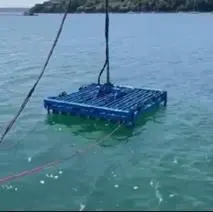
Marine civils firm Land & Water has teamed up with marine conservation organization Project Seagrass to design and build an automated seagrass planter (ASP).
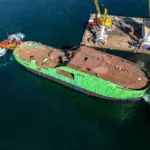
Seeds are loaded into the ASP, which is then transported out to sea on the deck of a multicat. It is lifted off the deck and swung out over the side to be lowered to the seabed – at which time the automated system takes over and seeds are planted on the ocean floor.
The approach, says Land & Water, is much less invasive than by hand or individual diver, with 64 sacks being planted at once and then covered over by the machine.
The work is being done with Land & Water’s division Earth Change as well as Swansea University.
Calling it ‘ground-breaking technology that promises to revolutionise the large-scale planting of seagrass’, Land & Water says it is currently testing the equipment before rolling it out commercially.
The ASP can accurately place sacks filled with sand and seeds in pre-assessed locations to ensure optimal growth conditions, Earth Change says, and can work in subtidal and intertidal areas in depths of up to six metres.
Its automated system is designed to space the seagrass plugs at their best positions and using GPS can record where they are placed. It can also be adjusted to accommodate different species, Earth Change says.
Seagrass meadows are thought to help maintain healthy marine environments and absorb carbon dioxide.
Trial planting regimes will be subject to ongoing monitoring by Project Seagrass to validate the effectiveness of the new planting regime. “We are excited by the planting results, and we must now see how this method of planting works,” said Richard Unsworth, associate professor at Swansea University.
Ultimately the plan is to roll out the ASP ‘in large-scale restoration initiatives worldwide’, say Earth Change and Project Seagrass, by working with governments, environment groups, research bodies and coastal communities.
“We found that at least 44% of the UK’s seagrass has been lost since 1936 – most of it since the 1980s,” said PhD candidate Alix Green and Dr Peter Jones, with the University of Swansea. “But when we modelled which coastal areas were likely to have been suitable for seagrass, we found that as much as 92% of it might have disappeared.
“The task of restoration of saltmarsh is enormous and made more difficult in temperate parts of the world as light quality is vital to the growth of seagrass. Most of the planting of seagrass is done by hand in the UK – by hand at low tide or by divers at a high cost and low output.”
Project Seagrass identified a site in Dale Bay, Pembrokeshire where seagrass has always been planted by hand. The recent test of a scalable prototype planted 2,000 bags in a day.