![MaritimeJournal[Seawork]](https://www.maritimejournal.com/wp-content/uploads/2026/09/MaritimeJournalSeawork.svg)



Bridging the gap: After-treatment keeps shipping afloat
As shipping faces mounting pressure to decarbonise, exhaust after-treatment specialist Eminox says the marine industry must remain realistic about what can be achieved in the short to medium term, and use cleaner diesel solutions until genuinely viable alternatives become widely available.
As shipping faces mounting pressure to decarbonise, exhaust after-treatment specialist Eminox says the marine industry must remain realistic about what can be achieved in the short to medium term, and use cleaner diesel solutions until genuinely viable alternatives become widely available.
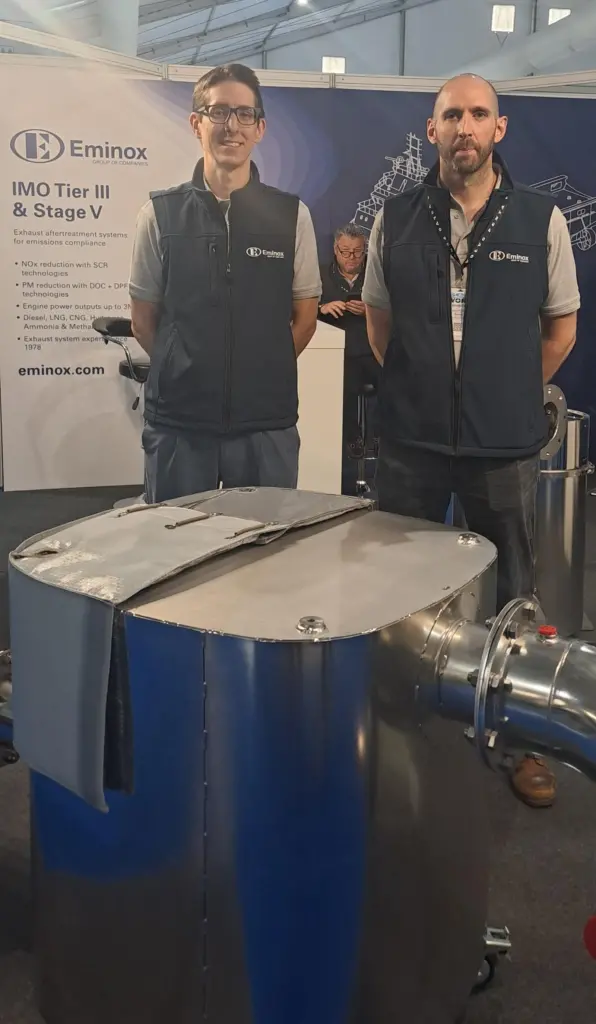
Speaking to Maritime Journal at the recent Seawork commercial marine conference and exhibition, where the company is a regular exhibitor, Engineering Director Dave Phillips said while vessel owners are increasingly recognising that compliance with tightening emissions legislation can no longer be postponed, they aren’t seeing realistic ways to adhere to it.
“Vessel owners are now realising they have to be IMO ready,” he said. “From 130kW up, there’s legislation in place across various vessels.
“For three or four years, exemptions have been in place and now there are fewer exemptions for NOx and particulate matter. More OEMs and end users are aware that they need an emissions solution. That it’s being regulated and exemptions removed.”
Phillips said inland waterways in Europe already operate under stringent emissions rules, while equivalent requirements are emerging elsewhere.
But he believes policy makers must acknowledge the limitations of today’s alternative fuels.
“You can’t penalise vessels for CO2, especially when alternative fuels aren’t readily available,” Phillips said. “If you want to do that you have to look at alternative fuels. I don’t think the technology is ready yet. We haven’t yet got a fully working policy for after-treatment implementation with existing fuels.”
“You also don’t have an abundance of alternative fuels. Methanol isn’t widely available. Ammonia produces nitrous oxide, a potent greenhouse gas, as well.”
While dual-fuel technologies may offer a way forward, Phillips said practical challenges remain.
“Dual fuel is an option – ammonia is viable as a dual fuel with diesel. Diesel as the pilot fuel. But you need six times as much storage capacity for ammonia compared with diesel. With hydrogen you would need over 10 times as much.”
In the meantime, Eminox believes conventional diesel engines can continue to play a significant role in reducing emissions.
“In the long term, diesel can be made cleaner,” Phillips said. “Realistically, the only fuel available is a hydrocarbon fuel. What can we do to help while keeping our economies afloat?”
After-treatment solution
The company’s answer lies in advanced exhaust aftertreatment technologies designed to meet stringent marine emissions regulations while allowing operators to continue using established propulsion systems.
Eminox’s modular IMO Tier III systems combine selective catalytic reduction (SCR) technology with integrated urea dosing, advanced exhaust gas mixing and sophisticated electronic controls. According to the company, the systems can reduce nitrogen oxides, carbon monoxide and hydrocarbons by up to 99%, even at relatively low exhaust temperatures.
For applications requiring particulate control, SCR can be integrated with diesel oxidation catalysts and diesel particulate filters, enabling compliance with standards including IMO Tier III and EU Stage V Inland Waterways legislation. Continuous monitoring of exhaust flow, sensors and onboard diagnostics is intended to maximise service intervals, while telemetry can provide operators with real-time performance and maintenance data.
Suitable for both newbuild and retrofit projects, Eminox systems are available for engines from 130kW to 3MW and can be installed aboard commercial workboats, fishing vessels, inland waterway craft, sea-going vessels and stationary marine power applications. Their modular design also helps accommodate challenging engine room layouts.
Phillips said Eminox is also working closely with engine manufacturers to improve integration.
“We are working with multiple engine manufacturers on fully integrating our after-treatment systems with their engines – ultimately we need to meet the regulations and then they need enforcing,” he said.
“I think you can’t undo globalization,” said Managing Director Jonathan Griffith, at the Seawork event. “You can’t turn back the clock. There’s nothing other than ICE at the moment. You have to be realistic. It’s the only way you can continue transportation in the way we are accustomed to, and we provide a realistic solution to all of it.”
Related Articles
 FEATURES & VIDEOS
 ENVIRONMENT
 OTHER NEWS