![MaritimeJournal[Seawork]](https://www.maritimejournal.com/wp-content/uploads/2026/09/MaritimeJournalSeawork.svg)




Busy times for European salvors
Greek salvor Tsavliris has completed a complex operation to recover a stranded yacht involving measures to protect an environmentally sensitive area.
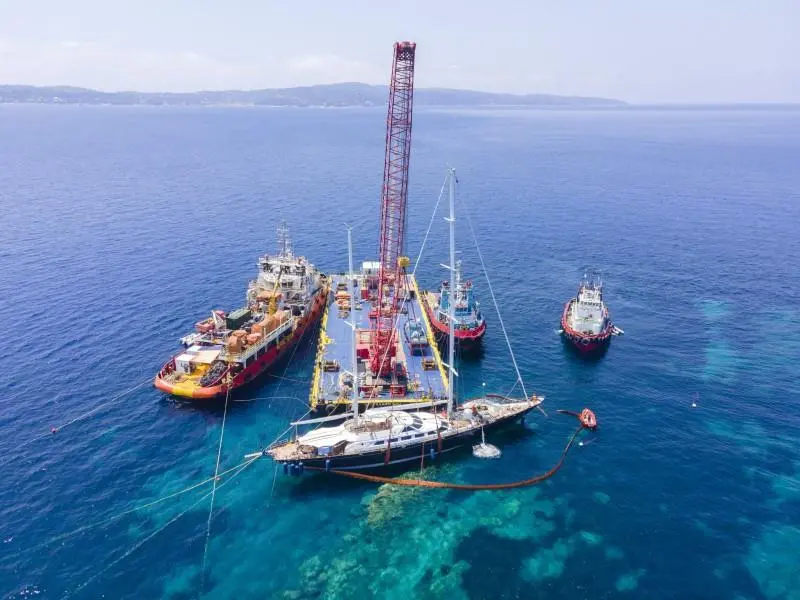
The 47m yacht, Tamarita, had stranded on Panagia Reef off Paxoi Island in the Ionian Sea, in an environmentally sensitive area included in the Natura 2000 network of Europe’s most valuable habitats.
The yacht suffered water ingress leading to a significant list and Tsavliris immediately mobilised local divers from Paxoi and Corfu Islands to the site, who succeeded in controlling the water ingress with diesel driven pumps and underwater patching.
Tsavliris also despatched a salvage team and equipment to the site, the response including mobilising its tug Proteas (45tbp) along with the Greece-owned anti-pollution vessel Aegis, despatched from Piraeus.
Underwater inspections by divers allowed a detailed assessment, whereby severe damage in the forward hull and significant water ingress was discovered.
The priority was to protect the environment, and all necessary precautions were taken to prevent pollution and reef damage while pumping, temporary patching and repairs continued.
Tamarita had around 30 tons of marine gas oil on board that was transferred to the Aegis and then loaded onto road tankers for delivery to the casualty’s sister vessel in Attica.
Heavy-lift crane
Calculations indicated that rock protrusions prevented re-floating the yacht without the assistance of a heavy-lift crane. Tamarita was subsequently re-floated with assistance from the 220t capacity floating crane C/B Clare, which was towed to the casualty site by the anchor-handling tug Pantokrator.
Four days after re-floating and following permission from port authorities, Proteas towed the yacht to a shipyard in Perama via the Corinth Canal, the entire operation completed safely two days later without any pollution.
Around 12,000km to the south, Tsavliris was in action again providing assistance for a somewhat larger vessel when the 87,326dwt bulk carrier Iolcos Dignity experienced engine problems and was immobilised 70 miles off East London, South Africa. The vessel was laden with 72,555t of soya beans at the time.
The African Marine Solutions Group (AMSOL)-owned AHTS Umkhuseli (205tbp) was tasked from Cape Town by Tsavliris and in adverse weather conditions established a towing connection with Iolcos Dignity, with destination Durban.
The convoy arrived safely at Durban and anchored with assistance from a second AMSOL tug, the RAmpage 5000 Siyanda (ex Smit Siyanda), where the operation was completed.
Local salvage for Multraship
The world’s leading marine salvage companies operate in a global market, so it is a welcome bonus when a casualty presents itself on their doorstep.
Such was the case for Dutch towage and salvage contractor Multraship, when the crane barge Jowi sank in the outer harbour at Terneuzen, Multraship’s home base.
The crane barge sank suddenly in the West Buitenhaven and after thorough inspection and preparations by Multraship’s salvage and diving teams, the barge was re-floated, its crane and other lost parts recovered within a week of the sinking.
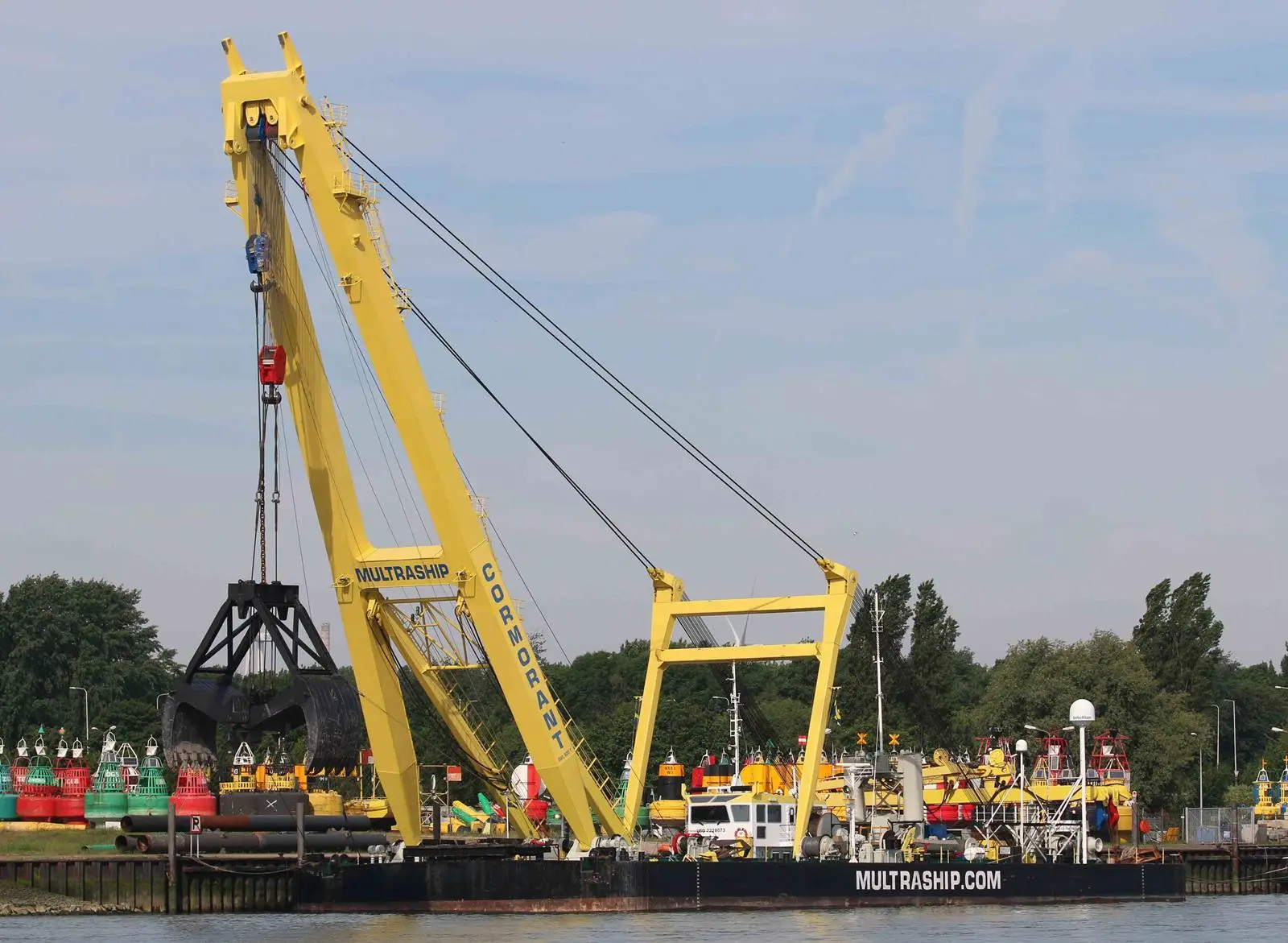
Assets deployed for the operation included Multraship’s 600t capacity crane barge Cormorant (ex Magnus), the salvage ship Multrasalvor 4, a vessel originally part of the Smit Salvage/van den Akker fleet operating as Duerloo and Multraship’s 1939-built tug Multratug 2.
Finally, a successful rescue operation in the Bay of Biscay that could easily pass under the radar illustrates the value of stationing Emergency Towing Vessels at strategic locations to help prevent pollution, a policy the French government has embraced after learning the hard way.
Les Abeilles reports that its UT515-design, 2005-built, 209tbp salvage tug Abeille Bourbon was tasked from its salvage station at Brest after the 150m general cargo vessel Guana suffered a fire in the engine room and went adrift without propulsion in the Bay of Biscay. Guana was on passage from the UK to Turkey at the time and had broadcast a Mayday distress call.
Once on scene, Abeille Bourbon found the Guana abandoned with SW Beaufort force 8 winds and 6 to 9 metre swells pushing the vessel to the coast with potential for significant pollution should it ground.
In just a few lines that doubtless hide the actual conditions, the International Salvage Union reports: “Three crew members of the Abeille Bourbon were hoisted on the casualty to establish the towing line and she was safely towed to the port of Brest.”
Related Articles
 FEATURES & VIDEOS
 ENVIRONMENT
 OTHER NEWS