![MaritimeJournal[Seawork]](https://www.maritimejournal.com/wp-content/uploads/2026/09/MaritimeJournalSeawork.svg)




Can ports really achieve Net Zero by 2050?
At the GreenPort in Le Havre this week, a panel tried to answer the billion dollar question from chairman Chris Wooldridge: can ports really hit Net Zero by 2050?
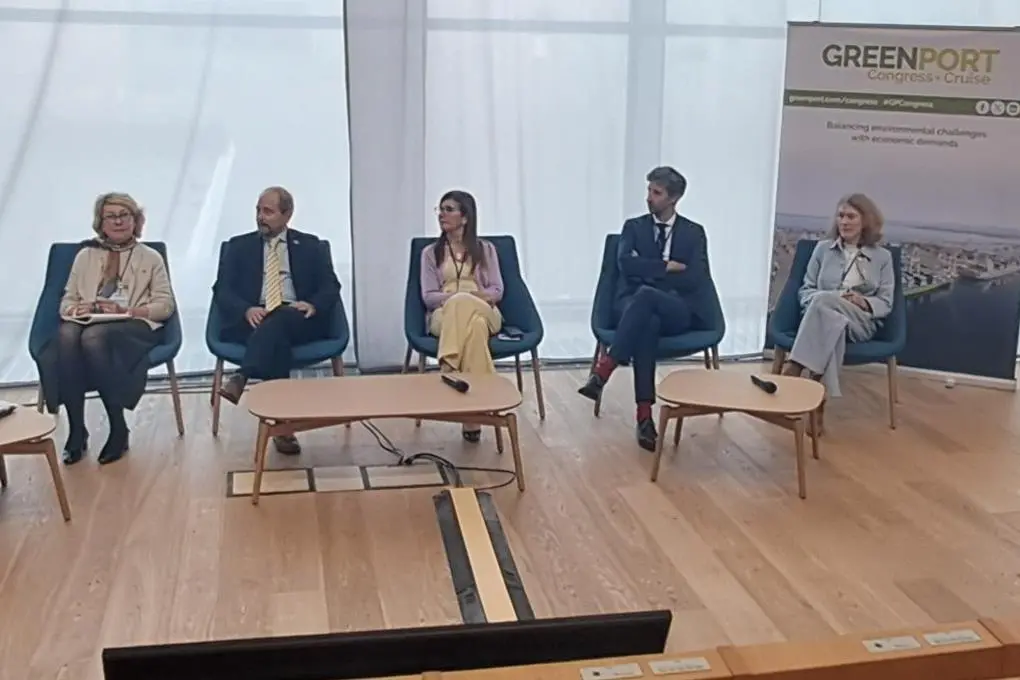
The looming EU target is causing a few anxieties, and with port operators in the past three years putting ‘Climate change’ as their number one concern, industry is coming together to bash out how they can hit it.
“I hope so but it will be challenging,” said Isabelle Ryckbost, Secretary General, ESPO, summing up what the panel basically agreed throughout the discussion. “We always say ports are part of the problem, but they are also part of the solution.”
Indeed, as FEPORT Secretary General Lamia Kerdjoudi said, ports themselves only produce 10 per cent of the pollution – the rest comes the customers who use them.
“Air doesn’t stop at the borders of the EU,” she said. “European ports are making a lot of effort, providing alternative fuels and so on; we want to reach the targets but we have to remain competitive and preserve employment. There is a lot of competition outside the EU and we have to be pragmatic and realistic, otherwise we will shoot ourselves.”
Policy makers, said Ryckbost, were keen to tell ports that they ‘can do this and do that’ – but is there a business case?
“We are trying to decarbonise while everyone is also trying to maintain their competitiveness,” said Antonis Michail, Technical Director, IAPH & WPSP IAPH. “I don’t know how we are going to do all this.”
“It will be difficult to reach the 2050 target, with the uncertainty over future fuels and so on, and that mentality takes a long time to change,” said Cedric Virciglio, Strategic Planning Director, HAROPA Port, citing the example of Dunkirk, where a system had been installed 12 years ago and to date, just one vessel had connected to it.
Global policy
“We are seeing it at a European level but I’m not seeing it at a global level,” said Ryckbost. “We have to live with this EU framework and we just have to hope that the new commission will listen more to the fact that it’s not so much why, as how. Tick box regulations and reporting is not green.
“It’s only at EU level that you have these strict measures, with the European parliament seeming to say it doesn’t matter what it takes, whatever it costs.”
The panel discussed the fact that developing countries may find strict environment regulations unfair.
“Developing countries need to become developed,” said Michail. “But that’s a global problem.”
“We have to look at the economic side of it,” said Ryckbost. “We have a strict framework to work in but I don’t think we will ever have a global policy.”
“If you are a country seeking development and getting access to what the western world has had access to, it’s very difficult to tell them ‘you have to go back to environment rules and reduce consumption,” said Kerdjoudj. “It’s a legitimate point of view, but I think awareness will come, when people see the damage it will play a role in making policy makers decide in the court of public opinion.”
“We need to achieve these targets,” said Michail. “We need a global pathway to hit the targets by 2050 at the latest.”
Related Articles
 FEATURES & VIDEOS
 ENVIRONMENT
 OTHER NEWS