![MaritimeJournal[Seawork]](https://www.maritimejournal.com/wp-content/uploads/2026/09/MaritimeJournalSeawork.svg)





Canada seeks European expertise on offshore wind drive
Canada will turn to Europe in its drive to unlock offshore wind potential, the government has said.
A spokeswoman from Natural Resources Canada, which is part of the government, said it and the province of Nova Scotia, which has been earmarked for the first four offshore wind farms, are engaging with international partners such as the Denmark-based Global Offshore Wind Alliance and European countries.
”This also includes collaboration with European countries, where offshore wind is more advanced, to learn from their experience and innovations.”
The comment is likely to bring some relief in the wake of Canada’s southern neighbour’s overhaul of the offshore wind industry, with several projects being cancelled or put on ice. In fact a few international developers, such as Equinor, had put their projects on hold before the Trump administration re-took power because of supply chain issues and high interest rates, according to the analyst company FactSet.
“Of the nearly 40 GW of capacity expected to be operational by 2030, 44% has already been cancelled by international developers,” it says. “Projects that still remained under development hit another regulatory setback after the Trump administration removed tax credits available to offshore wind with the passage of the One Big Beautiful Bill Act. This might be the final blow, or at the very least a serious delay, for the 14.5GW of projects yet to start construction.”
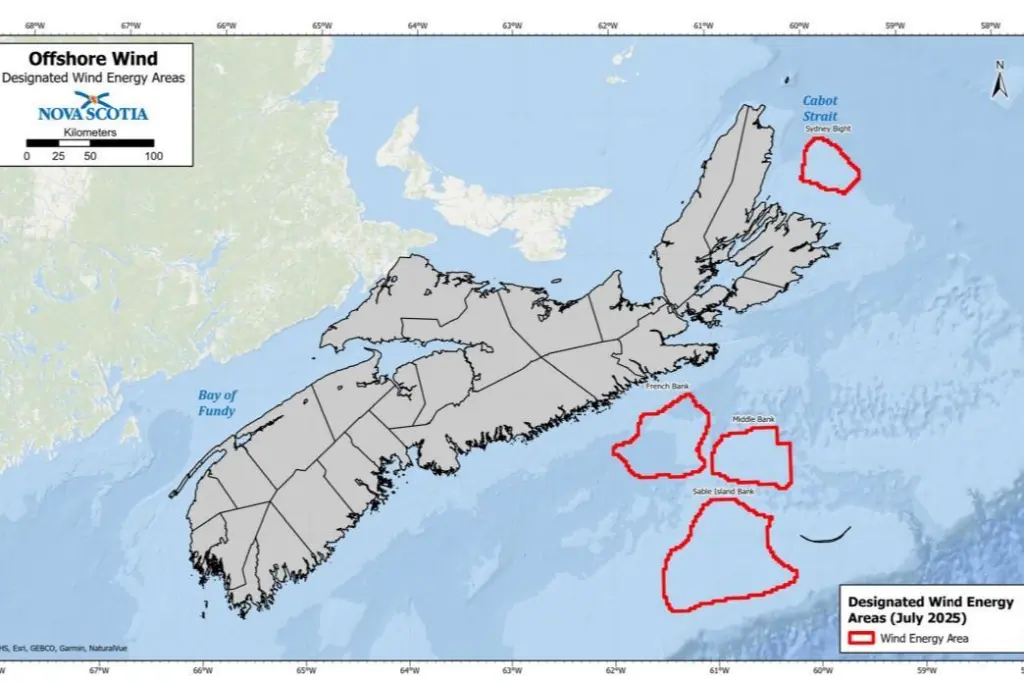
Back in Canada, as Maritime Journal reported last week, four areas have been earmarked for development – French Bank, Middle Bank, Sable Island Bank, and Sydney Bight.
“These areas will be the subject of a first call for bids, expected later this year, in line with Nova Scotia’s goal of licensing the equivalent to 5 gigawatts (GW) by 2030,” the spokeswoman said.
“Canada’s move into offshore wind reflects a broader shift in national strategy. The country is focused on building energy projects that secure our sovereignty, reduce emissions, and create long-term economic benefits. Offshore wind is a natural extension of this ambition — especially in Nova Scotia, where strong wind resources and suitable water depths and seabed conditions offer world-class potential.”
The reason Canada has been so late to offshore wind is because of its historically abundant supply of onshore renewable resources, she said, such as hydroelectric power, solar and biomass energy.
“This, combined with the need to establish clear legislative and regulatory frameworks and secure provincial procurement commitments, has shaped the pace of offshore wind development in Canada.”
Scaling offshore wind will require a lot of work, such as completing a Call for Bids process; setting up a route-to-market for offshore wind energy and the necessary grid infrastructure; enabling permitting and investment timelines; and, importantly for Europe, robust supply chains for vital specialised vessels, equipment and technological expertise.
Canada’s goal, said the spokeswoman, is to license the equivalent of 5GW by 2030.
Related Articles
 FEATURES & VIDEOS
 ENVIRONMENT
 OTHER NEWS