![MaritimeJournal[Seawork]](https://www.maritimejournal.com/wp-content/uploads/2026/09/MaritimeJournalSeawork.svg)


Floating wind: Costs, challenges and path to commercial scale
Speakers at a floating wind session at the recent WindEurope conference in Madrid highlighted the scale of the challenge ahead and the steps needed to bring the technology to commercial viability.
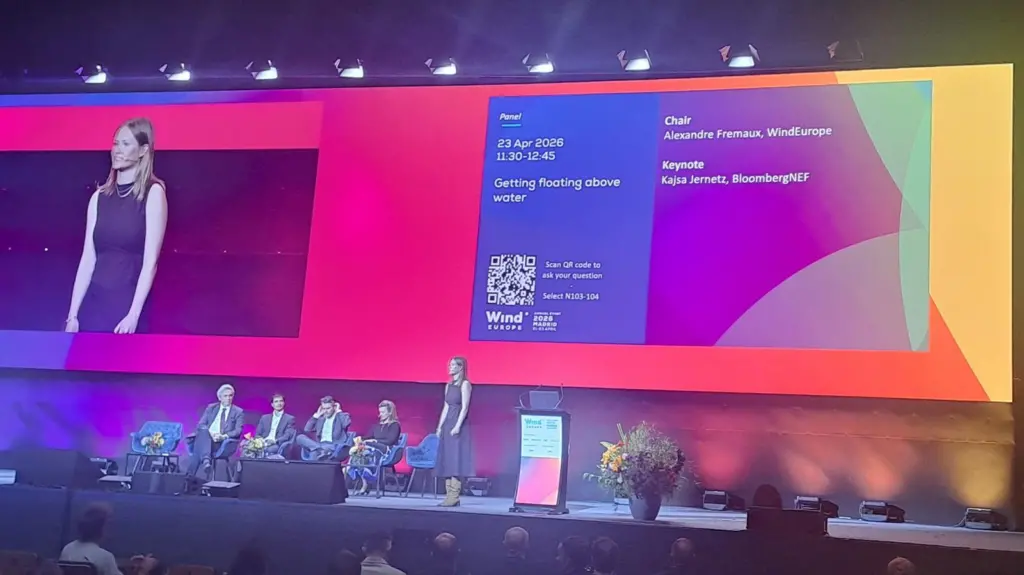
Giving the keynote speech at the ‘Getting Floating Wind Above the Water’ session, BloombergNEF’s Offshore Wind Analyst Kajsa Jernetz said earlier plans for commercial-scale projects to go ahead from 2030 were looking ‘less and less likely’.
“There’s an annual installation target of in countries like Greece and Spain but this will be no small feat and will still remain niche,” she said. “By 2040 we expect cumulative capacity. It will mainly be built in markets that lack other options, like waters that are too deep for fixed bottom.”
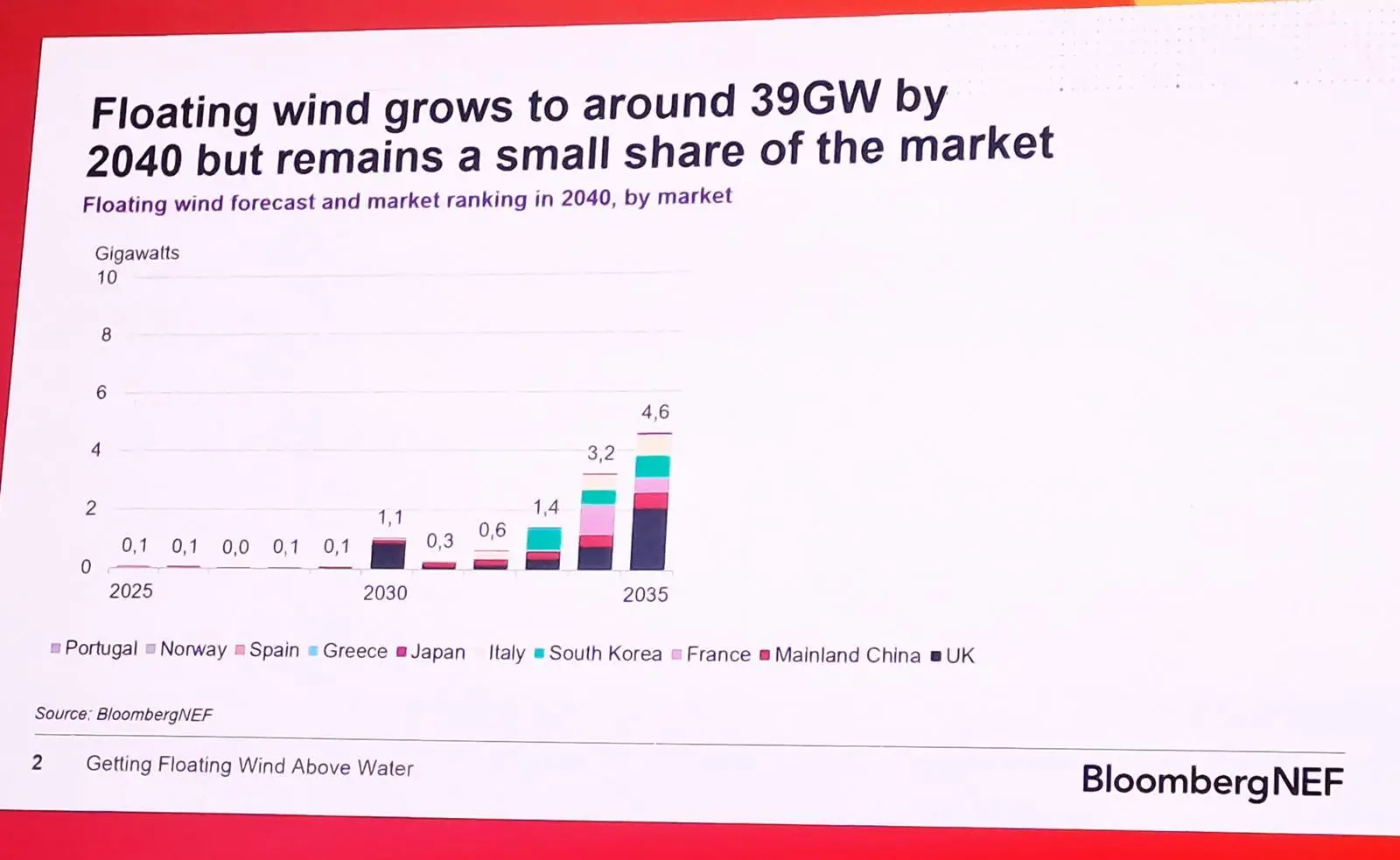
France has a much higher target of offshore wind by 2050, which means a large part of it is going to have to come from floating wind.
It could also be ramped up in areas like the North Sea, where shallower waters with fixed-bottom turbines nearer to shore were ‘already quite crowded’, said Jernetz.
The industry was still fragmented, with more than half of capacity still up for grabs, and it remained reliant on subsidies. Countries were moving back towards subsidising the sector, she said, with diverse auction frameworks emerging. She also cautioned that a successful auction does not always mean a project will go ahead, pointing to the example of a large Equinor project in South – the biggest floating wind project in the world – which was hit by inflation and cancelled.
Costs
For floating wind to succeed, costs have to come down ‘dramatically and continuously’, said Jernetz.
She said an early pilot project in Portugal had cost an eye-watering $23 million per megawatt, and although was no longer operational, had been considered a success in its five years of operation.
“Innovation will drive costs down,” said Alexandre Fremaux, with WindEurope.
Cost and bottlenecks were the major challenges, said Copenhagen Infrastructure Partners Associate Partner Larsen, who said the technology exists but industrialisation of manufacturing the mooring lines, dynamic cables and so on needed work.
“No new concepts are needed,” he said. “But more engineering investment is required.”
Bottlenecks
Several speakers identified grid limitations as a main obstacle to adoption, with the UK’s Department of Energy and Net Zero (DESNZ) admitting that millions of pounds a year are spent on switching turbines off because there is nowhere for the electricity they generate to go.
“The biggest challenge is grid availability,” said Laurent Verdier, Chief Business Development Officer at BW Ideol. “We also believe that component standardisation is needed” – something else that was echoed by other speakers, along with the need for competition.
“Industry has a role to impose some level of standardisation so that everyone has a more common language and framework,” said Severine Baudic, the CEO of Ekwil, a joint venture for floating offshore wind of SBM Offshore and Technip Energies.
“A modular design, a standard interface would improve competitiveness, which we need. The market can’t happen with just one turbine supplier.”
“The bad news is it takes time to build floating wind, but we are getting costs down and seeing technical improvements,” said Jan-Fredrik Stadaas, senior Strategy Advisor with Equinor. “It also brings value – cost reductions will come with scale. There is value in home-grown electricity. Floating wind can be built locally, a lot of the equipment and vessels is produced quite close to the market. We need to develop support systems and make them a lot more robust, and have the mindset that floating wind is a long-term development.”
Related Articles
 FEATURES & VIDEOS
 ENVIRONMENT
 OTHER NEWS