![MaritimeJournal[Seawork]](https://www.maritimejournal.com/wp-content/uploads/2026/09/MaritimeJournalSeawork.svg)

INTERVIEW: Stillstrom on the brink of offshore charging roll-out
 Part of our special report
Marine Batteries & Electrification · July 2026
All 8 features
Part of our special report
Marine Batteries & Electrification · July 2026
All 8 features
With the benefits of hindsight, a good question to pose is why at an electricity-generating offshore wind farm, electricity wasn’t used on site to charge the vessels carrying out operations and maintenance there. A no-brainer, you might think today.

But at the time, the idea of offshore vessel charging simply wasn’t on the radar.
“When the first offshore wind farms were built, battery technology was still in its infancy in the maritime sector,” says Stillstrom CEO Kristian Borum Jørgensen. “It was only just being introduced for limited applications like peak shaving – and most wind farms were close enough to shore that vessels could return easily each day, reducing the perceived need for electrification offshore.”
Service Operation Vessels (SOVs) have long played a key role in offshore wind operations. What’s changed is the scale and scope of their deployment. As wind farms grow in size and move further offshore, there’s a growing emphasis on keeping SOVs stationed at sea for extended periods, sometimes days or weeks, to maximise efficiency. The larger size of these modern vessels also allows for greater battery capacity, opening the door to cleaner, electrified operations.
Stillstrom (which means “quiet power”) began as a project in a division of Maersk in 2019, with a clear mission: to explore offshore power and charging solutions aimed at decarbonising the maritime sector.
“We saw other developments within wind where offshore wind farms were getting further from shore – and we saw the number of SOVs increase,” Jørgensen says. “We could see that the wind farms were providing clean, green, cheap electricity in abundance – so we asked, why can’t you actually provide the vessel with it?”
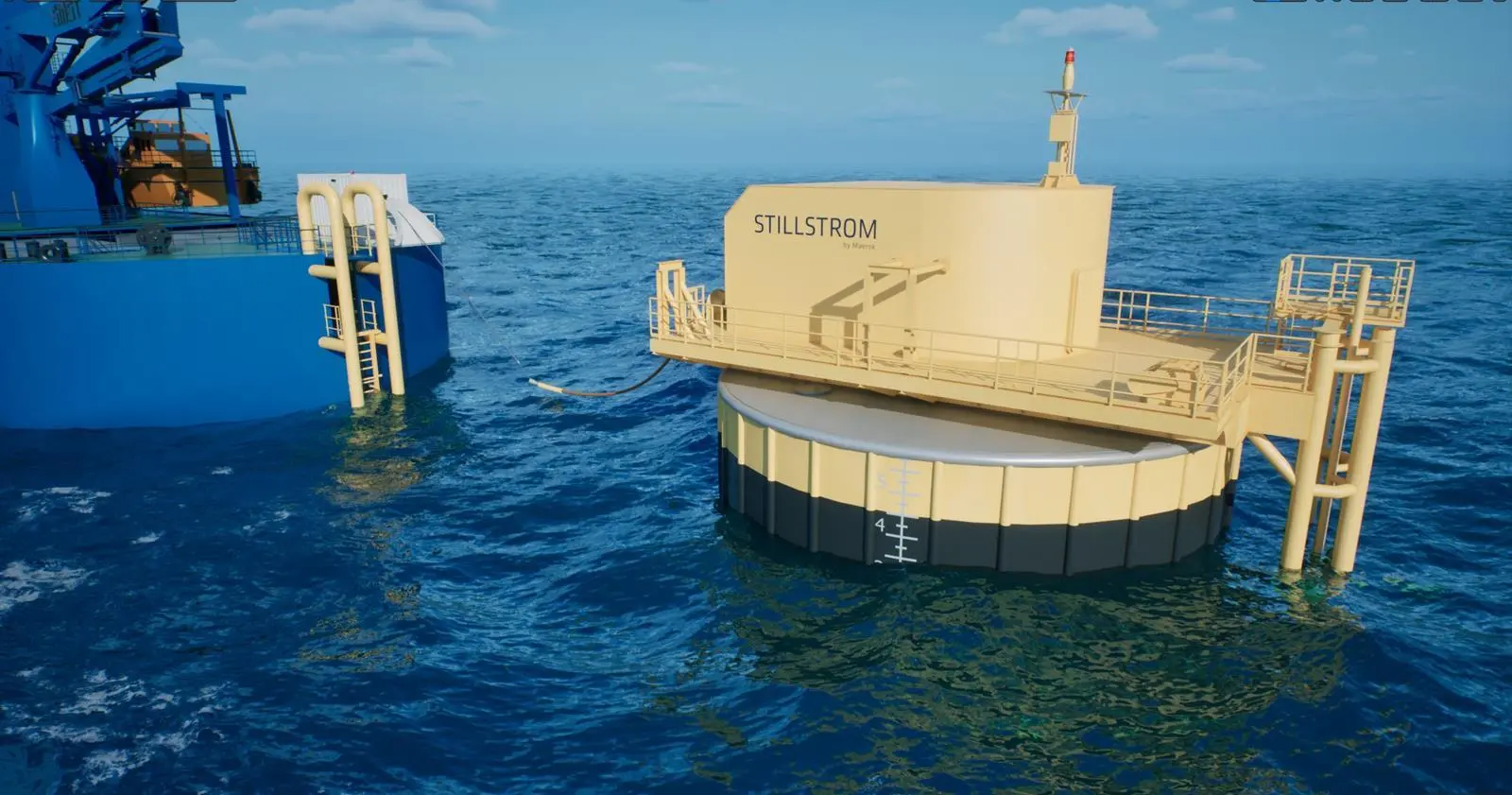
Stillstrom’s charging systems can be provided by buoy; or as a hang-off solution mounted on fixed structures such as a monopile, a substation or directly on the wind turbine – and the electricity comes from the wind farm’s own electricity grid.
And the beauty of Stillstrom’s offshore charging is that the technology can be used elsewhere as well.
Zero Emissions Anchorage Zones
Stillstrom is approaching two markets with its offshore charging solutions: offshore wind, and in anchorage zones outside ports, where thousands of vessels sit every day, idling, consuming diesel.
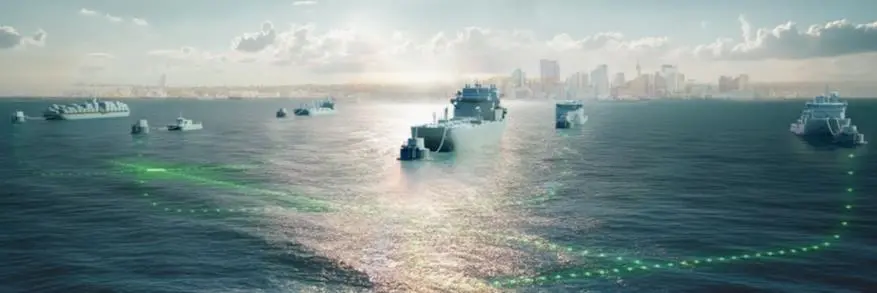
“In parts of the industry, vessels are spending a lot of time just being idle, waiting for the next job or for the client to give directions,” says Jørgensen. “We saw shore power being brought into ports around the world, and more and more vessels were being converted to take on board shore power and our thinking was quite simple: Why can’t we do that offshore?
“Many vessels don’t actually spend a lot of time in port; they are often spending a lot of time outside them – so why not give them access to electricity there?”
And so, the offshore charging solution idea was born, not only at wind farms, but outside ports the size of Hamburg and Antwerp, and while not in place yet, Stillstrom is already studying the feasibility of integrating their system in the Panama Canal.
There’s a lot to be worked out: when and at which charging point the vessels can hook up, and if the shore grid has enough capacity – but Jørgensen says there is actually quite a predictable timetable, because these vessels often operate on a schedule and slots can be worked out according to their operations.
The amount of power required is a completely different ballgame from electric vehicle charging, which requires about 300kW, whereas a vessel would need up to 20 times that.
“If you look at the zero-emissions anchorage zones, it can be anywhere up to 8MW, but it can also be 1MW or below, depending on the vessel size and type: a container vessel with refrigeration, or an LNG vessel that needs to be cooled, will consume a lot more than a standard bulk carrier vessel.
“And we would look at those anchorage zones where you have some of the same vessels coming back over and over again, running on long-term contracts on more or less the same schedules. We have a good example of the anchorage outside the Port of Skagen in Denmark, where vessels are anchored for days, even weeks, until they get the call, go out and come back again.
“The technology is not new, either – what’s new is the combination of the technologies into one. Delivering power to a vessel has been done in ports for many years now, and we’re basically combining and working out the complexity of doing it offshore close to port. There are a lot of other safety aspects – such as you need to have an emergency disconnect system, etc.”
Battery charging and development
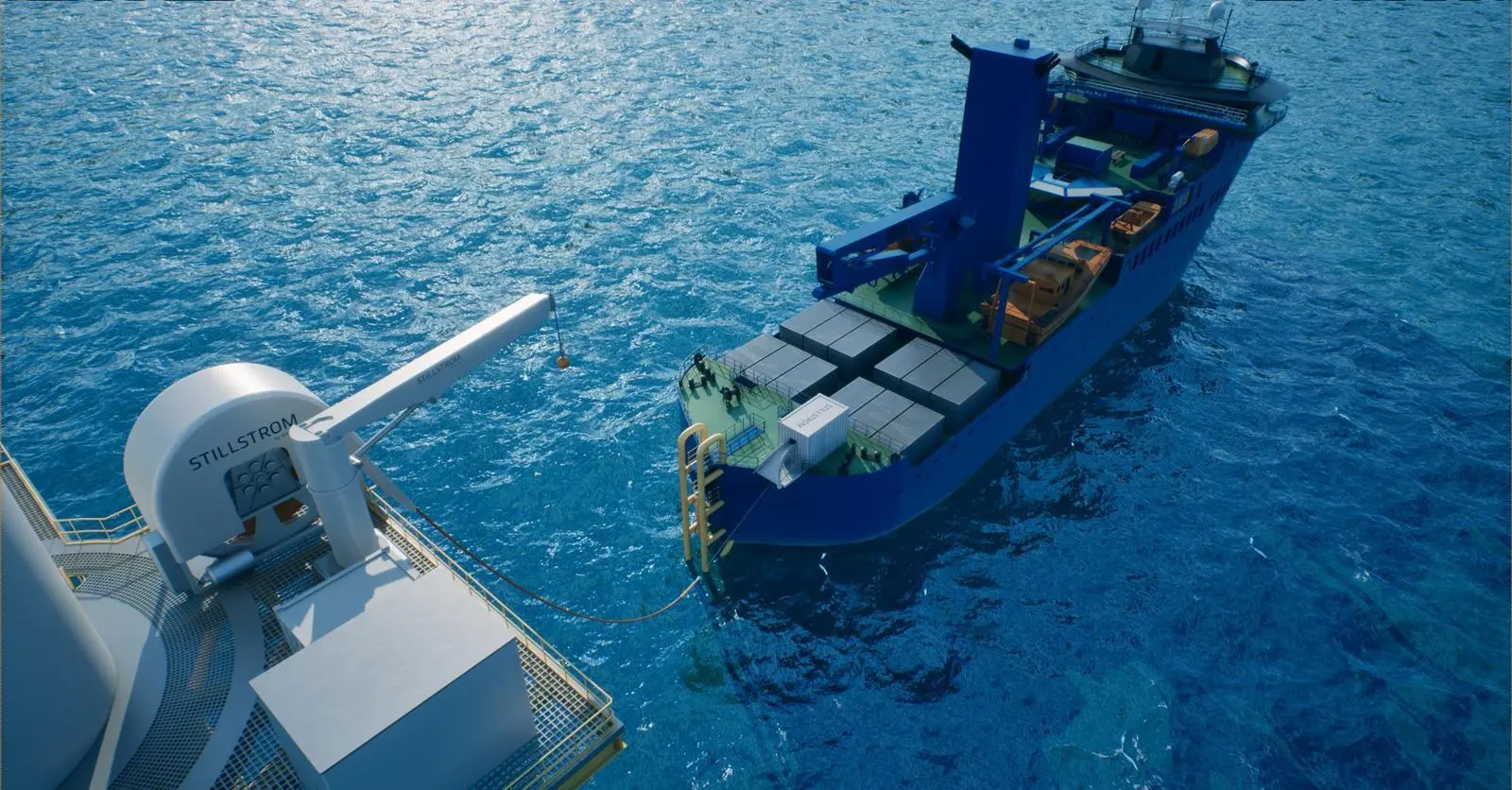
“For offshore wind the system will provide up to 8MW of power,” says Jørgensen. “It’s a significant amount and for an SOV you will probably see a battery capacity of 20-30MWh, and we need to charge the battery within four to five hours.
“We want to make it as easy as possible for the wind farm developers. The standard at a wind farm is 66kV, and our system transforms the power so it can be delivered safely to the vessel. With an SOV, you can – to put it simply – take out two gensets and put in batteries to make it an eSOV. It will run on the batteries all day and charge at night, to be ready for the following day. We are currently working closely with most larger SOV owners.
“We are seeing this change in the industry – if you go back a few years, most companies were talking about e-methanol, but now everyone’s talking about e-SOVs. It simply makes a lot more sense to use the energy in the wind farm, it’s a much better business case because when you make these new fuels you lose so much of the energy in just making them.
“If you’re able to electrify, you should electrify.”
And the cost compared to diesel?
“You actually have a business case that’s on par,” says Jørgensen. “It’s quite often cheaper, and you avoid the uncertainties of regulations and oil prices and so on. Battery technology is rapidly advancing and the cost has gone down significantly. New companies are stepping up – and where marine batteries used to be much more expensive, prices are really coming down very steeply.”
Energy density has also improved, meaning less space is needed for the same amount of power. And they are lasting longer – up to 15 years, Jørgensen says.
Next steps
Jørgensen says Stillstrom’s technology is commercially ready, and he is having ‘concrete dialogues’ with major global wind farm developers as well as some of the busiest ports and hubs across the globe.
Standardisation is being discussed, and Stillstrom is part of a body that’s looking to make that happen across the board.
“When I look at the future, I think it will be a mix of methanol, ammonia, batteries, standard diesel, MGO and so on,” Jørgensen says. “In general, when we compare against other sort of low-emission fuels like e-methanol, for instance, to create e-methanol you need to take it through the process, and you lose more than half of the energy.
“It’s a big pie but we definitely see that batteries and offshore charging will take a piece of that pie. The pie is very big, so you don’t need to take half the pie to have a decent business, you only need a small piece.
“You will not see the largest ocean-going vessels going from Asia to Europe being converted to battery technology tomorrow, but you will have batteries as being very, very relevant and that’s also proven by a number of studies, not just by us, but by different bodies that have been looking into this.
“I’m being biased here, but we have seen huge developments in the past year or two, our organisation has invested a lot in this and this is happening, this year.”
All photographs courtesy of Stillstrom
Related Articles
 FEATURES & VIDEOS
 ENVIRONMENT
 OTHER NEWS