![MaritimeJournal[Seawork]](https://www.maritimejournal.com/wp-content/uploads/2026/09/MaritimeJournalSeawork.svg)






Major OSW milestone hit as Canada, US look positive
A milestone has been reached at Ørsted and Eversource’s first US offshore wind farm, with the first XXL monopile foundation installed.
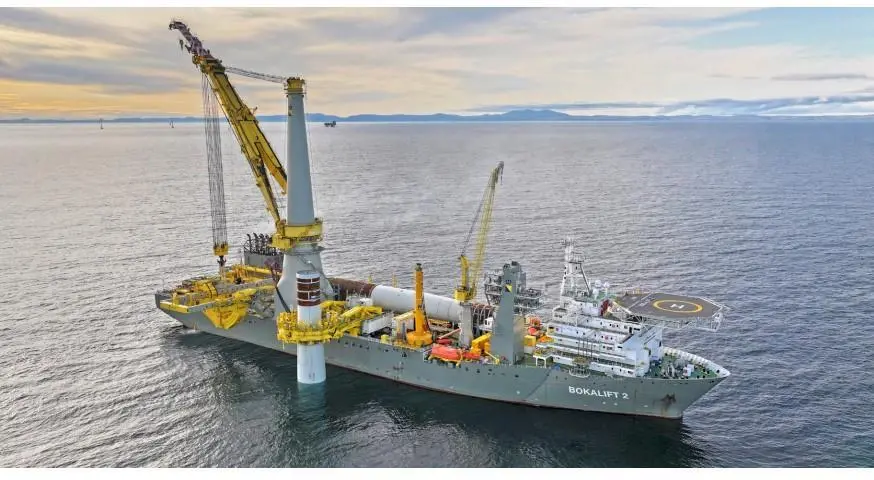
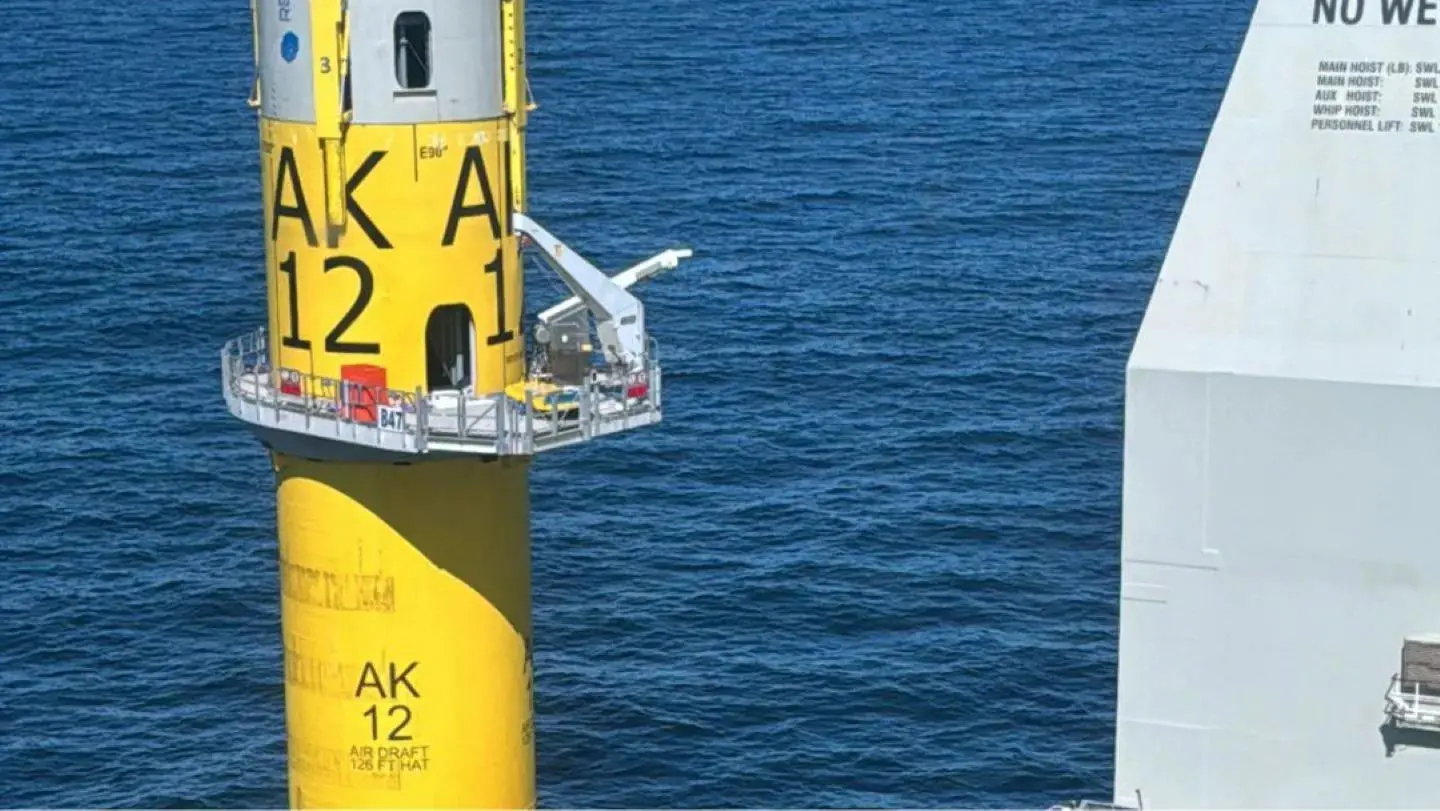
The monopile is the first of 66 earmarked for Revolution Wind, an offshore wind project led by Ørsted and Eversource at Rhode Island and Connecticut. It is the first utility-scale offshore wind farm in the area and the first multi-state project in the US.
Revolution Wind should have a power generation capacity of 704MW, which means the turbines will each be about 11MW – not today’s largest, but much bigger than those of just 10 years ago. The electricity supply will be divided between the two states.
Marine contractor Boskalis’ crane vessel Bokalift 2, a 4,000t offshore construction built by Harland & Wolff in 2000 and converted in 2020, is 231 metres in length with a width of 49 metres.
Boskalis’ other vessel, Bokalift 1, a slightly smaller 3,000t vessel, will install the secondary steel elements in and around the foundations, Boskalis says. The company’s semi-submersible heavy transport vessels will take the monopiles to the site.
Ørsted’s David Hardy said the project was important in scaling up America’s offshore wind industry, with the ability to generate more power than previous projects combined.
Positive signs across the Pond
Despite some reluctance to offshore wind in the United States, this project has received strong support from federal representatives, who see it as a critical component of the clean energy infrastructure, reducing long-term energy costs and emissions, and enhancing energy independence.
In a recent statement, consultancy Intelatus Global Partners also said ’the fundamentals are looking surprisingly positive in the context of what has taken place over the last 12 months’.
“In fact,” said Philip Lewis, at Intelatus, “the key concern for developers and the supply chain will be any negative impacts to offshore wind development arising from the forthcoming presidential elections.”
Lewis said the optimism could be seen with federal plans to offer leases this year with a minimum of 22GW in 16 sites in the Central Atlantic, Gulf of Mexico, Gulf of Maine and Oregon.
“Recent activity translates to more than 70 imminent, short‐term, medium‐term, longer‐term and future projects in our forecast which represent a CAPEX opportunity of more than $420 billion and an annual recurring operations and maintenance OPEX of around $9.8 billion,” he said.
In New York, three projects that were cancelled some months ago look likely to be revived after a new offshore wind solicitation for 2.6GW was released by the state in May, and other states including New Jersey, Maryland and Delaware were making moves in a similar direction.
The picture was also rosier in Canada, he said, where the province of Newfoundland and Labrador had identified 77 wind licensing areas with a theoretical potential of 94.5GW, including bottom-fixed and floating sites.
Nova Scotia has identified six potential offshore wind development areas, all no closer than 25 kilometres from shore, for future study for offshore wind development,” Lewis said. “The theoretical potential of the areas amounts to more than 34.5 GW. The six sites contain both bottom-fixed and floating wind potential.”
Revolution Wind’s construction involves three New England ports: New London, Connecticut for turbine components; Providence, Rhode Island for foundation components; and Quonset Point for crew operations. The project is expected to be operational by 2025.
Related Articles
 FEATURES & VIDEOS
 ENVIRONMENT
 OTHER NEWS