![MaritimeJournal[Seawork]](https://www.maritimejournal.com/wp-content/uploads/2026/09/MaritimeJournalSeawork.svg)






Study confirms charging viability at wind farms
A study into the viability of charging electric support vessels at the offshore wind farms they work on has shown the practice is technically and financially feasible.
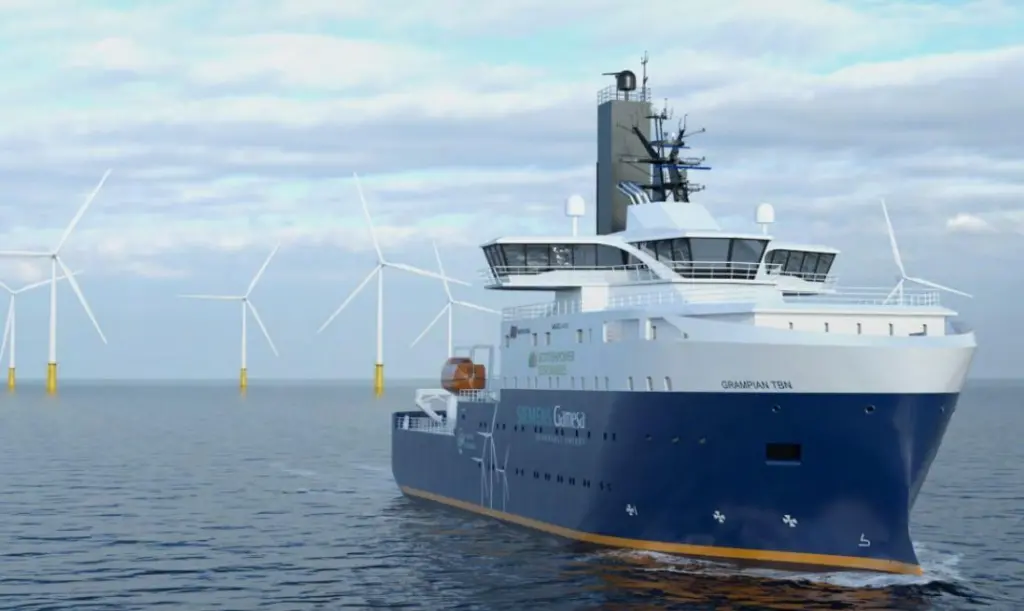
ScottishPower Renewables, part of the Spanish energy company Iberdrola, and Maersk firm Stillstrom commissioned the study as the first in a series of three exploring how to make offshore operations ‘greener’.
It has proved, the partners say, that ‘the electrification of offshore operations is not only technically feasible – but could also deliver both economic and operational benefits’.
In a white paper of the study, the business case for charging vessels offshore is found to be competitive with marine gas oil-fuelled vessels, and cheaper than using alternative fuels such as methanol.
The study claims that electric Service Operation Vessels (E-SOVs) can operate on electric power for up to 19 hours a day without needing to charge.
The vessel can then be plugged into one of one of Stillstrom’s modular chargers – at an offshore substation, wind turbine generator or using a buoy solution.
The study compares four charging methods: hang-off on an offshore substation (OSS), which it says has the lowest CAPEX costs; hang-off on a wind turbine generator (WTG); using an OSS buoy, or a WTG buoy.
It found that the buoy solutions had the highest operating costs and were more complicated with access as available space is more limited. Underwater maintenance would also be required on a buoy, the white paper says, something that would not be necessary on a WTG or OSS.
“The study with Stillstrom provides valuable learning on how this innovative technology could be integrated into offshore wind farms and shows the art of the possible,” said ScottishPower Renewables managing director for Offshore Ross Ovens. “What we need to do now is consider what this means in practice and what that would look like in real life.”
Stillstrom CEO Kristian Borum Jorgensen said: “Our collaboration with SPR highlights the potential of E-SOVs to full decarbonise vessel operations in offshore wind farms, making them more sustainable and cost-effective. With our offshore charging solutions now commercially ready, we are excited to deliver practical systems that accelerate decarbonisation and enable a cleaner future for offshore operations.”
Related Articles
 FEATURES & VIDEOS
 ENVIRONMENT
 OTHER NEWS