![MaritimeJournal[Seawork]](https://www.maritimejournal.com/wp-content/uploads/2026/09/MaritimeJournalSeawork.svg)


Workboat conference discusses hydrogen amid looming penalties
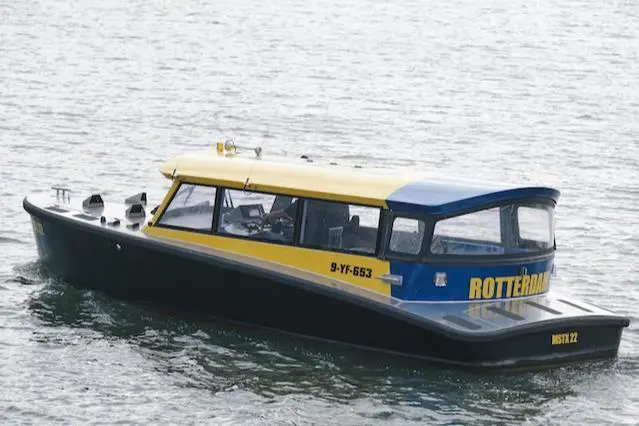
Among the many themes at last week’s Get Set Workboat 2050 Seawork conference in Rotterdam was hydrogen – and with the famous hydrogen water taxis whizzing up and down the Nieuwe Masse literally outside the door, it was an apt topic.
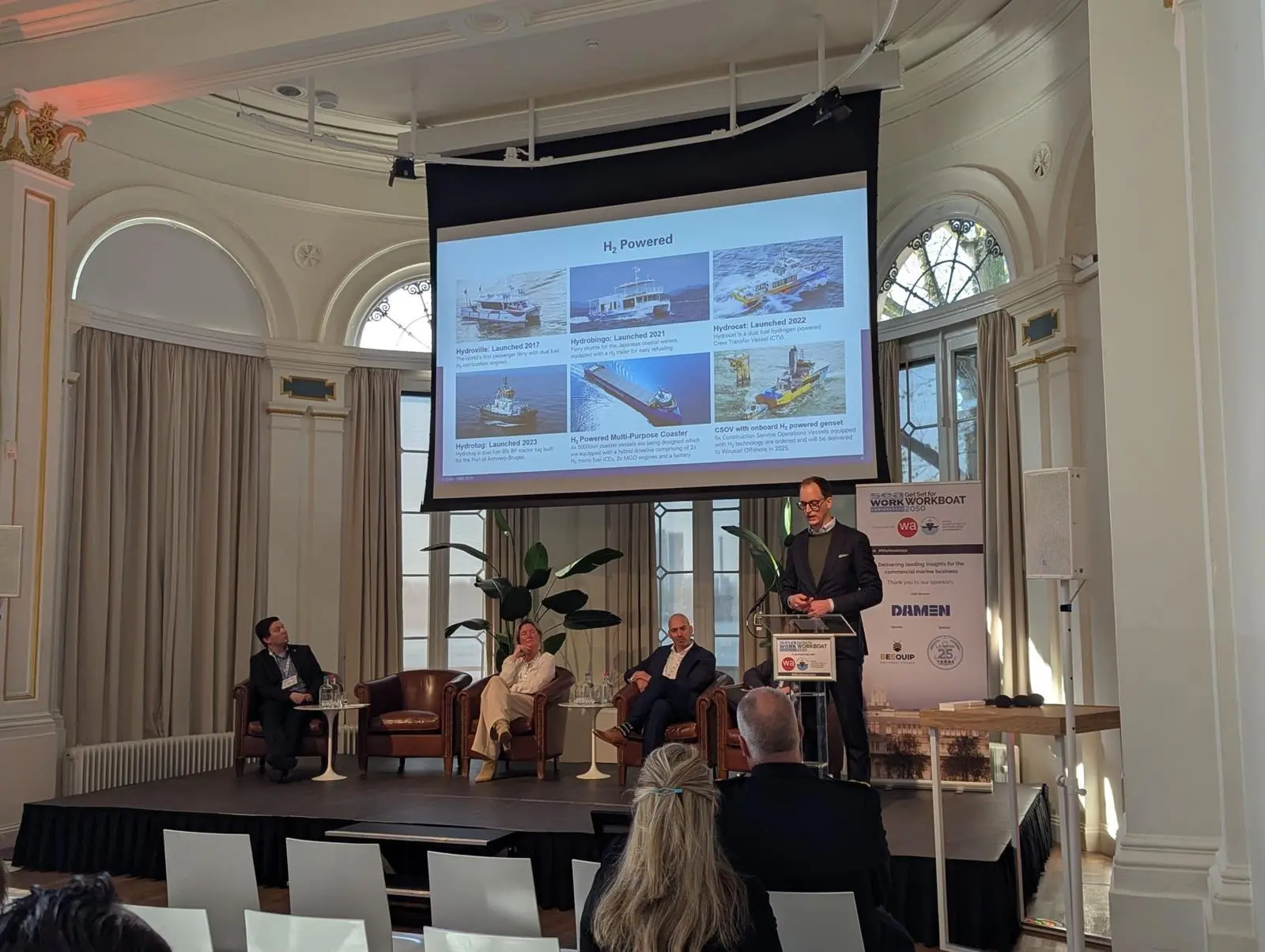
Windcat Workboats managing director Willem van der Wel told delegates about several projects happening under their watch: such as the dual-fuel hydrogen CTV that was going to begin operations in the UK the following week.
This was the second, larger iteration of a CTV that was already operating using hydrogen as a secondary fuel – in the earlier case, carrying 230kg of the fuel, in the newer case, up to 450kg.
“I don’t think the technology is necessarily a challenge – there are a lot of solutions available today that can be used on vessels,” he said. “Decarbonising North Sea operations is an opportunity.”
Dual-fuel combustion engines were used, he said, and the solution was easy to implement – but all vessels still had to be able to run on pure diesel because of the lack of available hydrogen, and not wanting to be ‘stopped in our tracks’, he said.
But this was the same with all new technologies, such as electric vehicles, where the problem of where to charge had now largely been solved.
“When you look at these kinds of developments, it’s always a chicken and egg,” he said.
Options for providing hydrogen
In what he called ‘the early days of the hydrogen economy’, one option Windcat had used was a mobile bunkering solution, he said, with the gas stored in a trailer at 500 bar of pressure. It could be moved to where it was needed – ‘bridging the gap between where the hydrogen is produced and where we want to use it’.
Another, built by Windcat owner CMB Tech, was a full-fledged, multi-model re-fuelling station at Antwerp. This supplied road-side vehicles but could also be sent to the quayside, van der Wel said.
“And that’s where I see the opportunity,” he said, “for hydrogen in ports. It’s going to be an important as a fuel in the future, we need to create hydrogen hubs for the future.
“We can start creating the demand, and that will scale up the supply, that will get things going so we can really kick-start the hydrogen economy by using vessels in ports.”
With it not being regulated, he said, it wouldn’t happen unless clients were willing to take it on – which, in his case, had happened, and that was why Windcat started on that path in the first place and had developed three Hydrocats that ran on it.
Not all hydrogen suppliers supplied green hydrogen, so for a well-to-wake provision ‘you are down to a few selected suppliers,’ said van der Wel. “But it is coming up.”
Looming penalties
When the European Trading scheme (ETS) is revised in 2026, and Fuel EU changes, it is likely that the threshold would be lowered for workboats before being forced to pay penalties for not using cleaner fuels, warned Annet Koster, managing director of the Royal Association of Netherlands Shipowners (KVNR).
“So then you will start to pay and it will be exactly the same as with the 5,000GT vessels – it will develop quite quickly. There will be a pricing mechanism, which is what the secretary general of the IMO is working towards.
“My guess is from 2027 you will start to pay.”
Vincent Doedée, founding partner of Sustainable Ships, agreed.
“Good to know that EU ETS allowances will go to zero in about 2038-ish,” he said. “They will be decreased each year, at which point to you can still emit and buy allowances and sell them. But at some point they are going to go to zero, roughly around 2040.
“What that means for industry, it’s hard to tell, because people and politics come up with new rules.”
Related Articles
 FEATURES & VIDEOS
 ENVIRONMENT
 OTHER NEWS